
Pronouns are essential components of the English language that help us avoid constant repetition of nouns. Among the various types of pronouns, object pronouns play a crucial role in creating clear, concise sentences. Whether you’re a language learner, student, or writer seeking to refine your skills, understanding object pronouns will significantly enhance your ability to communicate effectively and write with greater sophistication.
What Are Object Pronouns?
An object pronoun is a type of personal pronoun that functions as the grammatical object of a verb or preposition in a sentence. In simpler terms, an object pronoun represents the person or thing that is being acted upon or affected by the action described in the sentence. Unlike subject pronouns, which perform the action, object pronouns receive or experience the action.
The primary function of object pronouns is to replace nouns that serve as direct or indirect objects, allowing writers and speakers to create more fluid and natural-sounding sentences. Rather than repeatedly naming the same person or thing, we use object pronouns to streamline our communication and avoid awkward redundancy.
The Seven Core Object Pronouns
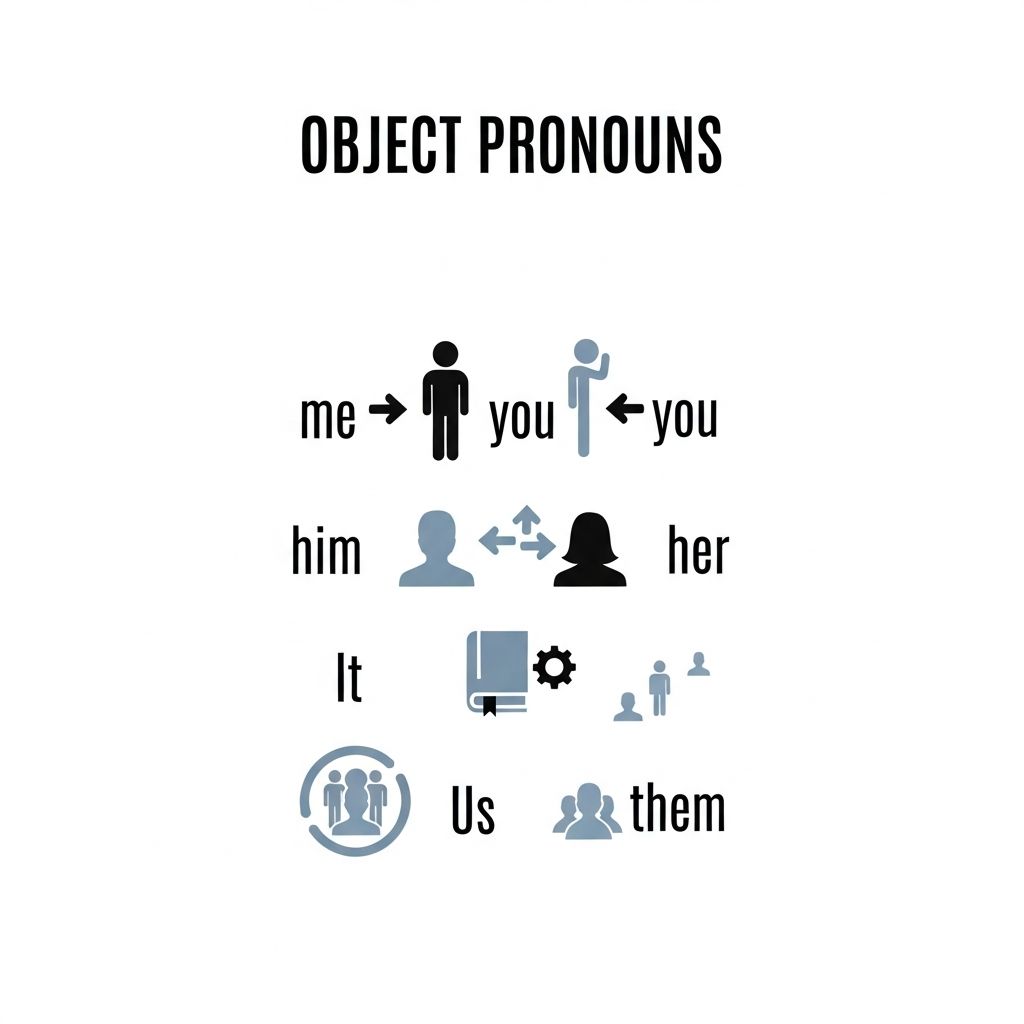
English contains seven fundamental object pronouns that correspond to different persons and numbers:
- Me — first person singular (replaces “I”)
- You — second person singular or plural (remains the same as subject pronoun)
- Him — third person singular masculine (replaces “he”)
- Her — third person singular feminine (replaces “she”)
- It — third person singular neuter (remains the same as subject pronoun)
- Us — first person plural (replaces “we”)
- Them — third person plural (replaces “they”)
Additionally, the relative pronoun whom functions as an object form when referring to people in formal contexts, though its usage has become less common in contemporary English.
Subject vs. Object Pronouns: A Comparative Framework
Understanding the distinction between subject and object pronouns is fundamental to mastering English grammar. Subject pronouns perform actions, while object pronouns experience or receive those actions. The following table illustrates this distinction:
| Person | Subject Pronoun | Object Pronoun | Example with Object Pronoun |
|---|---|---|---|
| First Singular | I | me | She gave me a book |
| Second Singular/Plural | you | you | I will help you tomorrow |
| Third Singular (Male) | he | him | The manager praised him for his work |
| Third Singular (Female) | she | her | We invited her to the celebration |
| Third Singular (Neuter) | it | it | I cannot find it anywhere |
| First Plural | we | us | They told us about the plan |
| Third Plural | they | them | I appreciate them joining the team |
Notice that three pronouns—you, it, and them in plural form—maintain identical forms whether functioning as subjects or objects. This structural similarity reduces the complexity of mastering these particular pronouns.
Positioning Object Pronouns in Sentences
Object pronouns occupy specific grammatical positions within sentences. Generally, object pronouns appear in two primary contexts: immediately following a verb or following a preposition.
After Action Verbs
When an object pronoun follows a verb, it typically functions as either a direct or indirect object of that verb. Direct objects receive the action directly, while indirect objects receive the action indirectly or benefit from the action. Consider these examples:
- Direct: “My friend called me yesterday.” (Me receives the action of calling)
- Indirect: “The teacher gave us homework.” (Us benefits from the action of giving)
- Direct: “I saw them at the market.” (Them receives the action of seeing)
Following Prepositions
Object pronouns consistently follow prepositions such as to, for, with, from, at, and in. This is a consistent grammatical rule in English that rarely has exceptions:
- “This gift is for you.”
- “I will travel with him next week.”
- “The message is from her.”
- “Can you sit between us?”
This positioning rule applies uniformly across all object pronouns, making prepositions a reliable guide for correct pronoun usage.
The Neuter Object Pronoun: Special Applications
The neuter object pronoun it functions distinctly compared to personal pronouns referring to people. It references inanimate objects, animals, weather conditions, or any concepts without inherent gender. The versatility of it appears in numerous contexts:
- References to purchased items: “I bought a laptop and use it daily for work.”
- References to animals: “We adopted a cat and named it Whiskers.”
- References to abstract concepts: “The project is complex; I need to understand it better.”
- References to weather or environmental conditions: “It is raining; I cannot find it in the forecast.”
Avoiding Common Object Pronoun Mistakes
Even experienced writers occasionally misuse object pronouns. Understanding frequent errors helps prevent them in your own writing:
Confusion Between Subject and Object Forms
The most prevalent error occurs when speakers or writers substitute subject pronouns where object pronouns belong. Sentences like “She gave the gift to John and I” represent incorrect usage; the correct form is “She gave the gift to John and me.” The rule remains consistent regardless of whether the pronoun appears alone or within a compound construction.
Misuse After Prepositions
Another frequent mistake involves using subject pronouns following prepositions. Constructions such as “between you and I” are grammatically incorrect; the proper form is “between you and me.” Remember that prepositions universally require object pronouns.
Uncertainty with “You”
Since “you” maintains identical forms in both subject and object positions, confusion is unlikely with this pronoun. However, learners sometimes second-guess themselves unnecessarily. Trust that “you” functions correctly in both roles without modification.
Eliminating Redundancy Through Object Pronouns
A primary purpose of object pronouns is reducing unnecessary repetition in discourse. When a noun has already been established or is understood in context, replacing it with an object pronoun creates more natural and economical communication.
Without object pronouns: “I called my friend Alex. I told Alex about the meeting. The manager asked Alex to attend.” (Repetitive and awkward)
With object pronouns: “I called my friend Alex. I told him about the meeting. The manager asked him to attend.” (Concise and flowing)
By using “him” instead of repeating “Alex,” the second version achieves greater readability and maintains the reader’s engagement.
Object Pronouns in Different Contexts
Object pronouns appear across diverse communication scenarios, from casual conversation to formal writing. Recognizing how they function in varied contexts reinforces proper usage:
In Formal Writing
Academic and professional documents employ object pronouns to maintain clarity and conciseness. Formal communication typically demonstrates consistent adherence to grammatical rules, including proper pronoun usage.
In Casual Speech
Conversational English sometimes relaxes grammatical strictness, yet object pronouns remain important for clear communication even in informal settings.
In Creative Writing
Authors utilize object pronouns strategically to develop natural dialogue and narrative flow, ensuring characters speak and act with grammatical authenticity.
Frequently Asked Questions About Object Pronouns
Q: What is the primary difference between subject and object pronouns?
A: Subject pronouns perform the action in a sentence (e.g., “I run”), while object pronouns receive or experience the action (e.g., “Run with me”). Subject pronouns typically appear at the beginning of clauses, while object pronouns follow verbs or prepositions.
Q: Which pronouns have identical subject and object forms?
A: Three pronouns maintain the same form regardless of their grammatical function: you (singular and plural), it, and in plural form, “you” again. This consistency simplifies learning these particular pronouns.
Q: Can object pronouns appear at the beginning of a sentence?
A: Generally, object pronouns do not initiate sentences in standard English grammar. However, in rare stylistic constructions or when emphasizing the object, exceptional usage may occur. In conventional writing, object pronouns follow verbs or prepositions.
Q: How should I handle compound objects containing pronouns?
A: When combining a noun and pronoun as compound objects, maintain the object pronoun form. Correct: “She gave the book to John and me.” Incorrect: “She gave the book to John and I.” A helpful tip is removing the noun to test: “She gave the book to me” (correct) versus “She gave the book to I” (incorrect).
Q: What role do object pronouns play in eliminating redundancy?
A: Once a noun is established, object pronouns replace it in subsequent references, avoiding repetition and improving readability. Instead of repeating “my boss,” use “him” or “her” in following sentences.
Q: Is “whom” still commonly used as an object pronoun?
A: “Whom” is the formal object pronoun for referring to people in interrogative or relative constructions. However, contemporary English increasingly abandons “whom” in favor of “who,” even in formal contexts, though strict grammarians still advocate for its proper use.
Practical Strategies for Mastering Object Pronouns
Developing proficiency with object pronouns requires deliberate practice and attention. Several strategies accelerate mastery:
- Identify the verb and noun: Locate the main verb and determine whether the pronoun receives the action; if so, use the object form.
- Test with prepositions: Remember that all prepositions require object pronouns following them, providing a consistent rule to apply.
- Remove compound elements: When pronouns appear in compound structures, mentally remove the noun to determine the correct pronoun form.
- Read aloud: Speaking sentences aloud helps develop intuitive recognition of correct pronoun usage.
- Review sample sentences: Regular exposure to correctly constructed sentences reinforces proper patterns in your mind.
Conclusion
Object pronouns form an indispensable component of English grammar, enabling clear, efficient communication by replacing nouns that receive actions or follow prepositions. By understanding their forms, positions, and functions, you equip yourself with essential tools for writing and speaking with confidence and precision. Whether navigating academic requirements, professional communication, or creative expression, mastery of object pronouns demonstrates linguistic competence and enhances your ability to convey meaning effectively.
References
- An Easy Guide to Object Pronouns: Rules and Examples — Busuu. Accessed April 2026. https://www.busuu.com/en/english/object-pronouns
- How to use object pronouns in English — Duolingo Blog. Accessed April 2026. https://blog.duolingo.com/object-pronouns-in-english/
- Subject & Object Pronouns | Definition & Examples — Scribbr. Accessed April 2026. https://www.scribbr.com/nouns-and-pronouns/subject-and-object-pronouns/
- The Basics on Subject and Object Pronouns — Grammarly Blog. Accessed April 2026. https://www.grammarly.com/blog/parts-of-speech/the-basics-on-subject-and-object-pronouns-b/
- Object Pronouns – Grammar rules — Ginger Software. Accessed April 2026. https://www.gingersoftware.com/content/grammar-rules/pronouns-2/object-pronouns
- Object Pronouns in English — Woodward English. Accessed April 2026. https://www.woodwardenglish.com/lesson/object-pronouns-in-english/
- Direct and Indirect Object Pronouns | English Grammar for Second Language Learners — University of Wisconsin–Madison. Accessed April 2026. https://courses.dcs.wisc.edu/wp/grammar/category/direct-and-indirect-object-pronouns/

- Integrated M.A. in Applied Linguistics, University of Hyderabad
- 5+ years in editorial, instructional, SEO, and research-based writing
Sneha is a relationships and lifestyle writer with a strong foundation in applied linguistics and certified training in relationship coaching. She brings over five years of writing experience to theskillvault, crafting thoughtful, research-driven content that empowers readers to build healthier relationships, boost emotional well-being, and embrace holistic living. Her writing and insights reflect the belief that beauty, happiness, and wellness…