
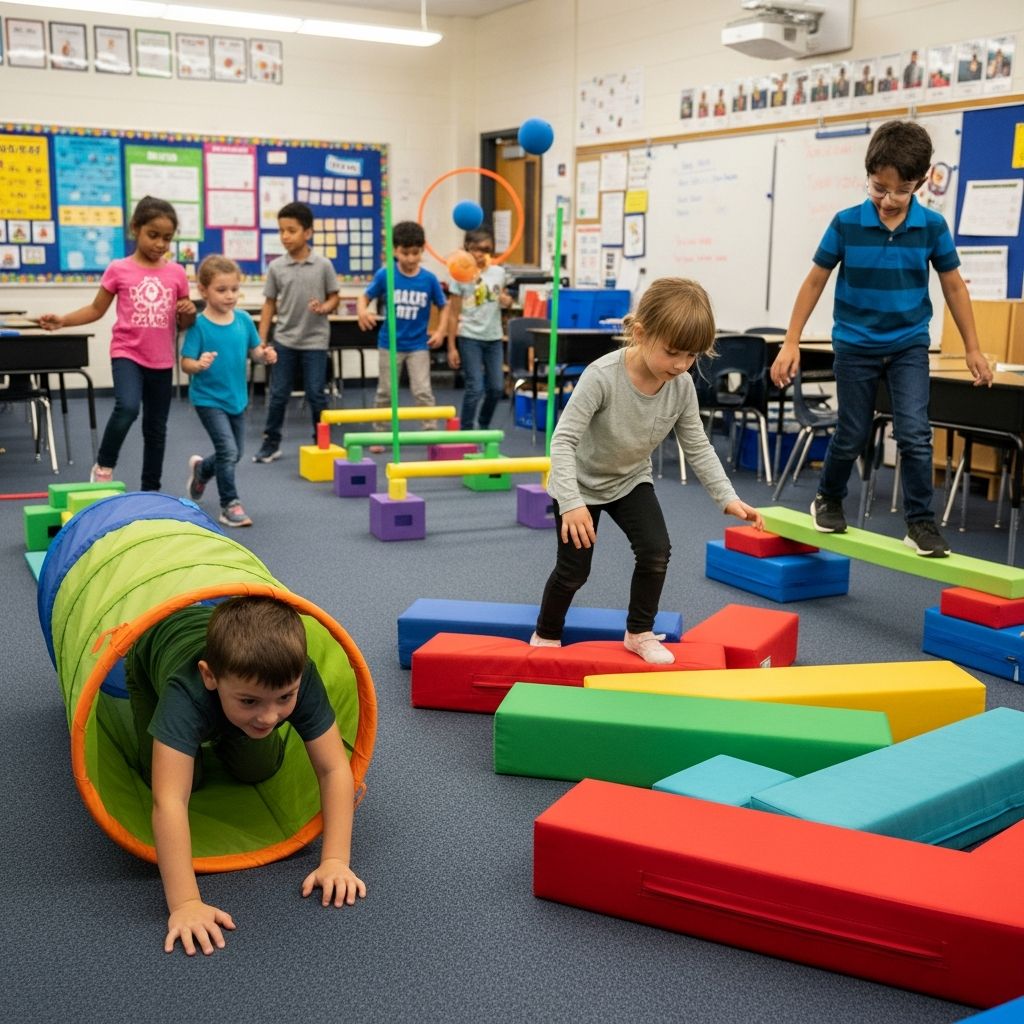
Building Physical Competence Through Strategic Course Design
Physical education programs have evolved significantly in how they approach student development and engagement. One of the most effective methods for building comprehensive motor skills while maintaining high levels of student enthusiasm is the thoughtful integration of obstacle course activities into the curriculum. These dynamic physical challenges serve multiple educational purposes simultaneously, combining exercise with skill development in ways that captivate learners across all age groups.
Obstacle courses function as multifaceted teaching tools that address numerous developmental domains. Students navigating these courses engage their gross motor systems, refine their balance and coordination abilities, expand their spatial awareness, and develop problem-solving capabilities. Beyond the physical dimensions, obstacle courses encourage collaborative learning, communication skills, and the cultivation of physical confidence that extends far beyond the gymnasium.
Understanding the Educational Value of Obstacle Courses
The pedagogical benefits of obstacle course activities have been well-documented by physical education specialists and developmental psychologists. When students move through carefully designed courses, they simultaneously work on multiple developmental markers. Balance and coordination improvements occur naturally as children navigate varied surfaces, heights, and movement patterns. Each obstacle presents unique demands that require students to adjust their body positioning and weight distribution constantly.
Beyond individual physical development, these courses create opportunities for students to develop spatial reasoning and body awareness. Children learn to judge distances, understand their body’s relationship to objects and space, and develop the proprioceptive awareness essential for athletic performance in all disciplines. This foundational awareness becomes particularly valuable as students progress to more specialized sports and activities.
The cooperative nature of obstacle courses also builds important social-emotional competencies. Students learn to encourage peers, provide spotting assistance for safety, and work collaboratively toward completing challenges. These social dimensions of physical activity create a supportive classroom environment while advancing the primary physical education objectives.
Foundational Design Principles for Course Layout
Creating an effective obstacle course requires thoughtful planning about spatial organization and flow. Physical educators have identified several primary approaches to course configuration that work effectively in different settings and with varied student populations.
Linear Configuration remains one of the most popular approaches for classroom and gymnasium settings. In this model, obstacles are arranged in a straight line, with students progressing from one station to the next in sequence. This configuration works particularly well for large groups, as it naturally controls traffic flow and allows teachers to observe student progress systematically. Teachers can position themselves at critical points along the course to provide feedback, safety monitoring, and encouragement.
Circular or Loop-Based Design offers different advantages, particularly for simultaneous participation by multiple students. In this format, obstacles are positioned around the perimeter of the available space, allowing several students to navigate the course at the same time on parallel paths. This configuration reduces wait times and maximizes activity time for each participant, making it ideal for classes with higher student counts.
Square or Rectangular Configurations provide a middle ground between linear and circular approaches. These designs allow for multiple stations around a defined boundary while maintaining clear directional flow. Teachers can create multiple entry and exit points, or establish different difficulty levels at various stations to accommodate mixed-ability groups within the same class period.
Regardless of the overall configuration chosen, successful courses maintain consistent directional flow to prevent collisions and confusion. Teachers should clearly mark routes using visual cues such as floor tape, directional arrows, or verbal instructions. The course should accommodate all students comfortably without bottlenecks or dangerous crowding at particular stations.
Creative Station Ideas for Building Various Motor Skills
An effective obstacle course combines diverse challenges that develop different physical capabilities. Variety maintains student interest while ensuring comprehensive skill development across multiple domains.
Locomotor Movement Stations
These stations emphasize different ways of moving through space. Jumping activities can be incorporated through simple designs such as hula hoops arranged in patterns for students to jump through sequentially. Hopscotch patterns created with tape or chalk provide familiar but challenging jumping opportunities. Teachers can construct jumping obstacles using foam blocks, small hurdles, or even rolled-up yoga mats.
Hopping stations present different demands than jumping, requiring students to propel themselves on a single leg while maintaining balance and directional control. Weaving and directional change stations incorporate cones, poles, or rolled towels arranged to require lateral movement and rapid directional changes. Backwards walking and sideways stepping stations challenge students’ proprioceptive awareness by requiring movement in non-preferred directions.
Balance and Stability Challenges
Balance beam activities don’t require expensive equipment. Teachers can create balance beams using foam padding, rolled carpets, or yoga mats arranged in lines on the floor. These provide different stability challenges depending on width and construction. Students can walk forward, backward, or sideways along these beams while incorporating upper body movements like arm extensions or rotations for added difficulty.
Stepping stone arrangements using cushions, foam squares, or tape-outlined shapes challenge students to control their body weight precisely as they transition from one support point to another. These activities naturally develop the ankle stabilizer muscles and proprioceptive awareness essential for athletic performance. Teachers can adjust difficulty by varying the distance between stones or their stability.
Climbing and Elevated Movement Stations
Climbing challenges need not involve specialized equipment. Carefully supervised climbing over sturdy chairs, climbing under tables, or navigating through PVC pipe structures arranged at various heights provides developmentally appropriate climbing experiences. Climbing stations should always include spotting positions for safety and challenge students to move smoothly and with control rather than speed.
Ramp walks present different challenges than climbing, requiring students to maintain balance and control while moving up and down inclined surfaces. These stations build ankle and core stability while developing safe movement patterns on sloped surfaces students will encounter throughout their lives.
Throwing, Catching, and Manipulation Skills
Obstacle courses need not be exclusively locomotive. Stations incorporating ball throws into targets, bean bag tosses into boxes, or catching activities between obstacles develop hand-eye coordination and upper body control. These activities can be timed or scored, adding competitive elements that motivate some students.
Rolling and pushing activities with various ball sizes and weights incorporate different muscle groups and require force control. Teachers can arrange targets that students must roll balls toward, or create bowling-style setups using plastic bottles or lightweight pins.
Equipment Options Across Budget Ranges
One significant advantage of obstacle course activities is their flexibility in accommodating various budget constraints and available resources.
| Budget Level | Primary Equipment | Setup Considerations |
|---|---|---|
| Minimal/No Budget | Classroom furniture, tape, chalk, body weight exercises | Uses existing resources; requires creative arrangement and safety verification |
| Low Budget | Foam mats, cones, rope, hula hoops, pool noodles | Versatile, durable, multi-purpose equipment with long usable life |
| Moderate Budget | Balance beams, agility ladders, hurdles, tunnel structures | Specialized PE equipment with greater durability and design options |
| High Budget | Permanent installations, professional obstacle course systems | Built-in timing systems, multiple difficulty levels, weather-resistant materials |
Low-cost alternatives often prove highly effective despite their simplicity. Rope creates laser obstacles when strung at angles between fixed points, or can be used for jumping practice. Cones guide movement and mark distances. Hula hoops define jumping targets and provide familiar props. Pool noodles serve as lightweight hurdles. Foam blocks and cushions become stepping stones or climbing platforms.
Cardboard boxes offer remarkable versatility. Teachers can cut holes for crawling tunnels, create throwing targets, stack them for jumping challenges, or arrange them as weaving obstacles. The construction process itself becomes a valuable learning activity when students help design and build obstacles.
Fabric and tapestry items like scarves, blankets, and clothing can be suspended to create ducking obstacles, hung as tactile elements, or arranged as tunnels. These soft materials maintain high safety margins while providing engaging challenges.
Instructional Strategies for Maximizing Effectiveness
Course design represents only one component of successful obstacle course instruction. The teaching methodology significantly influences student outcomes and engagement levels.
Clear Demonstration and Instruction should precede student navigation of any course. Teachers should walk students through the sequence, demonstrating proper technique at each station and explaining the primary focus for each challenge. This preview prevents confusion and helps students establish mental frameworks for approaching obstacles safely and effectively.
Differentiation Strategies allow teachers to meet diverse student needs within a single course. Teachers might provide optional variations where some students complete a simplified version of each obstacle while others attempt advanced versions. Timing challenges appeal to competitive students while self-improvement tracking appeals to others. Some students might focus on technique and control while others emphasize speed.
Safety Protocols require explicit attention. Teachers should establish spotting positions at challenging stations, ensure adequate spacing between students, enforce clear traffic flow patterns, and establish signals for stopping or pausing the activity. Regular reminders about body control and safe movement patterns maintain positive safety outcomes throughout the activity.
Feedback and Encouragement during course navigation significantly influence student confidence and effort levels. Teachers should position themselves strategically to provide specific, actionable feedback about movement quality, safety, and effort while the activity is in progress rather than waiting until afterward.
Adaptations for Different Age Groups and Ability Levels
Effective obstacle course design acknowledges that students arrive with vastly different starting points in terms of strength, coordination, confidence, and prior experience with physical activities.
Early elementary students typically benefit from simpler obstacles with greater emphasis on basic movement patterns and confidence-building. These students need more scaffolding, more frequent breaks, and activities that celebrate effort rather than performance outcomes. Teachers should use encouraging language and maintain shorter activity sessions to accommodate shorter attention spans.
Upper elementary students can handle more complex obstacle combinations and longer course sequences. This age group typically responds well to competitive elements, timing challenges, and opportunities to set personal performance goals. Teachers can introduce more sophisticated movement combinations and encourage peer leadership opportunities.
Students with limited physical abilities or prior injury require carefully scaled versions of obstacles that allow them to experience success while working within appropriate physical parameters. Teachers should work with special educators and healthcare providers to establish appropriate modifications that maintain challenge while ensuring safety.
Highly athletic students benefit from advanced challenges and opportunities to demonstrate mastery. Teachers might assign these students roles as peer spotters, course designers, or quality observers who provide feedback to classmates about safety and technique.
Integration with Broader Physical Education Curriculum
Obstacle courses function most effectively when integrated thoughtfully into comprehensive physical education programming rather than treated as isolated activities. Courses can reinforce specific skill development objectives identified in curriculum standards. Teachers might design courses specifically targeting balance objectives during one unit, then transition to courses emphasizing cardiovascular endurance or agility development during subsequent units.
Obstacle courses naturally connect to standard-based fitness education. Students develop functional fitness attributes including flexibility, strength, endurance, and coordination through course participation. Teachers can explicitly connect these observable improvements to the physiological principles underlying fitness development.
Many obstacle course activities lend themselves to cooperative and competitive structures that teach valuable social skills. Teachers can modify course objectives to emphasize teamwork, peer support, or collaborative problem-solving alongside individual physical development.
Safety Considerations and Best Practices
Creating safe obstacle course experiences requires systematic attention to multiple factors. All equipment should be regularly inspected for damage, proper function, and secure fastening. Surfaces should provide appropriate traction and cushioning based on the obstacles positioned above them. Teachers should establish and enforce consistent boundaries preventing unauthorized access to obstacle areas.
Supervision requirements intensify at climbing stations, balance beam activities, and any elevated challenges. Teachers should position themselves to prevent hazardous movements and respond rapidly to near-miss situations. Students should receive explicit instruction about speed control, particularly at higher-risk stations.
Crowd management prevents bottlenecks and dangerous congestion. Teachers might use signals to control movement, implement staggered start times, or establish waiting area protocols that prevent students from creating hazardous blocking situations.
Frequently Asked Questions
Q: How long should students spend on an obstacle course during a typical class period?
A: This depends on age, fitness level, and course complexity. Elementary students typically benefit from 10-15 minutes of active course navigation within a 30-minute class period, with time allocated for instruction, transitions, and cool-down. Teachers can increase time allocations as students become more familiar with courses.
Q: Can obstacle courses accommodate mixed-ability students in a single class?
A: Yes, through thoughtful design and instructional differentiation. Teachers can create optional variations at each station, allowing advanced students to attempt more difficult versions while beginning students work on fundamental patterns at the same stations. This approach maintains class cohesion while meeting diverse needs.
Q: What safety equipment should teachers use during obstacle course activities?
A: Essential safety items include foam mats beneath elevated obstacles, spotting stations for climbing activities, clear visual boundaries defining the course, and first aid supplies readily accessible. Teachers should verify that gymnasium or outdoor surfaces provide appropriate cushioning for potential falls.
Q: How often can the same obstacle course be used before students lose interest?
A: Students typically maintain engagement for 2-3 sessions with an identical course before interest begins declining. Teachers can refresh engagement by modifying obstacle arrangements, adjusting difficulty levels, adding timing elements, or introducing competitive variations without requiring completely new courses.
Q: Can outdoor spaces accommodate obstacle courses effectively?
A: Absolutely. Outdoor courses can incorporate natural features like trees, hills, and playground equipment alongside portable obstacles. Outdoor settings expand design possibilities and often accommodate courses serving larger groups simultaneously. Weather considerations and surface inspection become more important in outdoor settings.
References
- Obstacle Course Ideas — The Montessori Notebook. 2024. https://themontessorinotebook.com/obstacle-course-ideas
- 10 Obstacle Course Ideas for Children — Famly. 2024. https://www.famly.co/blog/obstacle-course-ideas-children
- 25 Obstacle Course Ideas to Improve Gross Motor Skills — NAPA Center. 2024. https://napacenter.org/obstacle-course-ideas/
- Obstacle Course Ideas for Elementary School — Gopher PE Blog. 2024. https://blog.gophersport.com/obstacle-course-ideas/
- Outdoor Obstacle Courses for Schools — GameTime. 2024. https://www.gametime.com/news/from-the-backyard-to-the-schoolyard-obstacle-courses-transform-the-way-students-play

- Integrated M.A. in Applied Linguistics, University of Hyderabad
- 5+ years in editorial, instructional, SEO, and research-based writing
Sneha is a relationships and lifestyle writer with a strong foundation in applied linguistics and certified training in relationship coaching. She brings over five years of writing experience to theskillvault, crafting thoughtful, research-driven content that empowers readers to build healthier relationships, boost emotional well-being, and embrace holistic living. Her writing and insights reflect the belief that beauty, happiness, and wellness…