
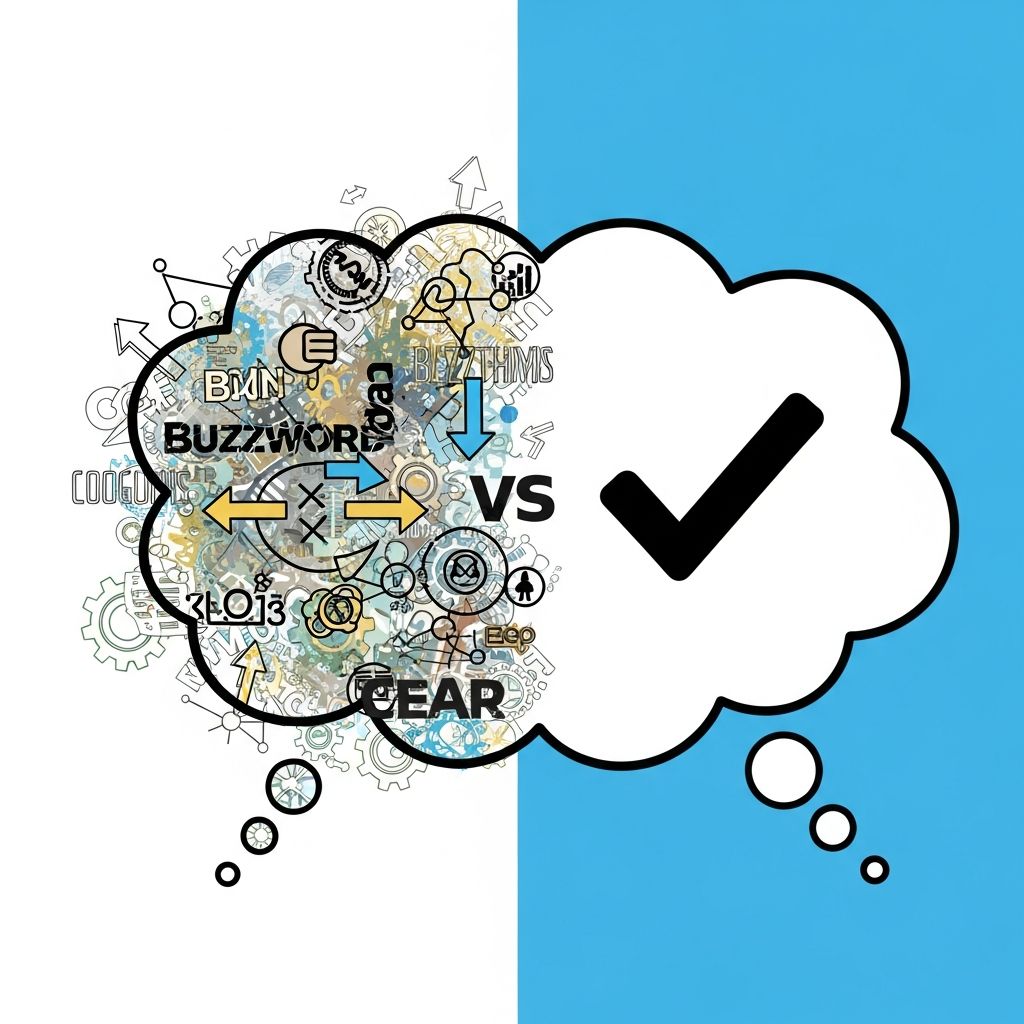
Every workplace develops its own language, but there is a point where handy shorthand turns into empty buzzwords. When phrases like “circle back,” “move the needle,” or “leverage synergies” take over, real meaning often disappears. This article explains why office jargon is a problem, which phrases to reconsider, and how to swap them for language that is simple, precise, and persuasive.
Why Office Buzzwords Are More Harmful Than Helpful
On the surface, buzzwords sound modern and professional. In reality, research shows they reduce clarity, damage inclusion, and can even backfire on your reputation.
They Make Messages Harder to Understand
The goal of workplace communication is understanding, not theatrics. Corporate jargon often makes instructions vaguer and more confusing, which slows down work and creates costly misunderstandings. When employees are unsure what leaders mean, they hesitate, make incorrect assumptions, or duplicate efforts.
- Vague phrases hide what action is actually required.
- Long strings of buzzwords make it harder to pick out key points.
- People are less likely to ask for clarification if they fear looking uninformed.
They Exclude and Alienate People
Specialized language can strengthen bonds inside a group, but it also creates insiders and outsiders.Groups that rely heavily on jargon risk making new hires, people from other industries, and non-native speakers feel shut out or less competent.
- New employees may assume they are behind or underqualified.
- Cross-functional partners may misread what your team is actually asking for.
- Colleagues whose first language is not English may find idioms especially confusing.
They Can Signal Insecurity, Not Expertise
People often assume that sophisticated language shows expertise. Research from Columbia Business School finds almost the opposite: those with lower perceived status tend to use more jargon to compensate, which can come across as inauthentic or pretentious.
- Overuse of jargon can be read as showing off rather than adding value.
- Clear, straightforward language is more often associated with real confidence.
- Trying too hard to sound important can damage credibility with colleagues and clients.
They Erode Trust and Engagement
Studies of internal communication show that employees respond more positively and trust leaders more when messages are plain and direct instead of packed with buzzwords and euphemisms. When people feel they are getting spin rather than transparency, they may disengage or resist change.
- Staff may feel leadership is hiding bad news behind upbeat corporate phrases.
- Teams may become cynical about initiatives framed only in trend-driven language.
- Employees are more likely to support decisions when they clearly understand the reasoning.
Common Jargon Traps to Watch For
You do not have to ban every bit of shorthand, but some patterns are almost guaranteed to confuse. Becoming aware of these categories makes it easier to spot and replace them.
1. Vague Action Phrases
These phrases sound energetic but rarely specify what needs to happen.
- “Let’s circle back on this.”
- “We need to move the needle.”
- “Let’s take this offline.”
- “We’ll double-click on that later.”
Unless you define when, how, and who, people walk away with different expectations.
2. Overblown Strategy Buzzwords
Big, abstract words can make routine tasks sound like bold innovation.
- “We’re building a robust, scalable, holistic solution.”
- “We must leverage synergies across the ecosystem.”
- “We’re driving transformational alignment.”
The problem is not ambition; it is the lack of concrete description. Colleagues need to know what will change in their day-to-day work.
3. Trendy Innovation Language
Words tied to innovation can be useful, but they are often used as decoration instead of description.
- “Let’s ideate around this space.”
- “We’re building a disruptive paradigm.”
- “We’ll de-silo our thinking and reimagine the future.”
If a term would confuse someone outside your field, you likely need plainer wording.
4. Euphemisms That Hide Hard Truths
In difficult conversations, leaders sometimes reach for gentle-sounding jargon to avoid discomfort.
- “We’re pursuing right-sizing and synergies.” (layoffs or restructuring)
- “We’re sunsetting the role.” (eliminating a position)
- “We’re reallocating resources.” (budget cuts)
While sensitivity matters, sugarcoating can undermine trust if people feel misled.
Plain-Language Alternatives: What to Say Instead
Eliminating buzzwords does not mean dumbing things down. It means choosing words that quickly convey who should do what, by when, and why. Use the table below as inspiration.
| Buzzword Phrase | What People Think It Means | Clearer Alternative |
|---|---|---|
| “Let’s circle back.” | Talk again sometime. | “Let’s schedule 20 minutes tomorrow at 2 p.m. to finalize this.” |
| “We need to move the needle.” | Improve results in some way. | “We need a 10% increase in qualified leads by next quarter.” |
| “Leverage synergies.” | Work together more. | “Marketing and sales should plan campaigns together, starting with a shared calendar.” |
| “Take this offline.” | Stop talking about this now. | “This needs more detail. I’ll set up a follow-up meeting with you and Alex.” |
| “Low-hanging fruit.” | Easy wins. | “Let’s start with the three fastest tasks: updating the FAQ, fixing form errors, and adding screenshots.” |
How to Shift Your Own Language Habits
Many professionals use buzzwords out of habit, not intention. Here is a practical approach to changing how you speak at work.
1. Notice Your Default Phrases
Start by listening to yourself for a day or two.
- Pay attention in meetings, emails, and chat messages.
- Write down phrases you repeat often, especially the ones that sound like “corporate speak.”
- Ask a trusted colleague which buzzwords you rely on without realizing.
Awareness is the first step toward more intentional communication.
2. Ask: “What Am I Really Trying to Say?”
Before speaking or hitting send, pause and translate your thought into everyday language.
- If you are tempted to say “align on priorities,” ask yourself:
What are the specific tasks or decisions we need to agree on? - If you want to “drive engagement,” clarify:
What actions from employees are you hoping to see?
Clear thinking usually leads to clear speaking.
3. Favor Verbs Over Abstract Nouns
Communication experts often recommend concrete verbs instead of dense noun phrases because they are easier to understand and remember.
- Instead of “execution of strategy,” say “carry out the plan.”
- Instead of “facilitation of communication,” say “help people talk openly.”
- Instead of “optimization of processes,” say “make our steps faster and simpler.”
4. Match Your Language to Your Audience
Some technical terms are useful when everyone in the room shares the same expertise. Problems arise when that language spills into broader communication where not everyone shares the same background.
- With your specialist team, use necessary technical vocabulary, but still avoid empty buzzwords.
- With cross-functional stakeholders, explain jargon the first time you use it.
- With executives or clients, focus on outcomes, trade-offs, and timelines rather than internal shorthand.
5. Invite Questions and Clarification
Leaders set the tone. When managers encourage questions and model simple language, teams feel safer admitting confusion and seeking clarity.
- Phrase check-ins as collaboration, not tests: “Does this make sense?” or “What seems unclear?”
- Reward people who ask for clarification instead of brushing them off.
- Rephrase complex points in plainer language without embarrassment.
Building a Culture of Clear Communication
Replacing buzzwords is easier when it is a shared effort. Organizations that value clarity see benefits in productivity, engagement, and inclusion.
Team-Level Practices
- Create a “plain language” norm. Openly agree that you will favor simple wording over trendy phrases in team meetings and written materials.
- Collect confusing phrases. Keep a running list of jargon your team encounters, then collaboratively rewrite them into clear alternatives.
- Review key documents. Before sending announcements, policy updates, or strategy decks, do a quick jargon scan and replace ambiguous terms.
Leadership Practices
- Model clarity in all-hands meetings. Explain complex decisions in direct language, and avoid hiding bad news behind euphemisms.
- Train managers. Offer short workshops or resources on effective, jargon-free communication rooted in research on employee engagement.
- Align HR and internal comms. Ensure performance reviews, onboarding materials, and policy documents are written with clarity as a priority.
Quick Self-Check: Is This a Buzzword?
Use this mini-checklist before you repeat a common phrase at work:
- Would a new hire understand this on day one?
- Can I point to a specific action or result this phrase describes?
- Could I explain this to a friend outside my industry without using the same words?
- Am I using this phrase to sound impressive, or to be understood?
If you answer “no” to the first three or “yes” to the last one, it is probably time to rephrase.
Frequently Asked Questions (FAQs)
Q: Is all jargon bad, or only certain kinds?
Some jargon is useful, especially technical terms that accurately describe specific tools, processes, or legal concepts. The problem is vague, fashionable phrases that replace concrete explanations. If a term improves speed and precision for everyone in the conversation, keep it. If it confuses or excludes people, replace it.
Q: Won’t I sound less professional if I stop using buzzwords?
Clear language usually makes you sound more professional. Research suggests that heavy jargon use can signal insecurity rather than expertise, while simple, direct explanations are linked to higher credibility and trust.
Q: How can I push back on buzzwords without embarrassing colleagues?
Ask gentle, clarifying questions instead of criticizing: “When you say ‘move the needle,’ what result are you hoping for by next month?” Over time, these questions encourage more precise language without calling anyone out.
Q: Are there times when euphemisms are appropriate?
In emotionally sensitive situations, tact matters. However, research on internal communication shows employees prefer honest, respectful language over vague corporate phrasing. You can be compassionate and still be clear about what is happening and why.
Q: What is one habit I can change this week?
Pick one common buzzword you use a lot—such as “circle back” or “align on this”—and replace it with a specific statement for an entire week. For example: “Let’s meet for 15 minutes after lunch to decide who owns each task.” Notice how much faster people understand you.
References
- Why Corporate Jargon Is Bad for Business — NeuroLeadership Institute. 2022-02-16. https://neuroleadership.com/your-brain-at-work/why-corporate-jargon-is-bad/
- The History and Impact of Business Jargon — Rivier University Academics. 2023-03-21. https://www.rivier.edu/academics/blog-posts/circling-back-on-corporate-speak-the-history-and-impact-of-business-jargon/
- The Hidden Impact of Professional Jargon: How Language Reveals Status and Intentions — Columbia Business School. 2022-11-10. https://business.columbia.edu/insights/business-society/hidden-impact-professional-jargon-how-language-reveals-status-and
- Know Exactly What a Buzzword Means Before Using It — HR Bartender (Lauby, S.). 2019-06-18. https://www.hrbartender.com/2019/communication/buzzword-means-before-using/
- No More ‘Tiger Teams’ and ‘Idea Showers’: Nix the Business Jargon for Clear Communication — Society for Human Resource Management (SHRM). 2021-03-05. https://www.shrm.org/topics-tools/news/employee-relations/business-jargon-employee-communication-barriers

Medha Deb is an editor with a master's degree in Applied Linguistics from the University of Hyderabad. She believes that her qualification has helped her develop a deep understanding of language and its application in various contexts. Medha specializes in the areas of beauty, health, sports, and wellness and is committed to ensuring that the content on the website is…