
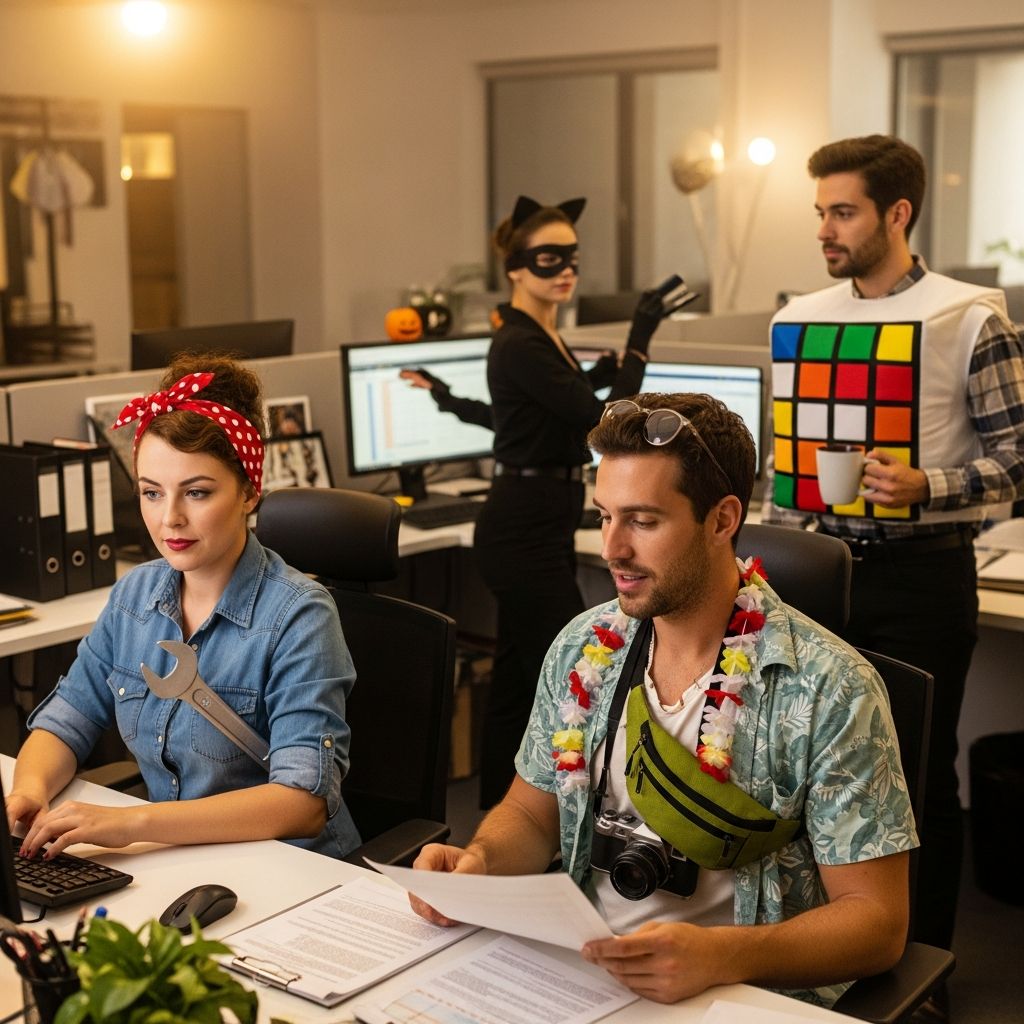
Celebrating Halloween at work can be a highlight of the year, but choosing the right costume is a balancing act. You want something fun enough to win the office contest, but polished and respectful enough to keep HR happy and your reputation intact. This guide walks you through creative, contest-worthy ideas that work for in-person, hybrid, and remote teams.
What Makes a Costume Office-Appropriate?
Before you start gluing glitter or ordering wigs, it helps to define what “office-appropriate” really means. Most workplaces expect costumes to be safe, inclusive, and not disruptive to getting work done.
- Respectful – Avoid costumes that stereotype cultures, religions, nationalities, or marginalized groups.
- PG-rated – Skip anything overly revealing, gory, or suggestive. If you’d be uncomfortable wearing it to a client meeting, it’s not right for work.
- Safe and functional – Choose outfits that allow you to move, see your screen, and use equipment without risk.
- Policy-aware – Many organizations publish dress code or holiday guidelines; check your intranet or HR portal in advance.
When in doubt, aim for clever and witty rather than shocking. Humor and creativity usually impress colleagues more than shock value.
Planning Around Your Workday and Workspace
The best costumes support your actual work. Think about your day: Will you be meeting clients? Working on-site? Dialing into video calls? Different setups call for different strategies.
| Work Situation | Costume Priorities | Good Example Styles |
|---|---|---|
| Traditional office | Comfort, adherence to dress code, minimal safety risks | Business puns, subtle makeup, props that can be stored |
| Hybrid / hot-desking | Easy to transport, quick to change into | Headbands, jackets, scarves, printed badges |
| Remote / video-first | Visible from the shoulders up, not noisy or distracting | Hats, glasses, virtual backgrounds, themed tops |
| Public-facing roles | Professional image, comfort with clients/customers | Soft pop-culture references, seasonal colors |
Single-Person Costumes: Low Effort, High Impact
Solo costumes are perfect if your coworkers are busy or your team is distributed. Focus on concepts that can be pulled together with pieces you already own plus one or two standout details.
1. Clever Professional Puns
Pun-based costumes often require minimal props but generate big laughs. They’re great for open-plan offices where you move between meetings.
- Benefits:
- Conversation starters without being loud or distracting.
- Often built from normal work clothes plus one or two themed items.
- Safe content that typically doesn’t offend.
- Tips:
- Add a small printed sign explaining the pun in case not everyone gets it.
- Keep wordplay work-related if your office culture leans conservative.
2. Classic Characters with a Professional Twist
Iconic characters become office-friendly when you tone down the drama and incorporate business attire.
- Build the costume around a blazer, shirt, or simple dress you’d wear to work.
- Use makeup and accessories to hint at the character rather than fully re-create a movie set.
- Avoid weapons, fake blood, and masks that obscure your face for long periods.
3. Minimalist “Zoom-Ready” Looks
Remote workers can focus on what’s visible on camera. Keep the rest of your outfit comfortable and meeting-ready.
- Swap your usual headphones for novelty ones just for informal calls.
- Use a themed mug or background that matches your costume.
- Check that your virtual background does not include copyrighted or inappropriate imagery.
Group and Team Costumes: Build Office Camaraderie
Coordinated costumes can strengthen relationships and break down silos. They’re especially memorable in large companies or cross-functional teams.
1. Department-Themed Ensembles
Base your concept on your team’s mission, tools, or inside jokes. This both entertains others and reinforces your team identity.
- Customer support team as different “helpful guides” (e.g., maps, manuals, digital assistants).
- Finance or accounting as different currencies or spreadsheets come to life.
- Engineering or IT as different software tools, error messages, or icons.
Keep references lighthearted. Avoid costumes that poke fun at specific colleagues or sensitive company challenges.
2. Color-Coordinated Concepts
If your group struggles to find time for elaborate planning, lean into color instead of complexity.
- Pick a shared accessory: same color tie, scarf, or t-shirt.
- Divide by shade: each person chooses a distinct hue within a color family.
- Add simple symbols or labels to tie all outfits into one story.
3. Inclusive Planning Across Locations
Global or hybrid teams often want to involve colleagues who aren’t physically present. Design your theme so everyone can participate from wherever they are.
- Choose costumes that can be expressed with a background, shirt color, or simple prop.
- Share a short costume guide with links to sample photos and clear expectations.
- Ask about local holidays, norms, and comfort levels before finalizing themes.
Remote and Hybrid: Virtual Halloween Done Right
Virtual celebrations require a slightly different mindset. The camera frame, audio quality, and bandwidth all matter when you show up in costume on a video call.
1. Camera-Friendly Details
- Think from the shoulders up – hats, glasses, wigs, and face paint are more visible than full-body outfits.
- Avoid noise – no jangling accessories or sound-producing props during calls.
- Test lighting – colored lights or heavy makeup can confuse your webcam’s exposure, so do a quick test before an important meeting.
2. Virtual Background Themes
Many platforms let you add custom backgrounds. They’re a simple way to participate even if you can’t wear a full costume.
- Create a branded or team-themed background with your name and subtle Halloween elements.
- Use high-resolution images that don’t contain copyrighted characters unless your company has permission.
- Avoid flashing or extremely dark imagery that may cause discomfort or accessibility issues.
3. Time-Zone-Friendly Celebrations
In distributed teams, not everyone can join a single live event. Consider asynchronous ways to showcase costumes:
- Shared channels where people post costume photos throughout the day.
- Short pre-recorded clips of teams introducing their costumes.
- Polls open for 24 hours to vote on contest categories.
Safety, Comfort, and HR Considerations
Costumes should never compromise safety or professionalism. Many organizations issue specific reminders around holidays on topics like harassment, cultural sensitivity, and dress code.
- Avoid cultural appropriation – professional HR guidance stresses that costumes based on ethnicity, religion, or historical trauma can create a hostile work environment.
- Skip weapons and realistic replicas – even toy versions can cause anxiety or violate workplace safety policies.
- Keep mobility in mind – you should be able to move quickly in case of an emergency and use stairs or equipment without risk.
- Use non-toxic makeup – check labels and perform a small patch test to avoid allergic reactions, especially when you will wear makeup for many hours.
If your company has a formal HR team, it is reasonable to ask for guidance in advance. Many HR departments prefer proactive questions to reactive problem-solving later.
Winning the Office Costume Contest (Without Trying Too Hard)
Office contests often include categories such as “Funniest,” “Most Creative,” “Best Group,” or “Best DIY.” You do not have to spend a lot of money to stand out; thoughtful details and a clear concept matter more.
1. Match the Culture of Your Workplace
- In a conservative industry, subtle, clever ideas generally outperform bold, shocking ones.
- Startups or creative agencies may reward big visuals and unusual themes—but still stay respectful.
- Align your costume with company values like innovation, teamwork, sustainability, or customer focus.
2. Add Interactive Elements
People remember costumes that invite participation, as long as they do not interrupt work.
- Small, individually wrapped candies or stickers at your desk.
- A simple, work-related riddle or pun printed on your costume.
- A low-key prop people can pose with for photos.
3. Keep Logistics Simple
Winning costumes should still allow you to:
- Type comfortably.
- Take calls without muffled audio.
- Use the restroom without a 20-minute struggle.
Judges and colleagues notice when you are clearly uncomfortable, and that can distract from the creativity of your idea.
Budget-Friendly and Last-Minute Ideas
You do not need a large budget or weeks of crafting to participate. Many of the best office costumes are built from everyday items reimagined.
- Use your wardrobe – formal wear, athleisure, or weekend outfits can be the foundation for a character or concept.
- Printables – badges, labels, and signs can transform a basic outfit into a recognizable theme.
- Office supplies – sticky notes, pens, clipboards, and folders can be styled into creative props.
- Shared prop bins – encourage teams to contribute hats, scarves, or costume jewelry for others to borrow.
If you are organizing the event, communicate that simple and DIY costumes are welcome. This reduces pressure and supports inclusion for colleagues with limited time or resources.
FAQ: Office Halloween Costumes
Q1: How do I know if my costume is appropriate for work?
Ask yourself whether you would feel comfortable if your photo appeared in an internal newsletter or on a client-facing page. If the answer is no—or even “I’m not sure”—choose a safer alternative. You can also review your company’s dress code and ask HR if anything is unclear.
Q2: What if my team does not want to coordinate costumes?
It is perfectly fine to go solo. Choose a low-key costume that does not depend on others to make sense. Alternatively, you can suggest a very simple shared theme, like a color palette, that people can join if they wish.
Q3: Are scary costumes allowed in professional settings?
Some workplaces welcome mild spooky themes (like pumpkins or friendly ghosts), but many discourage gore, horror props, or realistic injuries because they can distress coworkers or clients. Check existing guidelines and lean toward playful rather than terrifying.
Q4: How can managers make Halloween inclusive?
Managers can emphasize that participation is optional, schedule events during work hours, avoid themes tied to specific cultures or religions, and offer alternative ways to join in, like decorating a workspace or voting in contests without dressing up.
Q5: What should I do if a colleague’s costume feels offensive?
If you feel safe doing so, you can gently mention your concern to the colleague, assuming they may not realize the impact. If it feels uncomfortable or the issue is serious, it is appropriate to bring it to HR or a trusted manager so they can address it in line with company policy.
References
- Halloween in the Workplace: Tips for Employers — Society for Human Resource Management (SHRM). 2019-10-21. https://www.shrm.org/topics-tools/news/hr-magazine/halloween-workplace-tips-employers
- Holiday Parties and Workplace Celebrations — U.S. Equal Employment Opportunity Commission (EEOC). 2017-12-12. https://www.eeoc.gov/eeoc/newsroom/wysk/holiday_parties.cfm
- Safe and Healthy Halloween — U.S. Centers for Disease Control and Prevention (CDC). 2022-10-25. https://www.cdc.gov/family/halloween/index.htm
- Inclusive Holiday Celebrations in the Workplace — Harvard Business Review. 2022-12-14. https://hbr.org/2022/12/how-to-make-your-holiday-celebrations-more-inclusive
- Video Conferencing Etiquette for Remote Work — Harvard University Information Technology. 2021-06-10. https://huit.harvard.edu/news/video-conferencing-etiquette
- Cosmetics Safety Q&A — U.S. Food and Drug Administration (FDA). 2021-08-24. https://www.fda.gov/cosmetics/cosmetics-products/halloween-makeup-contact-lenses-and-more

- Integrated M.A. in Applied Linguistics, University of Hyderabad
- 5+ years in editorial, instructional, SEO, and research-based writing
Sneha is a relationships and lifestyle writer with a strong foundation in applied linguistics and certified training in relationship coaching. She brings over five years of writing experience to theskillvault, crafting thoughtful, research-driven content that empowers readers to build healthier relationships, boost emotional well-being, and embrace holistic living. Her writing and insights reflect the belief that beauty, happiness, and wellness…