
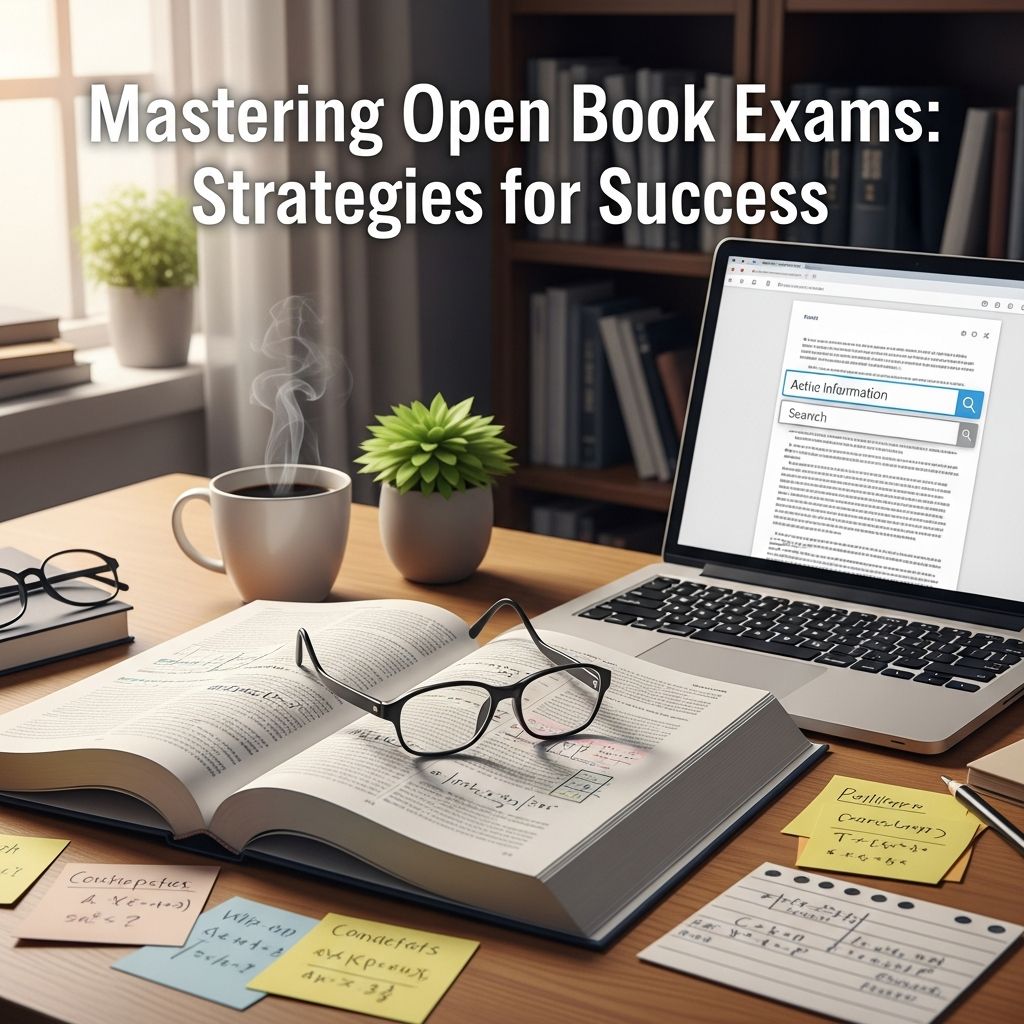
Open book exams represent a shift from traditional memorization-based testing to assessments that prioritize understanding, application, and critical analysis. Unlike closed-book formats, these exams allow access to notes, textbooks, and other approved materials, challenging students to demonstrate deeper comprehension rather than mere recall.
Understanding the Essence of Open Book Assessments
Open book exams test your ability to locate relevant information quickly and integrate it into coherent responses. They emphasize higher-order skills such as analysis, evaluation, and synthesis, aligning with Bloom’s Taxonomy’s upper levels. Instructors design questions that require applying concepts to novel scenarios, interpreting data, or critiquing arguments, making superficial knowledge insufficient.
Common misconceptions portray open book exams as easier, but evidence shows they often prove more demanding due to time constraints and complex problem-solving requirements. Success hinges on preparation that goes beyond passive reading, focusing on active engagement with course material.
Types of Open Book Exam Formats
Open book exams vary in structure and restrictions, influencing preparation approaches.
- Restricted Open Book: Limited to specific resources like class notes or a single textbook, testing targeted application.
- Unrestricted or Free Open Book: Permits broad access including personal notes and guides, emphasizing synthesis from diverse sources.
- Online Open Book: Common in digital formats, may include internet access but often with proctoring to uphold integrity.
- Take-Home Exams: Extended time versions allowing days for completion, demanding thorough analysis over rushed lookups.
| Format | Key Features | Preparation Focus |
|---|---|---|
| Restricted | Specific materials only | Deep familiarity with approved texts |
| Unrestricted | Any references allowed | Broad synthesis and quick indexing |
| Online | Digital proctoring possible | Tech setup and digital organization |
| Take-Home | Extended deadlines | Comprehensive analysis and editing |
This variety underscores the need to clarify rules early via syllabi or instructors.
Clarifying Exam Rules and Expectations
The first step in preparation is confirming parameters. Determine allowable materials—notes, books, internet?—and exam logistics like duration, format (essays, problems, multiple-choice), and submission methods. Ambiguities can derail performance, so seek clarification promptly.
Review course objectives to align study efforts. Identify major themes, key readings, and organizational structure from the syllabus. This framework reveals connections essential for integrative questions. Tools like Professor Smith-Chant’s SPEW method—Select concepts, Pen thoughts freely, Evaluate gaps, Write again—aid in pinpointing weaknesses.
Effective Preparation Techniques
Preparation transforms open book exams from resource hunts into showcases of expertise. Start by reviewing objectives to build a thematic skeleton.
Building Targeted Study Notes
Craft concise, organized notes rather than voluminous copies. Summarize key concepts, formulas, definitions, and relationships. Use visual aids for efficiency:
- Charts: Tabular overviews of processes or comparisons.
- Mind Maps: Branching diagrams linking ideas hierarchically.
- Tree Diagrams: Hierarchical breakdowns of complex topics.
Avoid clutter; prioritize scannable formats with tabs, color-coding, and indices for rapid access.
Practicing Application and Synthesis
Simulate exam conditions by timing practice with materials. Tackle past questions or create scenario-based problems requiring concept integration. Focus on higher-order tasks: explain phenomena, predict outcomes, or evaluate arguments using evidence from resources.
For problem-solving exams, drill formulas in context; for essays, outline responses blending multiple sources.
Organizing Resources for Quick Retrieval
Disorganization wastes time. Develop a retrieval system:
- Create a master index listing topics and page/note locations.
- Bookmark critical sections in digital or physical materials.
- Compile cheat sheets with essentials like timelines, vocabularies, or equations.
- Test the system in practice runs to refine.
For digital exams, use searchable PDFs, folders, and browser bookmarks. Print key pages if permitted to avoid tech glitches.
Exam Day Strategies for Peak Performance
Enter with a plan. Skim all questions first to strategize: prioritize familiar ones for momentum, then tackle complex lookups.
- Read Precisely: Note keywords and directives (analyze, compare) to tailor responses.
- Time Management: Allocate based on points; avoid over-researching.
- Respond Concisely: Prioritize original analysis over excessive quoting.
- Stay Integrity-Focused: Use resources ethically; no collaboration unless specified.
For essays, structure with thesis, evidence, analysis; for problems, show steps clearly.
Overcoming Common Challenges
Open book pitfalls include information overload and lookup paralysis. Counter by pre-identifying likely topics and practicing speed. Time pressure amplifies disorganization—hence rigorous indexing. Anxiety from perceived easiness fades with mock exams proving otherwise.
Comparison with closed-book formats highlights differences:
| Aspect | Open Book | Closed Book |
|---|---|---|
| Skill Tested | Application/Analysis | Recall/Memorization |
| Question Complexity | High (synthesis) | Low (factual) |
| Prep Emphasis | Organization/Understanding | Rote Learning |
| Stress Level | Lower initial, higher cognitive | High memorization |
Long-Term Benefits of Open Book Proficiency
Mastering these exams builds lifelong skills: rapid information navigation, critical thinking, and synthesis—valuable in professions demanding real-world application. They mirror workplace scenarios where resources abound, preparing students for evidence-based decision-making.
Frequently Asked Questions (FAQs)
What materials are typically allowed in open book exams?
Permissions vary: often notes and textbooks, sometimes internet. Always confirm with your instructor.
Are open book exams easier than closed book ones?
No, they demand deeper understanding and quick application, often under time limits.
How do I organize notes effectively?
Use indices, visuals like mind maps, and concise summaries for fast access.
What types of questions should I expect?
Conceptual ones: apply theories, analyze scenarios, evaluate evidence—not rote facts.
Can I use the internet during an open book exam?
Only if explicitly permitted; many restrict to prevent plagiarism.
Advanced Tips for Elite Performance
For top marks, anticipate question styles: case studies requiring multi-concept integration or data interpretation. Practice SPEW iteratively to solidify knowledge gaps. Post-exam, reflect on strategies to refine for future assessments.
Instructors favor open book for assessing true competency, climbing Bloom’s ladder from recall to creation. Embrace this by viewing resources as tools for argumentation, not crutches.
References
- Preparing for an Online, Open-Book Exam — Trent University Academic Skills. 2023. https://www.trentu.ca/academicskills/how-guides/how-study/prepare-and-write-exams/preparing-online-open-book-exam
- What Is Open Book Exam? A Complete Guide — 21K School. 2023. https://www.21kschool.com/us/blog/what-is-open-book-exam/
- Open-Book Exams — Cornell University Learning Strategies Center. 2023. https://lsc.cornell.edu/how-to-study/studying-for-and-taking-exams/open-book-exams/
- Creating Open Book Exams — Indiana University Center for Innovative Teaching and Learning. 2023. https://citl.indiana.edu/teaching-resources/guides/openbook.html
- Exam Preparation: Strategies for Open Book Exams — Simon Fraser University Library. 2023. https://www.lib.sfu.ca/about/branches-depts/slc/learning/exam-types/open-book-exams
- A Guide for Academics – Open Book Exams — University of Regina CTL. 2023. https://ctl.uregina.ca/assets/ldti-open-book-exams.pdf

- Integrated M.A. in Applied Linguistics, University of Hyderabad
- 5+ years in editorial, instructional, SEO, and research-based writing
Sneha is a relationships and lifestyle writer with a strong foundation in applied linguistics and certified training in relationship coaching. She brings over five years of writing experience to theskillvault, crafting thoughtful, research-driven content that empowers readers to build healthier relationships, boost emotional well-being, and embrace holistic living. Her writing and insights reflect the belief that beauty, happiness, and wellness…