
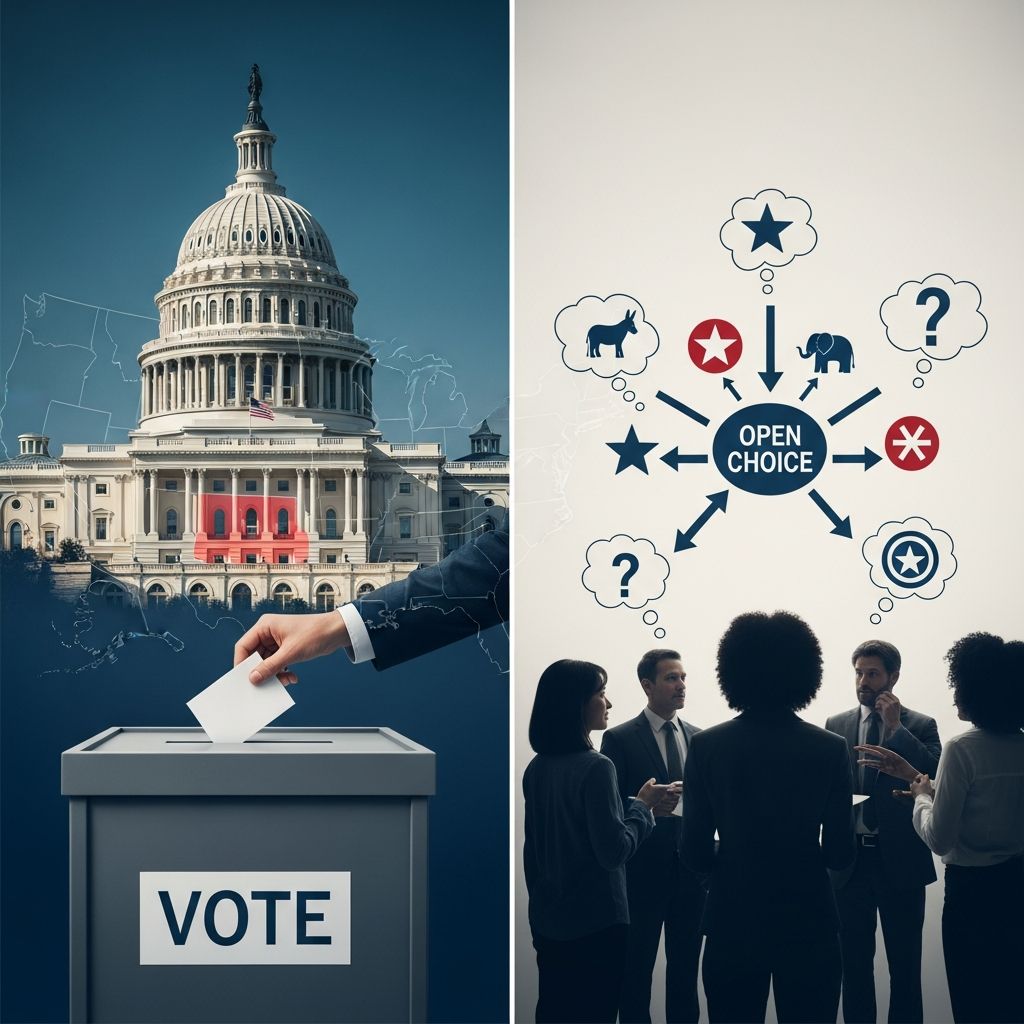
Open primaries represent a key variation in how American states conduct preliminary elections to select party nominees. Unlike more restrictive systems, they allow broader voter participation, potentially altering candidate selection and general election matchups. This article examines their mechanics, diversity, and implications for democracy.
Primary Elections: The Foundation of Candidate Selection
Primary elections serve as the initial stage where political parties choose their candidates for the general election. Held months before November voting, they determine who advances to represent major parties like Democrats and Republicans. The U.S. Constitution leaves primary administration to states, resulting in diverse formats.
These contests matter because winners often face little opposition in the general election. With turnout typically low—around 20-30% of eligible voters—primaries amplify the influence of engaged partisans. Variations in rules affect turnout, diversity of candidates, and ideological balance.
Defining Open Primaries and Their Core Principles
An **open primary** permits voters, regardless of party registration, to participate in selecting a party’s nominee. Voters pick one party’s ballot secretly, without affiliating publicly. This contrasts with closed systems limiting votes to registered party members.
The principle emphasizes voter choice and privacy. In states without party registration, like Texas or Michigan, any qualified voter selects a ballot at the polling place. This flexibility aims to boost participation but sparks debate over party integrity.
Variations in Primary Systems Across the Nation
No uniform standard exists; states experiment with hybrids. Here’s a breakdown:
- Closed Primaries: Restricted to party registrants, preventing crossover voting.
- Semi-Closed: Parties decide yearly if independents join, excluding opponents.
- Semi-Open: Allows party-switching at polls, sometimes publicly.
- Open to Independents: Unaffiliated voters choose, but partisans stay in their lane.
- Fully Open: All voters pick any ballot privately.
- Top-Two (Blanket) Primaries: All candidates on one ballot; top two advance, regardless of party.
These differences create a patchwork: 15 states use open or top-two systems, per recent tallies.
State-by-State Implementation: Real-World Examples
California’s Top Two system, enacted via Proposition 14 in 2012, lists all candidates for state legislature, Congress, and executive offices on a single primary ballot. Voters select any, and the top two proceed—even same-party matchups. This applied to 2012 onward, excluding presidential races.
Wisconsin offers classic open primaries: no registration needed; voters choose secretly. Michigan mirrors this, fostering high independent involvement.
| State | Type | Key Feature |
|---|---|---|
| California | Top-Two Open | Top 2 advance regardless of party |
| Texas | Open | No party registration; secret choice |
| New Hampshire | Open to Unaffiliated | Independents declare at polls |
| Washington | Top-Two | Similar to CA; upheld by SCOTUS |
| Florida | Closed (recent change) | Only party members |
Changes occur: Florida shifted to closed in 2023 for presidential cycles, reflecting partisan pushes.
Historical Evolution and Legal Milestones
Primaries emerged in the Progressive Era (early 1900s) to curb bossism. Open formats gained traction post-1970s amid voter disillusionment. A pivotal moment: California’s 2012 shift reduced party control, prompting same-party generals like two Democrats in 2018 Senate race.
Legality faced challenges. Louisiana’s nonpartisan blanket (similar to top-two) predates others. The Supreme Court struck California’s old blanket in 2000 (California Democratic Party v. Jones) for forcing party association, but upheld top-two in 2008 (Washington State Grange v. Washington State Republican Party), deeming it non-partisan.
Advantages of Open Primary Systems
Proponents highlight inclusivity:
- Higher Turnout: Independents (40%+ of voters) participate, lifting participation rates.
- Moderation: Crossover votes favor centrists, avoiding extremes.
- Voter Empowerment: Privacy prevents manipulation; strategic voting possible.
- Diversity: Attracts broader candidates, less beholden to bases.
In top-two states, generals feature voter-preferred pairs, not party picks. California’s system correlated with more competitive races.
Criticisms and Drawbacks Highlighted by Opponents
Detractors argue open systems undermine parties:
- Party Raiding: Opponents vote to nominate weak rivals (e.g., extreme candidates).
- Diluted Representation: Non-members influence nominations, eroding loyalty.
- Minority Exclusion: Top-two can sideline third parties; same-party generals frustrate bases.
- Confusion: Rules vary, confusing voters—especially absentees.
Parties prefer closed for ideological purity, as in New York or Pennsylvania.
Impact on Electoral Outcomes and Voter Behavior
Open primaries reshape dynamics. Data shows increased independent turnout (up 10-15% in some states). Top-two fosters bipartisanship: Washington’s 2012 races saw cross-party appeals.
Yet, polarization persists. A 2020 study noted open systems yield slightly more moderate nominees, but national trends dominate. Presidential primaries differ: most states closed for 2024 cycle to prevent raiding.
Comparing Primary Types: A Detailed Overview
| Type | Voter Eligibility | Party Control | Pros | Cons |
|---|---|---|---|---|
| Closed | Party members only | High | Pure nominations | Low turnout |
| Open | Any voter, one party | Low | Inclusivity | Raiding risk |
| Top-Two | Any candidate | None | Competitive generals | Party squeeze-out |
This table illustrates trade-offs, guiding reform debates.
Future Trends and Reform Proposals
Open primaries face evolution. Ranked-choice voting hybrids (e.g., Alaska, Georgia runoffs) blend openness with majority support. Momentum grows for national standards, though federalism prevails.
With independents rising (46% in 2024 polls), pressure mounts for openness. Yet, parties resist, citing 2024 raiding fears.
Frequently Asked Questions (FAQs)
What is the difference between open and closed primaries?
Open allows any voter to choose a party’s ballot; closed restricts to registered members.
Which states use top-two primaries?
California, Washington, Louisiana (variant), Alaska (with RCV).
Can independents vote in every primary?
Depends: fully open yes; others limit to unaffiliated choice.
Do open primaries affect general elections?
Yes, by selecting broader-appeal candidates or creating same-party matchups.
Are open primaries constitutional?
Yes, per Supreme Court rulings on top-two; traditional opens unchallenged.
References
- State Primary Election Types — National Conference of State Legislatures. 2023-12-15. https://www.ncsl.org/elections-and-campaigns/state-primary-election-types
- Top Two Candidates Open Primary Act — Orange County Registrar of Voters. 2024-01-10. https://ocvote.gov/voting/top-two-primary
- Open primaries in the United States — Wikipedia (citing primary sources). 2026-04-01. https://en.wikipedia.org/wiki/Open_primaries_in_the_United_States
- Voting in Primaries Fact Sheet — Federal Voting Assistance Program. 2023-05-20. https://www.fvap.gov/uploads/FVAP/Outreach-Materials/PrimaryElectionsFactSheet.pdf
- Primary Elections in California — California Secretary of State. 2024-02-28. https://www.sos.ca.gov/elections/primary-elections-california
- Presidential primaries and caucuses — USA.gov. 2024-11-05. https://www.usa.gov/primaries-caucuses

- Integrated M.A. in Applied Linguistics, University of Hyderabad
- 5+ years in editorial, instructional, SEO, and research-based writing
Sneha is a relationships and lifestyle writer with a strong foundation in applied linguistics and certified training in relationship coaching. She brings over five years of writing experience to theskillvault, crafting thoughtful, research-driven content that empowers readers to build healthier relationships, boost emotional well-being, and embrace holistic living. Her writing and insights reflect the belief that beauty, happiness, and wellness…