
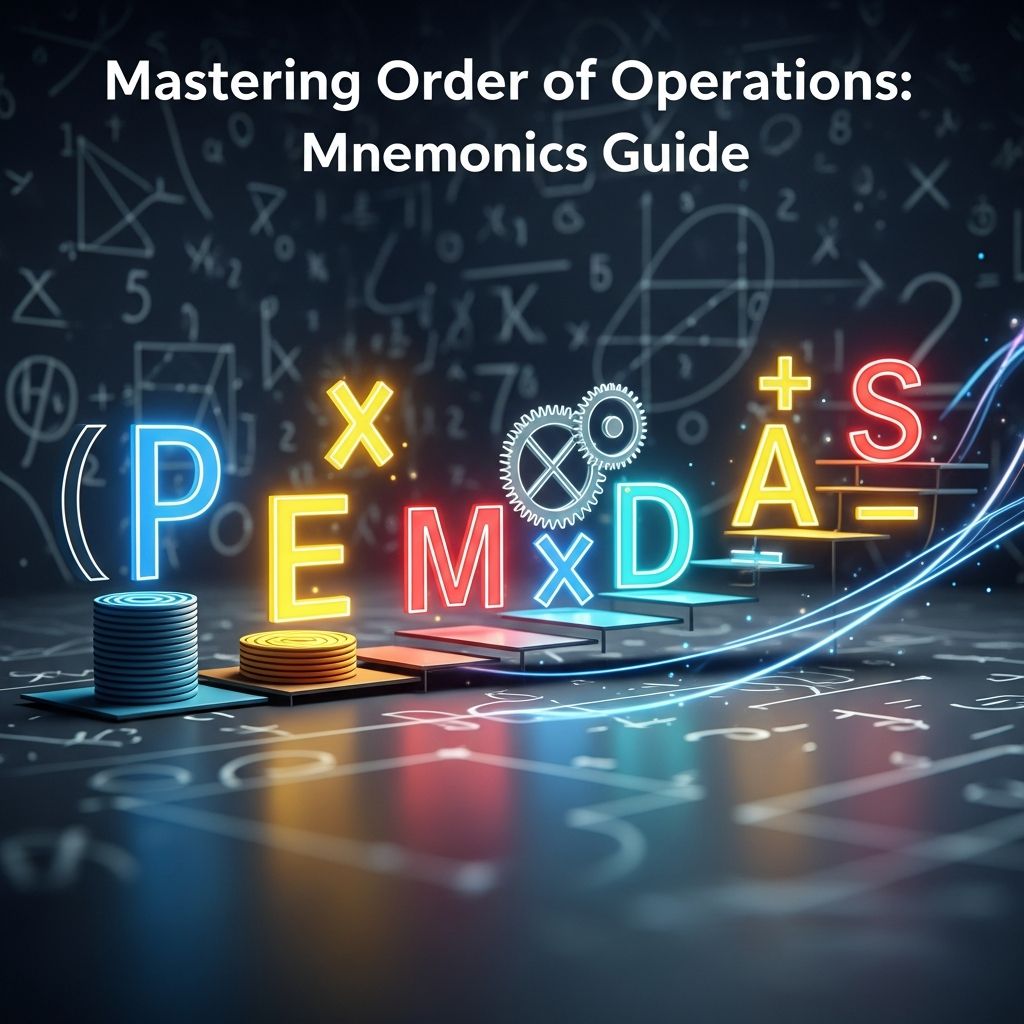
The order of operations forms the backbone of accurate mathematical computation, ensuring consistent results across expressions. Without a clear sequence, simple equations can yield wildly different answers. Mnemonics such as PEMDAS provide a straightforward way to internalize this sequence, transforming confusion into confidence for learners at all levels.
Why Sequence Matters in Math Calculations
Mathematical expressions often contain multiple operations, and performing them in the wrong order leads to errors. For instance, in 2 + 3 × 4, multiplying first gives 14, while adding first yields 20. Standard rules dictate multiplication precedes addition, preventing ambiguity.
These conventions originated from efforts to standardize algebra in the 19th century, evolving into universal agreements taught worldwide. Ignoring them disrupts problem-solving in algebra, calculus, and real-world applications like engineering or finance.
Breaking Down the Core Sequence
The fundamental order prioritizes grouping symbols, then powers, followed by horizontal operations from left to right, and finally vertical ones similarly.
- Grouping Symbols: Parentheses, brackets, or braces contain sub-expressions resolved first.
- Powers and Roots: Exponents, such as squares or cubes, come next.
- Horizontal Operations: Multiplication and division, performed left to right regardless of which appears first.
- Vertical Operations: Addition and subtraction, also left to right.
This hierarchy ensures expressions like 10 – 2(3 + 1) resolve to 4, not 16, by handling the parenthesis and implied multiplication correctly.
Popular Mnemonics Around the World
Different regions use tailored acronyms to encode this sequence, adapting to local terminology for better recall.
| Mnemonic | Stands For | Region |
|---|---|---|
| PEMDAS | Parentheses, Exponents, Multiplication, Division, Addition, Subtraction | United States |
| BODMAS | Brackets, Orders/Indices, Division, Multiplication, Addition, Subtraction | United Kingdom, India |
| BIDMAS | Brackets, Indices, Division, Multiplication, Addition, Subtraction | Common in UK variants |
| GEMDAS | Grouping, Exponents, Multiplication, Division, Addition, Subtraction | US alternative |
| BEDMAS | Brackets, Exponents, Division, Multiplication, Addition, Subtraction | Canada |
All variants convey identical rules; differences lie in wording for parentheses (brackets/grouping) and exponents (orders/indices). Division precedes multiplication in some listings, but both are same-priority, executed left to right.
PEMDAS in Action: Step-by-Step Examples
Consider 8 + 4 × 2² – 6 ÷ 3.
- Parentheses: None.
- Exponents: 2² = 4, so 8 + 4 × 4 – 6 ÷ 3.
- Multiplication/Division: 4 × 4 = 16, 6 ÷ 3 = 2, yielding 8 + 16 – 2.
- Addition/Subtraction: 8 + 16 = 24, 24 – 2 = 22.
Result: 22.
Another: (15 – 3) ÷ (2 + 1) × 4².
- Parentheses: 15 – 3 = 12, 2 + 1 = 3, so 12 ÷ 3 × 16.
- Exponents: Already handled in grouping.
- Division/Multiplication: 12 ÷ 3 = 4, 4 × 16 = 64.
Result: 64.
International Variations and Their Nuances
BODMAS emphasizes ‘Brackets’ over parentheses and ‘Orders’ for exponents, common in British curricula. Example: 12 ÷ (4 – 2) + 3² = 12 ÷ 2 + 9 = 6 + 9 = 15.
GEMDAS uses ‘Grouping’ to encompass all symbols like {}, [], (), clarifying nested cases. BIDMAS swaps ‘Orders’ for ‘Indices,’ highlighting roots and powers explicitly.
These adaptations boost retention by linking to familiar concepts, proving mnemonics’ versatility across cultures.
Crafting Your Own Memory Aids
Personal mnemonics enhance sticking power. Popular ones include:
- Please Excuse My Dear Aunt Sally (PEMDAS classic).
- Big Old Dogs Make Awesome Students (BODMAS).
- Pandas Eat Milk, Drink Apple Sauce (PEMDAS fun twist).
- George’s Elderly Mother Does Almost Nothing (GEMDAS).
To create yours, associate each letter with vivid imagery: Picture parentheses as a fenced yard, exponents as explosive growth. Test by solving problems aloud.
Avoiding Frequent Errors
Common pitfalls derail even knowledgeable students:
- Always Multiply First: No—left to right with division.
- Ignoring Implied Multiplication: 2(3) binds tighter than 2 × 3 in some conventions, but PEMDAS treats equally unless specified.
- Nested Groups: Resolve innermost first: [2(3+1)] = [2×4] = 8.
- Calculator Traps: Verify device follows left-to-right rules; some prioritize differently.
Practice with varied expressions builds intuition.
Applications Beyond Basic Arithmetic
Order of operations underpins advanced math. In algebra, it clarifies 2x + 3x² as 3x² + 2x (exponents before multiplication). Calculus derivatives respect it, as do physics formulas like kinetic energy: ½mv².
Programming languages like Python enforce it, preventing bugs in code. Real-life: Budgeting compound interest requires exponents before additions.
Strategies for Long-Term Retention
- Flashcards with expressions on front, solved steps on back.
- Daily drills: 10 problems timed.
- Teach a peer—explaining solidifies.
- Visual aids: Flowcharts showing priority tiers.
- Mnemonic songs or rhymes for auditory learners.
Combine with spaced repetition apps for mastery.
Frequently Asked Questions
What does PEMDAS stand for exactly?
PEMDAS represents Parentheses, Exponents, Multiplication, Division, Addition, Subtraction—a U.S.-standard memory tool.
Is BODMAS different from PEMDAS?
No, they describe the same rules with regional terms: Brackets for parentheses, Orders for exponents.
Why left to right for multiplication and division?
They share priority; direction ensures consistency, e.g., 12 ÷ 3 × 2 = (12 ÷ 3) × 2 = 8, not 12 ÷ (3 × 2) = 2.
Do calculators always follow PEMDAS?
Most do, but confirm—some handle implied multiplication differently.
Can I use multiple mnemonics?
Yes, understanding the underlying rules matters more than the phrase.
Practice Problems for Reinforcement
Test skills:
- 6 + 2 × 3² – 4 ÷ 2 = ? (Answer: 19)
- (10 – 4) × (8 ÷ 2) + 5 = ? (Answer: 49)
- 20 ÷ 5 + 3 × 4 – 7² = ? (Answer: -29)
Solutions follow PEMDAS/BODMAS steps.
References
- Mnemonic for Memorizing the Order of Operations for the PSAT/NMSQT — Dummies.com. 2023-01-15. https://www.dummies.com/article/academics-the-arts/study-skills-test-prep/psat/mnemonic-for-memorizing-the-order-of-operations-for-the-psatnmsqt-164714/
- Maths Mnemonics Showdown: PEMDAS vs BODMAS — Exam Study Expert. 2023-05-20. https://examstudyexpert.com/mnemonics-pemdas/
- A Memorable Mnemonic for the Order of Operations — JMPigott WordPress. 2022-11-10. https://jmpigott.wordpress.com/portfolio/a-memorable-mnemonic-for-the-order-of-operations/
- PEMDAS: Remembering Math’s Order of Operations — HowStuffWorks. 2024-02-28. https://science.howstuffworks.com/math-concepts/PEMDAS.htm
- Please Excuse My Dear Aunt Sally – Order of Operations and PEMDAS — Chem LibreTexts (University of Wisconsin Stevens Point). 2023-08-12. https://chem.libretexts.org/Courses/University_of_WisconsinStevens_Point/CHEM_101:_Basic_Chemistry_(D’Acchioli)/01:_Laying_the_Groundwork_for_Chem_101/1.06:_Please_Excuse_My_Dear_Aunt_Sally-_Order_of_Operations_and_PEMDAS
- PEMDAS — Math.net. 2024-03-05. https://www.math.net/pemdas

- Integrated M.A. in Applied Linguistics, University of Hyderabad
- 5+ years in editorial, instructional, SEO, and research-based writing
Sneha is a relationships and lifestyle writer with a strong foundation in applied linguistics and certified training in relationship coaching. She brings over five years of writing experience to theskillvault, crafting thoughtful, research-driven content that empowers readers to build healthier relationships, boost emotional well-being, and embrace holistic living. Her writing and insights reflect the belief that beauty, happiness, and wellness…