
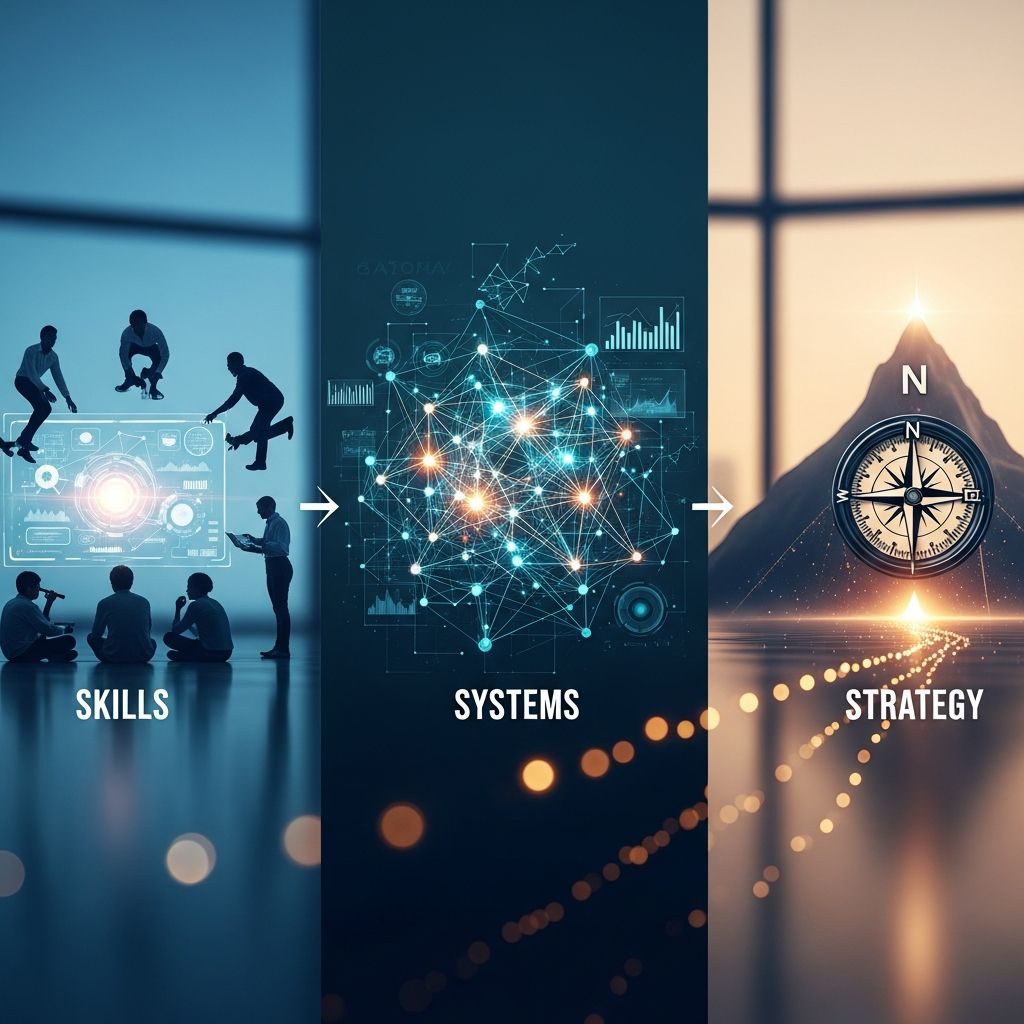
Creating an organization that reliably does a lot of good is much more than having a strong mission. It requires a blend of skills, structures, and habits that turn good intentions into consistent results. This guide explains the key capabilities behind effective organisation-building and how you can develop them over time.
Why Organisation-Building Skills Matter
Many promising missions underperform not because the ideas are weak, but because the organizations behind them lack the skills to execute. Effective organisation-building:
- Turns abstract goals into concrete plans, budgets, and responsibilities.
- Aligns people, processes, and resources around a clear strategy.
- Allows an organization to grow without losing quality or focus.
- Creates resilience during funding shocks, staff turnover, or external crises.
Research on organizational performance consistently finds that strong management practices and well-designed systems predict productivity and long-term success, even controlling for industry and size. Strong organisation-building skills are therefore a powerful way to increase your long-term impact.
Core Skill Areas for Organisation-Builders
Organisation-building is not a single skill. It is a cluster of mutually reinforcing abilities. The most important areas include:
- Operations and execution: Making sure day-to-day work runs smoothly and reliably.
- Project and program management: Turning goals into timelines, milestones, and deliverables.
- People management and leadership: Hiring, developing, and supporting the people doing the work.
- Strategy and prioritization: Deciding what to do first, what to delay, and what not to do.
- Financial and legal oversight: Keeping the organization compliant, solvent, and transparent.
- Culture and communication: Building trust, clarity, and shared norms.
- Entrepreneurship and adaptation: Spotting opportunities, testing ideas, and changing course when needed.
Operations: The Backbone of Reliable Impact
Operations is everything that keeps the organization running: systems, processes, tools, and logistics. In high-impact organizations, operations is not an afterthought; it is a central enabling function.
Key operational responsibilities
- Designing predictable workflows for recurring tasks (e.g., payroll, onboarding).
- Maintaining information systems and documentation.
- Ensuring compliance with regulations and internal policies.
- Coordinating cross-team work so projects do not get stuck.
| Operational Focus | Example Questions |
|---|---|
| Process design | How does a new hire go from offer to fully productive? |
| Risk and compliance | Where could we break the law, lose data, or fail key obligations? |
| Information flow | Who needs which information, in what format, and when? |
| Tools and infrastructure | Which software or systems would cut the most friction? |
Building operational strength
- Map recurrent tasks and document them as simple checklists.
- Automate repetitive steps where possible (e.g., templates, forms, integrations).
- Create single sources of truth (for contacts, finances, projects) to reduce confusion.
- Regularly review bottlenecks: where delays or errors happen most often.
Project Management: Turning Vision into Deliverables
Project management links high-level strategy to concrete work. Strong project management reduces waste, clarifies expectations, and improves follow-through.
Foundations of effective project management
- Clear objectives: Define what success looks like in measurable terms.
- Ownership: Every project has a single person ultimately accountable.
- Plans and milestones: Break work into phases with deadlines.
- Feedback loops: Short cycles for checking progress and adjusting.
Evidence from organizational research shows that well-defined goals and regular progress monitoring significantly improve performance across sectors. Frequent check-ins and small course corrections often matter more than perfect initial plans.
Practical tools and habits
- Use simple project tracking tools (digital boards or spreadsheets) visible to the whole team.
- Run regular, time-bounded check-in meetings focused on blockers and next steps.
- Record key decisions so that new team members can quickly understand context.
- Pause briefly after each project to capture lessons learned.
People Management and Leadership
People do the work; management ensures they can do their best work sustainably. Research suggests that engaged employees, supported by good managers, are more productive and less likely to leave, which reduces costly turnover.
Core management skills
- Setting expectations: Clarifying responsibilities, standards, and priorities.
- Coaching and feedback: Helping people grow, not just evaluating them.
- Delegation: Matching tasks to strengths and giving real ownership.
- Conflict resolution: Addressing tensions early and fairly.
- Psychological safety: Creating conditions where people speak up about problems, risks, or mistakes.
Building a healthy leadership culture
- Model the behaviors you want to see: openness, accountability, and willingness to learn.
- Invest in 1:1 conversations that cover both work and professional development.
- Share rationales behind decisions to build understanding and trust.
- Recognize and celebrate contributions, not just outcomes.
Strategy, Prioritization, and Impact
Without clear strategic thinking, even highly skilled teams can work hard on the wrong things. Strategy aligns efforts with the organization’s mission and the external landscape.
Questions that sharpen strategy
- What is our theory of change – how do our activities lead to our desired outcomes?
- Which problems or segments are we best-positioned to address?
- What are we explicitly not doing this year, and why?
- Which indicators will tell us early if we are on the right track?
Prioritization in practice
Good prioritization means choosing between worthwhile options. Practical approaches include:
- Ranking projects by expected impact, cost (time and money), and likelihood of success.
- Creating a short list of top priorities and protecting time for them.
- Setting decision rules in advance (e.g., when to stop a pilot that underperforms).
- Reviewing priorities regularly as conditions change.
Financial and Legal Foundations
No mission can be sustained if the organization runs out of money or fails legal obligations. Good financial and legal stewardship is a core impact skill, not a side concern.
Financial oversight essentials
- Maintain realistic budgets and cash-flow forecasts.
- Track spending against budget regularly and adjust early.
- Build modest reserves where possible to handle shocks.
- Align fundraising and revenue plans with strategic goals.
Legal and governance basics
- Choose an appropriate legal structure and understand associated obligations.
- Document key policies (e.g., data protection, safeguarding, conflicts of interest).
- Establish governance bodies or advisors with relevant expertise.
- Review contracts and partnerships carefully; clarify responsibilities in writing.
Regulatory and compliance failures can quickly undermine public trust and operational capacity, as documented in multiple case studies of nonprofit and public-sector organizations. Building basic systems early is usually far easier than rebuilding trust later.
Culture, Communication, and Information Flow
Culture is the set of shared expectations and habits that shape how people behave when no one is watching. Communication is how that culture is reinforced day to day.
Designing a functional culture
- Define a small number of explicit values tied to concrete behaviors.
- Balance ambition with realism: encourage high standards without burnout.
- Encourage truth-seeking over status-seeking; reward people who surface problems.
- Build inclusion by ensuring key decisions are understandable and, where appropriate, consultative.
Improving communication
- Agree on default channels for different types of information (urgent, strategic, routine).
- Use written updates to reduce meeting load and create records.
- Summarize decisions and next steps at the end of discussions.
- Create simple orientation materials so newcomers can get up to speed quickly.
Entrepreneurship and Adaptation
New and fast-changing fields demand entrepreneurial thinking within organizations. Being entrepreneurial does not just mean starting new entities; it also means exploring ideas, testing them cheaply, and exiting quickly when they do not work.
Entrepreneurial habits
- Start with small, low-cost experiments before committing fully.
- Talk early and often with the people you aim to serve or influence.
- Measure outcomes where possible instead of relying only on intuition.
- Create a norm that it is acceptable to stop projects when evidence is weak.
Organizations that systematically experiment and learn tend to adapt more effectively to technological and economic change, which is increasingly important as skills and roles evolve rapidly.
Developing Your Own Organisation-Building Skills
Whether you are a founder, an early employee, or a later-stage manager, you can deliberately cultivate organisation-building skills.
1. Start from your current strengths
- Identify which of the core areas (operations, people management, strategy, etc.) you already enjoy or have some experience in.
- Seek roles or projects that let you apply those strengths while stretching into adjacent areas.
2. Learn through scoped responsibility
- Volunteer to own a specific process (e.g., onboarding) or project (e.g., a new pilot program).
- Ask for clear success criteria, then debrief afterwards with a more experienced colleague.
3. Combine formal learning with practice
- Use targeted courses or readings on topics like project management, budgeting, or coaching.
- Apply at least one concept immediately in your current work to solidify learning.
- Track your own mistakes and lessons in a short learning log.
4. Build a network of peers and mentors
- Connect with others doing operations, management, or strategy in similar organizations.
- Share templates, checklists, and postmortems to avoid reinventing the wheel.
- Seek mentors who have scaled organizations and are willing to discuss failures as well as successes.
Where Organisation-Builders Can Have Outsized Impact
Certain contexts particularly reward strong organisation-building skills:
- Early-stage organizations: You can shape systems from the ground up.
- Fast-growing teams: Good operations and management help growth without chaos.
- Coalitions and networks: Coordination, shared infrastructure, and governance matter more as collaboration scales.
- Under-resourced but high-potential groups: Basic structure and reliability can unlock substantial additional impact.
Frequently Asked Questions (FAQs)
Q: Do I need to be a founder to work on organisation-building?
A: No. Many of the most important organisation-building contributions come from operations leads, project managers, and team managers who improve systems, coordination, and culture inside existing organizations.
Q: Which organisation-building skill should I develop first?
A: Start with the area closest to your current role that also addresses a clear organizational need, such as improving one process, learning basic project management, or taking on people-management responsibilities for a small team.
Q: How can small organizations build strong systems without a large budget?
A: Focus on simple, low-cost tools (shared documents, basic accounting software, clear checklists) and on habits like regular reviews and written procedures. Consistent use of simple systems often beats complex tools that no one maintains.
Q: What if my strengths are more technical or research-focused?
A: Technical or research skills pair well with organisation-building. You can lead or support projects, help design metrics, or gradually move into roles that mix subject-matter expertise with management or operations.
Q: How do I know if I am a good fit for organisation-building roles?
A: Signs of good fit include enjoying coordination, being bothered by messy systems, caring about reliability, liking to help others succeed, and taking satisfaction in behind-the-scenes improvements that enable visible impact.
References
- Building a Skills Training Strategy for Organizational Growth — Association for Talent Development. 2023-08-21. https://www.td.org/content/atd-blog/building-a-skills-training-strategy-for-organizational-growth
- Why Prioritizing Skills Development Is Essential for Organizational Success — BizLibrary. 2023-10-05. https://www.bizlibrary.com/blog/training-programs/why-prioritizing-skills-development-is-essential-for-organizational-success/
- The Art of Skill-Building in Modern Organizations — Nestor. 2023-06-14. https://nestorup.com/blog/the-art-of-skill-building-in-modern-organizations/
- Keep Your Organization Successful with Skills Development — Learningbank. 2023-04-18. https://www.learningbank.io/blog/skills-development-keep-organization-successful
- Skill Building in the Workplace: An HR’s Guide — AIHR. 2023-02-09. https://www.aihr.com/blog/skill-building/
- Skills-based organizations: A new operating model for work and the workforce — Deloitte Insights. 2022-04-05. https://www.deloitte.com/us/en/insights/topics/talent/organizational-skill-based-hiring.html

Medha Deb is an editor with a master's degree in Applied Linguistics from the University of Hyderabad. She believes that her qualification has helped her develop a deep understanding of language and its application in various contexts. Medha specializes in the areas of beauty, health, sports, and wellness and is committed to ensuring that the content on the website is…