
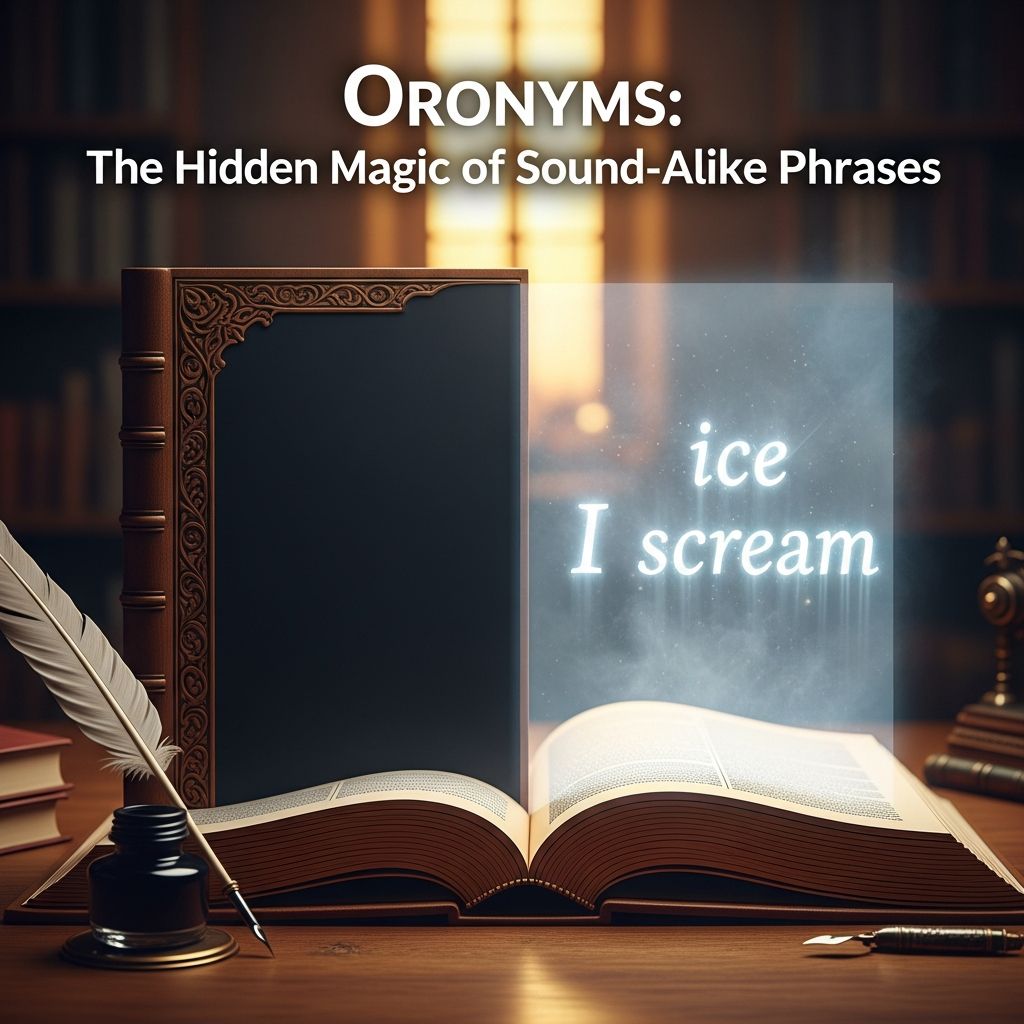
In the rich tapestry of language, few phenomena delight the ear and challenge the mind quite like oronyms. These are sequences of words or entire phrases that, when spoken aloud, sound identical to another completely different sequence, yet carry entirely distinct meanings. Imagine hearing ‘a wise uncle’ or ‘advise uncle’—both blend seamlessly in sound but diverge wildly in intent. This auditory illusion underpins much of linguistic humor, poetic innovation, and even modern technology challenges.
Oronyms emerge from the fluid nature of spoken language, where boundaries between words aren’t marked by spaces or punctuation. They exploit homophony—the sameness of sound—and prosody, the rhythm and stress patterns that give speech its musicality. Linguists define them as strings of speech that can be parsed in multiple valid ways, each yielding a coherent but unrelated interpretation. This article delves deep into their essence, tracing origins, unpacking examples, and exploring applications across culture and tech.
Defining Oronyms in Linguistic Terms
At its core, an oronym is a product of phonetic ambiguity. Unlike homophones (single words like ‘pair’ and ‘pear’), oronyms span multiple words, creating longer chains of identical pronunciation. The term itself entered English lexicon in the late 20th century, coined to describe these multi-word homophones. Dictionaries like Wiktionary formalize it as ‘a phrase or sentence that sounds the same as another phrase or sentence,’ highlighting its dual-parse nature.
To grasp this, consider the mechanics: English phonology allows rapid transitions between consonants and vowels, where listeners infer word breaks based on context. Without visual cues, ‘four candles’ might register as ‘fork handles’—a classic setup for comedy. This isn’t mere coincidence; it’s a feature of how our brains segment continuous sound streams into meaningful units, a process called speech segmentation.
- Key Traits: Identical phonetic transcription in broad terms.
- Scope: Typically 2–10 words per side.
- Dependency: Relies on natural speech flow, ignoring pauses.
Distinguish oronyms from mondegreens (misheard lyrics) or eggcorns (misunderstood idioms). Oronyms are deliberate, bidirectional ambiguities—both parses are valid English.
A Brief History of Wordplay and Oronym Discovery
While ‘oronym’ is modern, the concept echoes through history. Ancient Greek and Roman rhetoricians toyed with paronomasia, sound-based puns. In English, Shakespeare littered plays with auditory tricks, like ‘a horse! a horse! my kingdom for a horse!’ which could twist into unintended echoes.
The formal naming credits 1980s popularizers. Gyles Brandreth’s The Joy of Lex (1980) spotlighted them as ‘sentences that can be read in two ways with the same sound,’ cementing their place in word-lovers’ lexicons. Paul McFedries later expanded in The Complete Idiot’s Guide to Weird Word Origins (2008), linking them to broader homophonic traditions. Wikipedia notes a secondary toponymic use for mountain names, but the linguistic sense dominates discussions today.
By the 21st century, oronyms fueled internet memes and viral challenges, evolving from scholarly curiosity to digital entertainment staple.
Classic Examples That Showcase Oronym Power
Oronyms shine brightest in examples. Here’s a curated selection, grouped by theme:
Everyday Phrases
| Parse 1 | Parse 2 | Phonetic Match |
|---|---|---|
| The stuffy nose | The stuff he knows | /ðə ˈstʌfi ˈnoʊz/ |
| I scream | Ice cream | /aɪs ˈkriːm/ |
| Four candles | Fork handles | /fɔːr ˈkændəlz/ |
| A duck named Fred | Attack named Fred | /ə dʌk neɪmd frɛd/ |
These illustrate how context flips meaning: ‘I scream’ evokes panic or delight, while ‘ice cream’ conjures dessert.
Longer, Elaborate Chains
Advanced oronyms stretch across sentences:
- ‘The male heir to the throne will inherit the throne’ vs. ‘The Malaysia thrown will inherit the throne.’
- ‘You go to the exhibition of Chinese art’ vs. ‘Eugenia’s eye, knee, sore chin, Zsa Zsa art.’
- ‘Sometime after New Year’s there’ll be a rash of New Year’s resolutions’ vs. ‘Some time after New Year’s, they’ll be a rash of nude areas, Olivia’s Asians.’
Such feats demand precise syllabic alignment, rewarding creators with ‘aha!’ moments for listeners.
Why Oronyms Captivate: Psychological and Cognitive Angles
Our fascination stems from cognitive wiring. The human auditory system processes ~150 words per minute, relying on heuristics for disambiguation. Oronyms exploit the lack of acoustic boundaries between words—studies in psycholinguistics show listeners use lexical knowledge and prediction to resolve them.
In humor, they trigger incongruity resolution: initial confusion resolves into laughter. Comedians like The Two Ronnies popularized ‘four candles,’ a sketch where miscommunication builds hilarity. Poetry leverages them for ambiguity; e.g., e.e. cummings-style run-ons mimic spoken flow.
Cognitively, they reveal language acquisition: infants learn segmentation via statistical probabilities in sound patterns, making oronyms a window into early development.
Crafting Your Own Oronyms: A Step-by-Step Guide
Anyone can invent oronyms with practice. Follow this method:
- Start Simple: Pick homophones (e.g., ‘knight’/’night’).
- Build Chains: Link to form phrases: ‘The knight rider’ → ‘The night rider.’
- Match Prosody: Ensure stress aligns (e.g., primary beats on key syllables).
- Test Aloud: Record and play back; refine for seamlessness.
- Contextualize: Embed in stories for punch.
Tools like phonetic transcribers (IPA converters) aid precision. Challenge friends to guess parses—it’s a brain-teasing game.
Oronyms in Popular Culture and Media
From sketches to songs, oronyms permeate entertainment. The 1976 ‘Four Candles’ sketch remains iconic British comedy. Modern YouTube shorts explain them via quick demos, amassing views. Linguistics blogs like Linguistics Girl compile ‘funny oronyms,’ blending education with laughs.
In music, misheard lyrics (mondegreens) overlap: Creedence Clearwater Revival’s ‘There’s a bad moon on the rise’ becomes ‘There’s a bathroom on the right.’ Advertisers use them for memorable slogans, like implied puns in fast-talking commercials.
Challenges for Technology: Speech Recognition Hurdles
AI voice assistants grapple with oronyms. Systems like Siri or Alexa use n-gram models and context, but ambiguities persist—’recognize speech’ vs. ‘wreck a nice beach.’ Research advances via neural networks trained on vast corpora, improving segmentation accuracy to 95%+ in controlled settings.
This ties to natural language processing (NLP): oronyms test disambiguation algorithms, pushing innovations in acoustic modeling.
Related Linguistic Phenomena: A Comparative Overview
| Phenomenon | Description | Example | Key Difference from Oronyms |
|---|---|---|---|
| Homophone | Single words, same sound/different meaning | To/too/two | Limited to one word |
| Mondegreen | Misheard lyrics/phrases | ‘Scuse me while I kiss this guy (Jimi Hendrix) | Unidirectional mishearing |
| Eggcorn | Idiom misinterpretation | ‘Escape goat’ for ‘scapegoat’ | Semantic drift, not sound-based |
| Holorime | Poem where lines match sounds perfectly | Full verse pairs | Poetic, multi-line scale |
Understanding these enriches appreciation of oronyms’ niche.
Frequently Asked Questions (FAQs)
What is the origin of the term ‘oronym’?
Coined in the 1980s from ‘oro-‘ (related to boundaries or mountains in some senses) + ‘-onym’ (name), but popularized for sound-alike phrases by authors like Gyles Brandreth.
Are oronyms the same as homophones?
No—homophones are single words; oronyms are multi-word phrases with identical pronunciation but different meanings.
How do oronyms impact speech-to-text technology?
They create parsing errors, requiring advanced AI context models to resolve ambiguities effectively.
Can oronyms be found in other languages?
Yes, though English’s irregular spelling-pronunciation favors them; languages like Chinese (tonal) have analogs.
Why are oronyms useful in education?
They teach phonetics, segmentation, and creativity, engaging students in interactive language lessons.
Conclusion: Embracing Auditory Ambiguity
Oronyms remind us language is as much heard as read, blending sound, sense, and surprise. Whether for fun, art, or tech, they invite playful exploration of expression’s edges. Next time you speak, listen closely—hidden phrases await.
References
- Oronym — Wikipedia Contributors. 2023-10-15. https://en.wikipedia.org/wiki/Oronym
- oronym — Wiktionary Editors. 2024-01-20. https://en.wiktionary.org/wiki/oronym
- Fun with English Oronyms — Linguistics Girl. 2022-05-12. https://linguisticsgirl.com/fun-with-english-oronyms/

- Integrated M.A. in Applied Linguistics, University of Hyderabad
- 5+ years in editorial, instructional, SEO, and research-based writing
Sneha is a relationships and lifestyle writer with a strong foundation in applied linguistics and certified training in relationship coaching. She brings over five years of writing experience to theskillvault, crafting thoughtful, research-driven content that empowers readers to build healthier relationships, boost emotional well-being, and embrace holistic living. Her writing and insights reflect the belief that beauty, happiness, and wellness…