
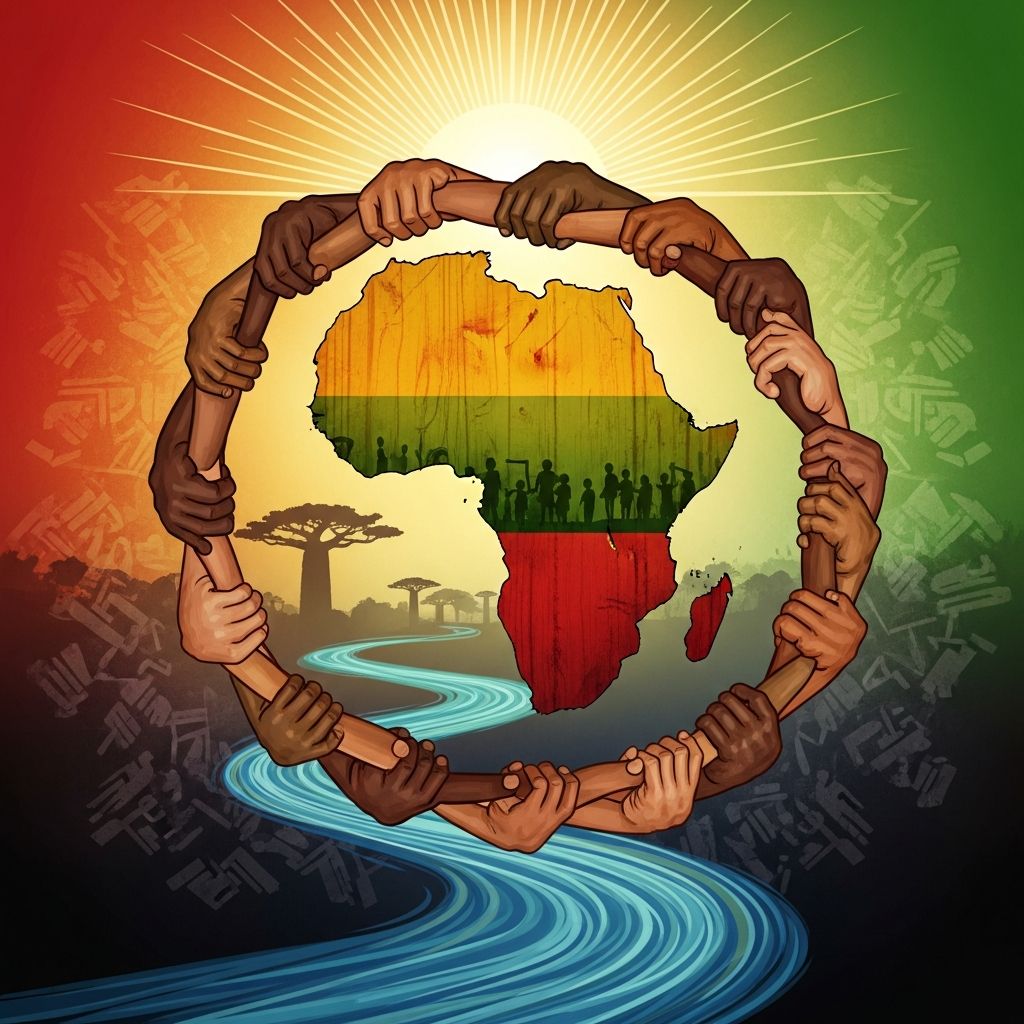
Pan-Africanism represents a powerful ideological framework that seeks to forge bonds among people of African descent across the globe, promoting self-determination, cultural pride, and collective resistance against oppression. Emerging from the shadows of slavery, colonialism, and racial injustice, this movement has shaped modern African politics, independence struggles, and international solidarity efforts.
Foundational Ideas and Core Principles
At its heart, Pan-Africanism asserts that individuals of African ancestry share a profound common heritage that transcends national borders, warranting unified action for progress. It champions the right to self-governance, where African peoples control their political, economic, social, and cultural destinies free from external domination. This philosophy directly confronts the legacies of transatlantic slavery and European colonialism, which scattered millions into the African diaspora and imposed systems of exploitation and dehumanization.
Key tenets include eradicating racism, ensuring equitable resource distribution, and reviving African cultural values. The movement demands education, freedom of expression, and respect for indigenous traditions, as outlined in early manifestos like the 1921 London Manifesto from the first Pan-African Congress. Unity stands as the cornerstone: connecting continental Africans with diaspora communities to amplify their voices against injustice.
- Self-Determination: Africans directing their own futures without foreign interference.
- Anti-Racism: Dismantling systemic prejudices rooted in colonial histories.
- Cultural Revival: Celebrating African heritage, art, spirituality, and philosophies.
- Economic Justice: Fair access to global resources and opportunities.
- Political Solidarity: Collaboration among African states and diaspora for mutual advancement.
These principles evolved from ancient African civilizations’ values of communalism and resilience, adapting through centuries of struggle into a modern ethical system.
Historical Roots and Early Stirrings
The seeds of Pan-Africanism were sown long before its formal articulation, drawing from pre-colonial African societies’ emphasis on kinship and collective welfare. However, the transatlantic slave trade and colonial conquests catalyzed its rise as a response to displacement and subjugation. In the 19th century, pioneering thinkers like Martin Delaney advocated for Black self-reliance, arguing that true prosperity required separation from oppressive white societies and a return to African roots.
Alexander Crummell echoed this, envisioning a unified African nation as the ideal homeland for people of African descent. These ideas gained traction amid abolitionist movements and early nationalist stirrings, setting the stage for organized action. By the late 1800s, the industrial era’s global migrations brought African-descended peoples together in urban centers, fostering dialogues on shared plight.
Pan-Africanism as a distinct movement crystallized in the early 20th century, propelled by intellectuals confronting rampant discrimination and land theft in colonies. It positioned unity as essential for economic, social, and political upliftment, evolving from cultural affinity to a robust political force.
Pioneering Leaders Who Shaped the Movement
Visionary figures propelled Pan-Africanism from theory to action. Henry Sylvester Williams, a Trinidadian barrister, organized the first Pan-African Conference in 1900 in London, protesting colonial land grabs and racial inequities—a landmark gathering of Black voices worldwide.
W.E.B. Du Bois, often hailed as the father of modern Pan-Africanism, convened the inaugural Pan-African Congress in 1919 in Paris, followed by others in 1921 across London, Brussels, and Paris. These forums issued declarations decrying colonial exploitation and demanding resource equity. Du Bois’s scholarly activism bridged diaspora and continental struggles, emphasizing education and global solidarity.
Marcus Garvey, through his Universal Negro Improvement Association, popularized mass mobilization with slogans like “Africa for the Africans,” inspiring millions toward Black economic empowerment and repatriation. Later, Kwame Nkrumah, Ghana’s first president, advanced political Pan-Africanism, co-authoring the 1959 Sanniquellie Declaration with Guinea’s Sékou Touré and Liberia’s William Tubman. This pact balanced national sovereignty with continental unity.
| Leader | Nationality | Major Contribution |
|---|---|---|
| W.E.B. Du Bois | American | Organized Pan-African Congresses; promoted intellectual solidarity |
| Henry Sylvester Williams | Trinidadian | First Pan-African Conference (1900) |
| Kwame Nkrumah | Ghanaian | All-African Peoples’ Conference; OAU founding |
| Marcus Garvey | Jamaican | UNIA; mass mobilization for African redemption |
| George Padmore | Trinidadian | Theoretical framework; advised Nkrumah |
George Padmore, a West Indian thinker, provided ideological depth, influencing decolonization strategies. These leaders transformed Pan-Africanism into a global rallying cry.
Milestone Conferences and Organizational Growth
Congresses served as crucibles for Pan-African thought. The 1945 Fifth Pan-African Congress in Manchester, UK, drew participants from Africa and the diaspora, demanding an end to imperialism, apartheid, and racial injustice. It marked a shift toward mass involvement and liberation strategies.
The 1958 All-African Peoples’ Conference in Accra, Ghana, united voices against colonialism, birthing groups like the Pan-African Freedom Movement of East and Central Africa (PAFMECA). These events culminated in the 1963 formation of the Organization of African Unity (OAU) in Addis Ababa, Ethiopia. The OAU Charter affirmed non-alignment, anti-colonialism, and territorial integrity, bridging radical Casablanca Group’s federation dreams with the Monrovia Group’s gradualism.
In 2002, the OAU evolved into the African Union (AU), continuing unity efforts through forums on peace, democracy, and development. These bodies institutionalized Pan-African ideals, though challenges like border disputes persisted.
Decolonization Triumphs and Independence Waves
Pan-Africanism fueled Africa’s decolonization in the mid-20th century. Nkrumah’s Ghana (1957) ignited a chain reaction, with the OAU supporting liberation fronts like Algeria’s FLN against French rule. By 1960, the “Year of Africa,” 17 nations gained independence, crediting Pan-African networks for solidarity and resources.
The movement condemned assassinations, subversion, and championed total emancipation, non-alignment, and human rights. It empowered southern Africa against apartheid, culminating in South Africa’s 1994 democratic transition. Pan-Africanism’s emphasis on popular sovereignty and non-indifference shaped these victories.
Modern Relevance and Ongoing Challenges
Today, Pan-Africanism addresses neocolonialism, economic disparities, and global inequities. The AU advances Agenda 2063 for an integrated, prosperous Africa, echoing founders’ visions. Diaspora engagement grows via cultural festivals, economic partnerships, and anti-racism campaigns.
Slogans like “Africa Must Unite,” “Aluta Continua,” and “I Am Because We Are” (Ubuntu) encapsulate its spirit. Yet, intra-African divisions, debt burdens, and climate vulnerabilities test resilience. Revived Pan-Africanism promotes retooled academia, democratic norms, and youth-led innovation.
In a multipolar world, it fosters South-South cooperation, digital unity, and cultural exports like Afrobeats, reclaiming narrative control.
Frequently Asked Questions (FAQs)
What is the main goal of Pan-Africanism?
The primary aim is to unite people of African descent for self-determination, equality, and resistance to oppression, fostering political, economic, and cultural solidarity.
Who is considered the father of Pan-Africanism?
W.E.B. Du Bois is widely regarded as the father of modern Pan-Africanism for organizing key congresses and intellectual leadership.
What replaced the Organization of African Unity?
The African Union (AU), established in 2002, succeeded the OAU to strengthen integration and address contemporary African issues.
How did Pan-Africanism contribute to independence?
It provided ideological fuel, conferences for coordination, and OAU support for liberation struggles across the continent.
Is Pan-Africanism still relevant today?
Yes, it guides AU initiatives, diaspora ties, and fights against neocolonialism, racism, and economic inequality.
References
- Pan-Africanism Principles, Origins & Organizations — Study.com. 2023. https://study.com/academy/lesson/pan-africanism-history-flag-facts.html
- Pan-Africanism — Wikipedia. 2026-04-01. https://en.wikipedia.org/wiki/Pan-Africanism
- Pan-Africanism Reborn? — Africa Center for Strategic Studies. 2020-06-25. https://africacenter.org/spotlight/pan-africism-reborn/
- The Pan-Africanist Movement and the road to liberation — OAU-AU. 2023. https://oau60.au.int/en/pan-africanist-movement-and-road-liberation
- Pan-Africanism | History, Achievements, & Facts — Britannica. 2026-03-15. https://www.britannica.com/topic/Pan-Africanism
- Pan-Africanism | History | Research Starters — EBSCO. 2022. https://www.ebsco.com/research-starters/history/pan-africanism
- Pan-Africanism in Brief — PAC9-Lome2024. 2024. https://pac9-lome2024.com/pan-africanism-in-brief/

- Integrated M.A. in Applied Linguistics, University of Hyderabad
- 5+ years in editorial, instructional, SEO, and research-based writing
Sneha is a relationships and lifestyle writer with a strong foundation in applied linguistics and certified training in relationship coaching. She brings over five years of writing experience to theskillvault, crafting thoughtful, research-driven content that empowers readers to build healthier relationships, boost emotional well-being, and embrace holistic living. Her writing and insights reflect the belief that beauty, happiness, and wellness…