
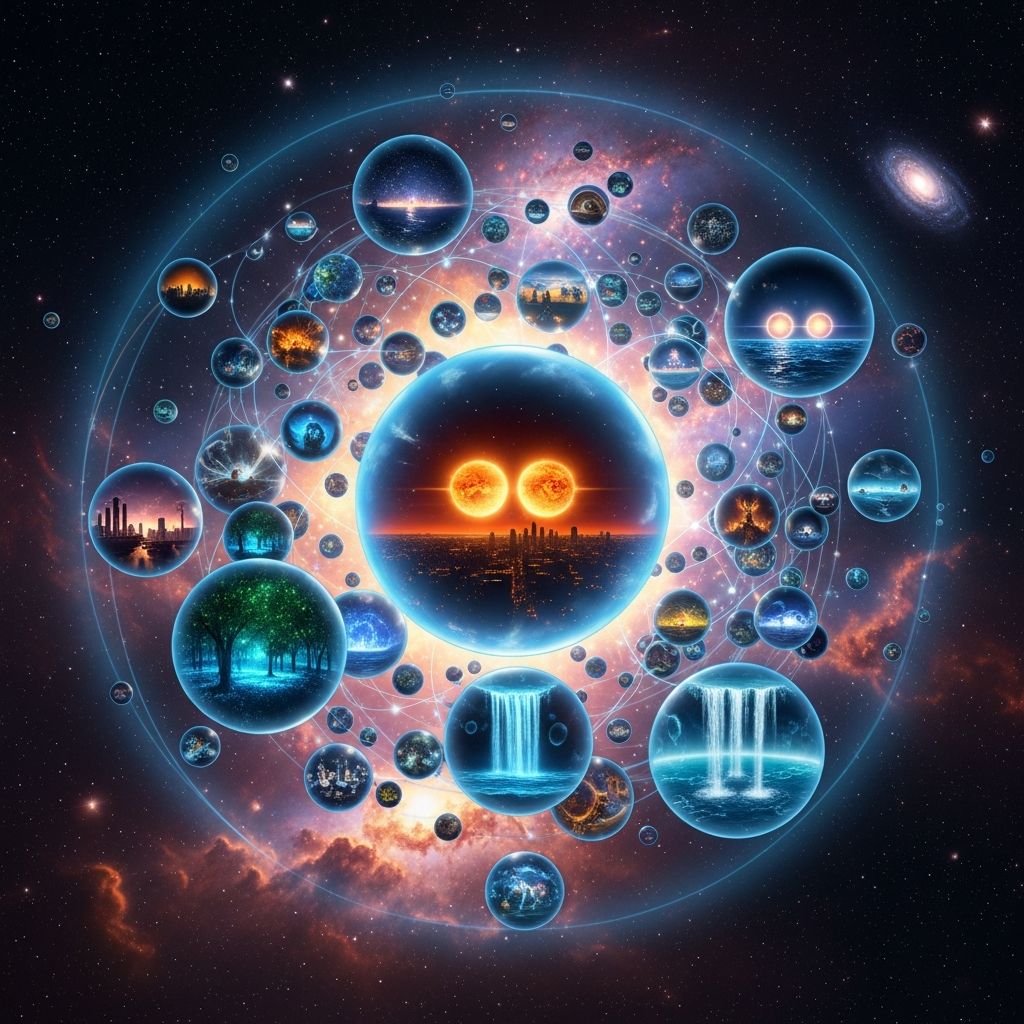
The notion of parallel universes captivates scientists and philosophers alike, proposing that our reality might be just one thread in an expansive cosmic tapestry. These ideas emerge from cutting-edge physics, blending quantum mechanics, cosmology, and string theory to suggest multiple coexisting realities.
Foundations of Multiverse Concepts
Multiverse theories posit that our universe is not singular but part of a larger collection of universes, each potentially governed by unique physical laws or initial conditions. This framework addresses longstanding puzzles in cosmology, such as the fine-tuning of fundamental constants that allow life to exist.
Physicists like Max Tegmark and Brian Greene have categorized these into distinct types, drawing from observational data like cosmic microwave background radiation and theoretical models from inflation theory. While unproven, these hypotheses gain traction through mathematical consistency and indirect evidence from particle accelerators and telescopes.
Infinite Space and the Quilted Multiverse
In an infinitely vast universe, every conceivable configuration of matter and energy repeats endlessly. This **quilted multiverse** argues that beyond our observable horizon—limited by the speed of light—identical copies of Earth and humanity exist, separated by insurmountable distances.
- Key Mechanism: Infinite spatial extent ensures all quantum possibilities manifest repeatedly.
- Implications: Explains statistical anomalies in cosmic structure without invoking new physics.
- Challenges: Unobservable by definition, relying on assumptions of spatial infinity.
Supporting evidence comes from measurements indicating a flat, potentially infinite universe, as per data from the Planck satellite.
Bubble Universes from Cosmic Inflation
The rapid expansion phase post-Big Bang, known as inflation, could spawn disconnected **bubble universes**. Each bubble represents a region where inflation halted, birthing a new cosmos with possibly varied physical properties.
These pockets form within an eternally inflating backdrop, where quantum fluctuations trigger bubble nucleation. Our universe is one such bubble, surrounded by others inaccessible due to accelerated expansion.
| Aspect | Bubble Multiverse Features |
|---|---|
| Origin | Quantum fluctuations in scalar fields during eternal inflation. |
| Diversity | Varying constants like electron mass or gravitational strength. |
| Evidence | Cosmic microwave background cold spots as potential bubble collisions. |
Brane Worlds in Higher Dimensions
String theory introduces **brane multiverses**, where our universe is a three-dimensional ‘brane’ floating in higher-dimensional ‘bulk’ space. Parallel branes, hosting alternate realities, might collide, sparking Big Bang-like events.
Gravity leaks between branes, potentially explaining its weakness compared to other forces. This model aligns with M-theory, unifying gravity and quantum mechanics in 11 dimensions.
Eternal Cycles of Cosmic Renewal
The **cyclic multiverse** envisions universes undergoing endless cycles of expansion, contraction, and rebirth through brane collisions. Each cycle erases prior information, starting afresh.
- Paul Steinhardt and Neil Turok’s model predicts observable gravitational waves from prior cycles.
- Avoids singularities by smoothing transitions via ekpyrotic scenarios.
Quantum Branching and Many Worlds
Quantum mechanics’ **many-worlds interpretation** (MWI) proposes that every measurement splits reality into branches, each realizing a different outcome. Superpositions don’t collapse; the universe decoheres into parallel versions.
Hugh Everett’s 1957 formulation resolves measurement paradoxes without observers influencing outcomes. In one branch, Schrödinger’s cat lives; in another, it dies—both equally real.
“All possible alternate histories and futures are real, each representing an actual ‘world’ or ‘universe’.” – Hugh Everett III
Holographic Projections of Reality
The **holographic multiverse** stems from the AdS/CFT correspondence, suggesting our three-dimensional universe is a projection from a two-dimensional boundary. Multiple holographic encodings could yield diverse bulk realities.
This principle, proven in anti-de Sitter spaces, hints at encoding volume information on surfaces, revolutionizing black hole entropy and quantum gravity.
Landscapes of String Theory Vacua
String theory’s **landscape multiverse** features 10^500 possible vacuum states, each a universe with distinct laws from Calabi-Yau compactifications. Anthropic selection explains our life’s permitting constants.
Quantum fluctuations in the string landscape create pockets with fixed parameters, addressing the cosmological constant problem.
Simulated and Ultimate Ensembles
A **simulated multiverse** imagines advanced civilizations running universe simulations, our reality potentially one such program. Nick Bostrom’s simulation argument posits we’re likely simulated given computational feasibility.
The **ultimate multiverse** encompasses all mathematical structures capable of hosting self-consistent universes, per Tegmark’s Level IV.
Experimental Probes and Observational Hints
While direct detection eludes us, indirect signatures abound:
- Cosmic microwave anomalies as brane collision scars.
- Hubble tension resolved by twin-universe interactions.
- Quantum experiments testing many-worlds via interference patterns.
Future gravitational wave detectors like LISA may reveal cyclic model imprints.
Philosophical and Cultural Reverberations
Multiverses challenge determinism, free will, and identity. If infinite ‘yous’ exist, what defines uniqueness? Popular media amplifies these via films like Everything Everywhere All at Once, blending science with speculation.
Frequently Asked Questions (FAQs)
What is the strongest evidence for parallel universes?
Theoretical consistency in inflation and string theory, plus cosmic observations like flat geometry supporting infinity.
Can we ever travel to another universe?
Current physics suggests no, due to light-speed limits and causal disconnection.
Does the multiverse disprove the Big Bang?
No, it extends it—our Big Bang is local within a larger framework.
How many types of multiverses exist?
Greene outlines nine; Tegmark four levels, encompassing spatial, inflationary, quantum, and mathematical variants.
Is the simulation hypothesis scientific?
It’s philosophical but gains traction from quantum computing advances.
References
- Multiverse — Wikipedia Contributors. 2023-10-15. https://en.wikipedia.org/wiki/Multiverse
- Nine different types of multiverses in fiction — Carla Ra. 2023-01-20. https://www.authorcarlara.com/post/9-types-of-multiverses
- 4 different types of multiverse — Big Think. 2022-11-10. https://bigthink.com/hard-science/4-different-types-multiverse/
- Do parallel universes exist? We might live in a multiverse — Space.com. 2023-05-05. https://www.space.com/32728-parallel-universes.html
- The True Science of Parallel Universes — PBS Space Time (YouTube). 2018-06-12. https://www.youtube.com/watch?v=Ywn2Lz5zmYg
- Top Multiverse Theories: Many Worlds, Bubble Universes — Adler Planetarium. 2024-02-28. https://www.adlerplanetarium.org/blog/top-multiverse-theories-niyah-and-the-multiverse/

- Integrated M.A. in Applied Linguistics, University of Hyderabad
- 5+ years in editorial, instructional, SEO, and research-based writing
Sneha is a relationships and lifestyle writer with a strong foundation in applied linguistics and certified training in relationship coaching. She brings over five years of writing experience to theskillvault, crafting thoughtful, research-driven content that empowers readers to build healthier relationships, boost emotional well-being, and embrace holistic living. Her writing and insights reflect the belief that beauty, happiness, and wellness…