
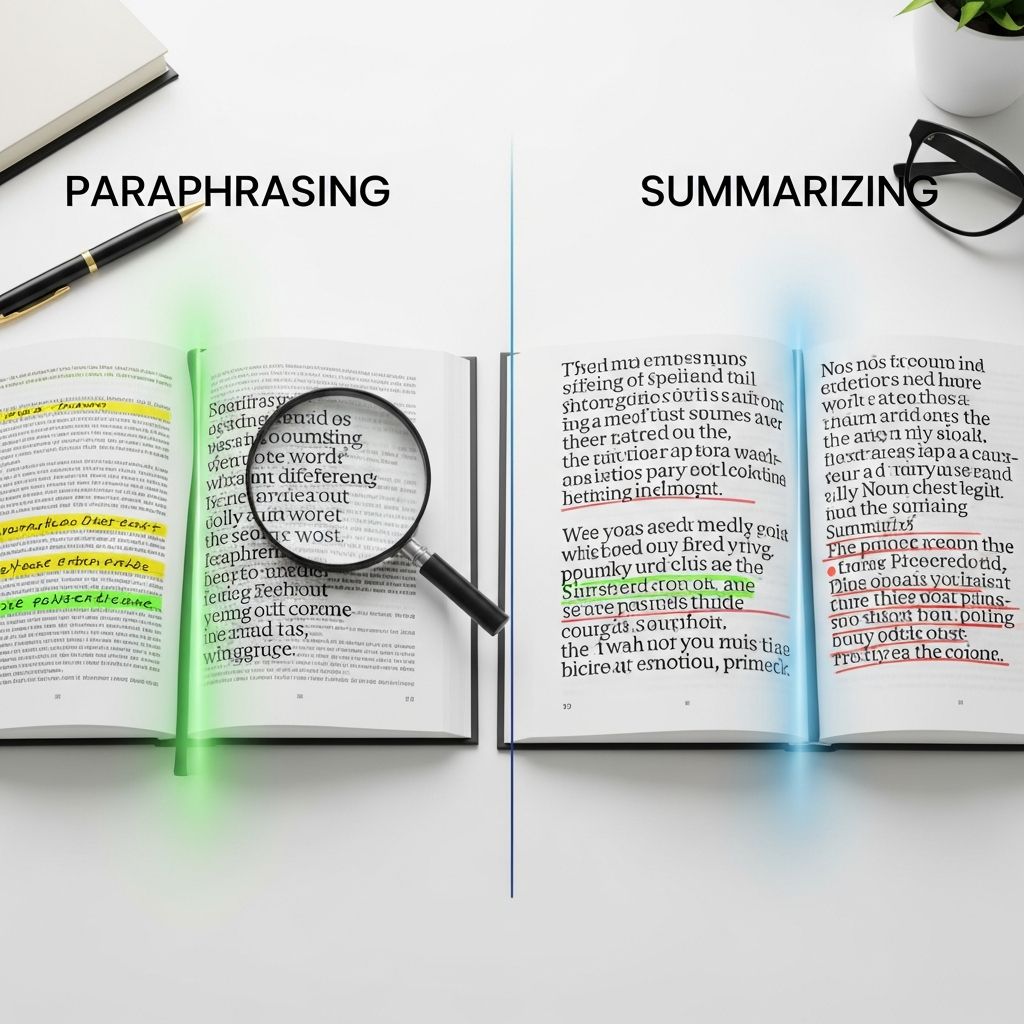
In the world of effective communication, whether in academia, business, or everyday writing, two techniques stand out for incorporating external ideas without direct quotation: **paraphrasing** and **summarizing**. Both methods allow writers to restate information in their own words, promoting originality and understanding while crediting sources. However, they serve distinct purposes and are applied differently based on the scope of the content and the writer’s goals. This comprehensive guide explores these techniques in depth, providing definitions, comparisons, practical examples, and strategies to help you choose the right approach every time.
Defining Paraphrasing: Restating with Precision
**Paraphrasing** is the process of rephrasing a specific passage or idea from a source using your own words and sentence structures, while preserving the original meaning and level of detail. It involves taking a targeted segment—often a sentence, paragraph, or short section—and translating it into fresh language that conveys the same concepts without copying the exact wording.
The goal of paraphrasing is to clarify or emphasize particular points for your audience, demonstrating your comprehension of the material. Unlike quoting, which retains the author’s exact words, paraphrasing shows that you have processed and internalized the information. Paraphrased content is typically similar in length to the original, though it can sometimes be slightly shorter or longer depending on how you restructure the ideas.
For instance, if a source states: “Climate change is accelerating due to human activities like deforestation and fossil fuel consumption,” a paraphrase might read: “Human actions such as cutting down forests and burning fossil fuels are speeding up global warming.” This maintains the core message but uses different vocabulary and structure.
Defining Summarizing: Capturing the Essence
In contrast, **summarizing** involves condensing a larger body of text—such as an article, chapter, or entire document—into a brief overview that highlights only the main ideas, themes, or conclusions. It omits supporting details, examples, and minor points to focus on the “big picture.”
Summaries are always significantly shorter than the source material, making them ideal for providing quick insights or overviews. The emphasis is on brevity and selectivity, allowing readers to grasp key arguments without delving into the full content. Attribution to the original source remains essential to avoid plagiarism.
Using the same climate change example, a summary of a full report might be: “The report concludes that human-induced factors are the primary drivers of rapid climate change, urging immediate policy interventions.” This distills multiple pages into one concise statement.
Core Differences: A Side-by-Side Comparison
Understanding when and how to use each technique hinges on recognizing their fundamental differences. The table below outlines key distinctions for quick reference:
| Aspect | Paraphrasing | Summarizing |
|---|---|---|
| Scope | Specific sentences or paragraphs | Entire articles, chapters, or sections |
| Length | Similar to original (can vary slightly) | Always much shorter |
| Detail Level | Retains most details and specifics | Focuses on main ideas only; omits details |
| Purpose | Clarify or integrate specific points | Provide overviews or condense information |
| Example Use | Explaining a single study finding | Recapping a book’s key arguments |
These differences ensure that paraphrasing suits targeted analysis, while summarizing excels at broad comprehension.
Practical Examples: Paraphrasing and Summarizing in Action
To illustrate, consider this original passage from a hypothetical research paper: “The study examined 500 participants over five years, revealing that regular exercise reduces the risk of heart disease by 30%. Participants who exercised at least 150 minutes per week showed improved cardiovascular health, lower cholesterol levels, and better blood pressure control. However, adherence was challenging for those with busy schedules.”
- Paraphrase: Researchers tracked 500 individuals for five years and found that consistent physical activity lowers heart disease risk by 30 percent. Those exercising 150 minutes weekly experienced enhanced heart function, reduced cholesterol, and stabilized blood pressure, though maintaining routines proved difficult for time-constrained subjects.
- Summary: A five-year study of 500 people demonstrated that regular exercise significantly cuts heart disease risk, with benefits including better cholesterol and blood pressure, despite adherence issues.
Notice how the paraphrase covers nearly all details in new words, while the summary boils it down to essentials.
When to Choose Paraphrasing Over Summarizing
Opt for paraphrasing when you need to delve into specific arguments, data, or claims from a source without losing nuance. It’s particularly useful in argumentative essays, literature reviews, or when building on a precise idea.
- Highlighting a researcher’s unique methodology or finding.
- Integrating evidence to support your thesis directly.
- Avoiding excessive quotes while showing deep understanding.
Paraphrasing signals to readers (and instructors) that you’ve engaged critically with the material, fostering academic integrity.
Ideal Scenarios for Summarizing
Summarizing shines when space is limited or when introducing a source’s overall stance before your analysis. It’s common in executive summaries, annotated bibliographies, or when contextualizing multiple sources.
- Recapping a long article’s thesis and conclusions.
- Providing background in reports or proposals.
- Comparing broad themes across several works.
By focusing on core elements, summaries save time and guide readers efficiently.
Techniques for Effective Paraphrasing
Mastering paraphrasing requires practice. Start by reading the source multiple times until you grasp it fully, then set it aside and rewrite from memory. Key steps include:
- Identify synonyms for key terms (e.g., “accelerate” to “speed up”).
- Alter sentence structure (e.g., active to passive voice).
- Combine or split ideas for freshness.
- Check against the original to ensure accuracy and cite properly.
Common pitfalls: changing only a few words (patchwriting) or altering meaning. Revise iteratively to differentiate sufficiently.
Strategies for Strong Summaries
To summarize effectively:
- Pinpoint the main thesis and supporting arguments.
- Exclude anecdotes, data lists, or tangents.
- Use objective language to reflect the source neutrally.
- Keep it concise—aim for 10-30% of original length.
Always attribute: “As Smith (2023) argues…”
Benefits and Pitfalls: Enhancing Your Writing
Both techniques combat plagiarism, improve readability, and showcase analytical skills. They allow seamless integration of sources, strengthening arguments. However, misuse—such as inaccurate rephrasing—can distort facts or invite penalties.
Benefits include:
- Developing critical thinking.
- Adapting content for diverse audiences.
- Reducing reliance on quotes for fluid prose.
Avoid pitfalls by cross-verifying with originals and using tools like plagiarism checkers ethically.
Frequently Asked Questions (FAQs)
Can a paraphrase be longer than the original text?
Yes, paraphrases can expand slightly for clarity, though they usually match the source length.
Is summarizing always objective?
Yes, summaries should neutrally capture main points without injecting personal opinion.
Do both require citations?
Absolutely—always credit sources to maintain integrity.
When should I quote instead?
Quote for unique phrasing, emphasis, or when rephrasing risks losing precision.
How do I know if I’ve paraphrased correctly?
Compare to the original: meaning intact, words/structure changed, citation included.
Advanced Applications in Academic and Professional Writing
In research papers, combine both: summarize literature reviews, paraphrase key studies. In business, summarize reports for executives, paraphrase data for proposals. Literature fields favor paraphrasing for analysis; sciences lean on summaries for reviews.
Practice builds fluency—try exercises with news articles or textbooks. Over time, these skills elevate your writing from rote to insightful.
References
- Paraphrasing vs Summarizing – Know the Difference — Citation Machine. 2023. https://www.citationmachine.net/resources/plagiarism/paraphrasing-vs-summarizing-know-the-difference/
- Paraphrasing vs. Summarizing — Grammarly. 2023-10-15. https://www.grammarly.com/blog/summarizing-paraphrasing/paraphrasing-vs-summarizing/
- Quoting, Paraphrasing, and Summarizing — Purdue OWL, Purdue University. 2024. https://owl.purdue.edu/owl/research_and_citation/using_research/quoting_paraphrasing_and_summarizing/index.html
- What is the difference between summarizing, paraphrasing and quotation? — Marist College Library. 2023. https://marist.libanswers.com/faq/365901
- The Difference Between Summarizing & Paraphrasing — Microsoft 365. 2023-05-20. https://www.microsoft.com/en-us/microsoft-365-life-hacks/writing/difference-summarizing-paraphrasing
- Paraphrase and Summary — University of Toronto. 2024. https://www.uc.utoronto.ca/paraphrase
- Paraphrase and Summary — University of Kansas Writing Center. 2023. https://writing.ku.edu/paraphrase-and-summary

Medha Deb is an editor with a master's degree in Applied Linguistics from the University of Hyderabad. She believes that her qualification has helped her develop a deep understanding of language and its application in various contexts. Medha specializes in the areas of beauty, health, sports, and wellness and is committed to ensuring that the content on the website is…