
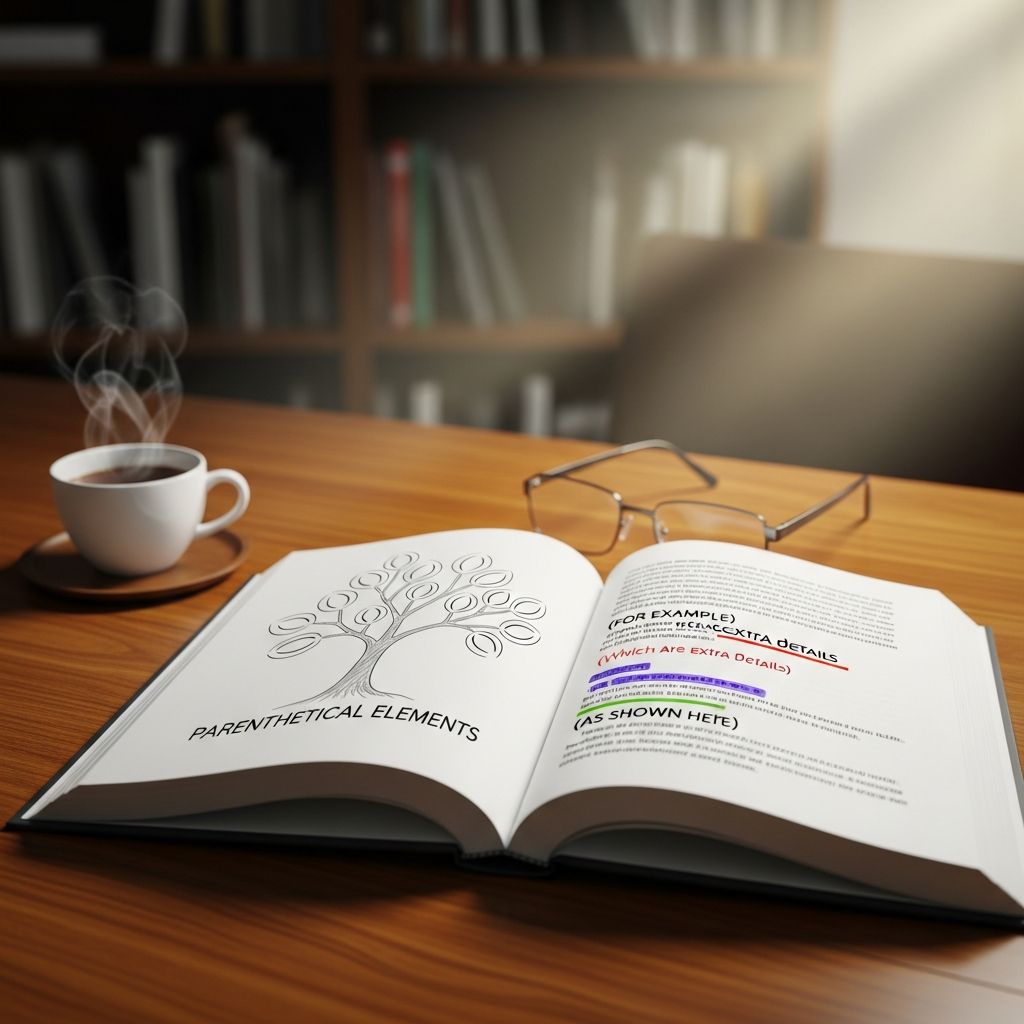
Parenthetical elements are powerful tools in English grammar that allow writers to insert additional information into sentences without disrupting the core meaning. These non-essential phrases or clauses provide context, emphasis, or elaboration, making writing more engaging and informative. Understanding how to identify and punctuate them correctly is essential for clear communication.
Defining Parenthetical Elements
A **parenthetical element**, often called an interrupter or parenthetical expression, is a word, phrase, or clause that can be removed from a sentence while leaving the remaining structure grammatically complete and meaningful. It adds supplementary details such as explanations, examples, or emotional tones but is not crucial to the sentence’s primary message.
For instance, consider the sentence: “The conference, scheduled for next week, will feature industry leaders.” Here, “scheduled for next week” is the parenthetical element; removing it yields “The conference will feature industry leaders,” which stands alone perfectly.
These elements can appear at the start, middle, or end of a sentence, each requiring specific punctuation to maintain flow and readability. Their flexibility makes them invaluable in academic, professional, and creative writing.
Key Characteristics of Parenthetical Phrases
- Non-Essential Nature: Test by removal—if the sentence remains logical, it’s parenthetical.
- Positions: Beginning (followed by comma), middle (surrounded by commas), or end (preceded by comma).
- Punctuation Variety: Primarily commas, but dashes or parentheses for emphasis or formality.
- Functions: They clarify, emphasize, or provide asides without altering the main clause.
Primary Types of Parenthetical Elements
Parenthetical elements come in various forms, each serving distinct purposes. Recognizing these types helps in precise usage and punctuation.
1. Introductory Expressions
These phrases set the scene by indicating time, place, manner, or reason. Lacking a subject-verb pair, they cannot stand alone and always precede the main clause, separated by a comma.
Example: After the storm passed, the residents emerged to assess the damage.
Here, “After the storm passed” introduces the action without being essential.
2. Expressive Interjections
Interjections convey emotions, reactions, or affirmations like “wow,” “alas,” or “indeed.” They can stand independently and fit anywhere in a sentence, adjusting punctuation accordingly.
- Beginning: Wow, that performance was breathtaking.
- Middle: The decision, surprisingly, favored the underdog.
- End: You aced the exam, right?
3. Appositive Phrases
An appositive renames or describes a nearby noun, often using commas to signal it’s non-restrictive. Without commas, it becomes restrictive, changing meaning.
Example: My colleague, a talented engineer, solved the puzzle quickly. (Implies one colleague.)
Vs. My colleague a talented engineer solved the puzzle. (Identifies which one among many.)
4. Participial Phrases
Featuring a participle (e.g., “running,” “broken”) plus modifiers, these act as adjectives modifying the whole sentence or a noun. They often appear at the start or end.
Example: Exhausted from the hike, the hikers collapsed by the fire.
| Position | Example | Effect |
|---|---|---|
| Beginning | Breathing heavily, he crossed the finish line. | Sets simultaneous action |
| Middle | The team, motivated by the coach, won decisively. | Adds description |
| End | She presented her idea, smiling confidently. | Concludes with detail |
5. Free Modifiers
These versatile phrases or clauses modify the main idea and can shift positions without losing sense, always needing commas.
Examples:
- Whispering softly, the storyteller captivated the children.
- The storyteller captivated the children, whispering softly.
6. Summative Modifiers
Found at sentence ends, they recap the idea with a noun clause, reinforcing the point.
Example: The policy change boosted productivity, a shift long overdue.
7. Resumptive Modifiers
These echo earlier words for emphasis, extending the thought and shifting focus.
Example: The ancient ruins, ruins shrouded in mystery, drew archaeologists from afar.
Punctuation Guidelines for Parentheticals
Correct punctuation prevents confusion. Commas are standard, but alternatives suit tone.
- Commas: For mild interruptions. E.g., The book, my favorite read, inspired me.
- Dashes: For dramatic emphasis. E.g., The solution—simple yet brilliant—eluded us.
- Parentheses: For formal asides or technical notes. E.g., Photosynthesis (a process converting light to energy) sustains plants.
Avoid over-punctuating; test readability by reading aloud.
Common Mistakes and Fixes
Misusing parentheticals leads to run-ons or fragments. Key pitfalls:
| Error | Example | Correction |
|---|---|---|
| Missing Commas | The chef who trained in Paris prepared the meal. | The chef, who trained in Paris, prepared the meal. (Non-essential) |
| Overuse | Multiple, unneeded, commas, everywhere, disrupt flow. | Limit to essentials for clarity. |
| Confusing Restrictive/Non-Restrictive | My sisters are coming. (All sisters) | My sisters, who live nearby, are coming. (Specifies) |
Proofread by removing the element to verify sentence integrity.
Advanced Applications in Writing
Beyond basics, parentheticals enhance style:
- Narrative Flow: Build tension—suddenly, a shadow loomed—in stories.
- Academic Precision: Cite sources (see Smith, 2020) seamlessly.
- Persuasive Rhetoric: Indeed, the data confirms, our strategy succeeds.
In journalism, they add color without derailing facts; in essays, they weave arguments fluidly.
Frequently Asked Questions (FAQs)
What is the difference between essential and non-essential clauses?
Essential clauses (restrictive) are vital to meaning and lack commas; non-essential (parenthetical) add extras and use commas.
Can parentheticals use semicolons?
Rarely; they typically pair with independent clauses, but commas suffice for parentheticals.
How do parentheticals differ from direct addresses?
Direct addresses (e.g., “Pass the salt, John.”) name the audience; parentheticals provide info.
Are parentheses always appropriate?
No—reserve for technical/formal; commas suit general use.
Do parentheticals affect sentence diagramming?
They branch off the main diagram as modifiers, not core components.
Practice Exercises for Mastery
Strengthen skills:
- Insert: “a skilled artisan” into “The vase broke.” → The vase, a skilled artisan’s creation, broke.
- Punctuate: “The event postponed again drew complaints.” → The event, postponed again, drew complaints.
- Reposition: “Running late” in a sentence.
Review daily to internalize rules.
Mastering parentheticals transforms rigid prose into dynamic, nuanced writing. Practice consistently for fluency.
References
- What is a Parenthetical Element? — XterraWeb. Accessed 2026. http://editing.xterraweb.com/writing-tips/what-is-a-parenthetical-element
- Parenthetical Phrases – Definition & Examples — Grammarist. Accessed 2026. https://grammarist.com/grammar/parenthetical-phrases/
- Commas: Parenthetical Elements — YouTube (Jason Horn). Accessed 2026. https://www.youtube.com/watch?v=BJF5-yTmI6k
- Parenthetical Phrases — University of Nevada, Reno Writing & Speaking Center. Accessed 2026. https://www.unr.edu/writing-speaking-center/writing-speaking-resources/parenthetical-phrases
- Parentheses () | Definition, Punctuation, Rules & Examples — Scribbr. Accessed 2026. https://www.scribbr.com/language-rules/parentheses/
- How do I use commas with parenthetical elements? — ProWritingAid. Accessed 2026. https://prowritingaid.com/grammar/1008086/How-do-I-use-commas-with-parenthetical-elements

- Integrated M.A. in Applied Linguistics, University of Hyderabad
- 5+ years in editorial, instructional, SEO, and research-based writing
Sneha is a relationships and lifestyle writer with a strong foundation in applied linguistics and certified training in relationship coaching. She brings over five years of writing experience to theskillvault, crafting thoughtful, research-driven content that empowers readers to build healthier relationships, boost emotional well-being, and embrace holistic living. Her writing and insights reflect the belief that beauty, happiness, and wellness…