
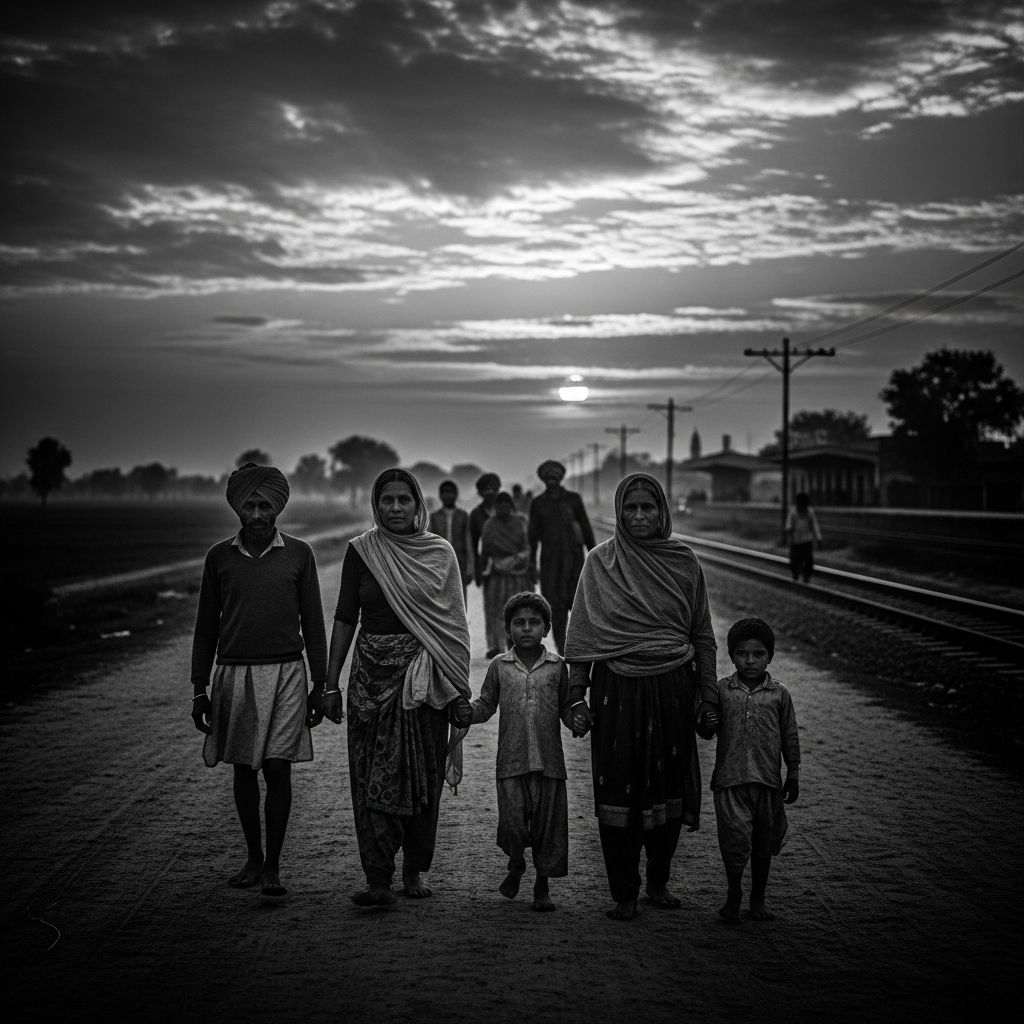
The Partition of India in 1947 marked the end of British colonial rule and the birth of two independent nations: India and Pakistan. This event, formalized by the Indian Independence Act passed on July 18, 1947, divided British India into the Union of India and the Dominion of Pakistan, leading to unprecedented population exchanges and communal strife.
Historical Context: Colonial Rule and Rising Tensions
British presence in the Indian subcontinent began with the East India Company in the 17th century and evolved into direct Crown rule after the 1857 rebellion. By the 20th century, nationalist movements gained momentum, led by figures like Mahatma Gandhi and the Indian National Congress, demanding self-governance.
Muslim concerns over Hindu-majority dominance fueled the All-India Muslim League’s push for a separate homeland under Muhammad Ali Jinnah. The 1940 Lahore Resolution formalized the ‘Two-Nation Theory,’ arguing Hindus and Muslims constituted distinct nations.
- Key factors escalating divisions: British ‘divide and rule’ policies, World War II weakening imperial control, and post-war communal riots like the 1946 Calcutta Killings.
- Failed negotiations, such as the 1946 Cabinet Mission Plan, deepened mistrust between Congress and the League.
By early 1947, Viceroy Lord Mountbatten recognized irreconcilable differences, accelerating independence from June 1948 to August 1947 to avert civil war or mutiny.
The Mountbatten Plan: Blueprint for Division
On June 3, 1947, Mountbatten unveiled his partition scheme, accepting a divided India with Muslim-majority areas forming Pakistan—West Pakistan (Punjab, Sindh, Balochistan, Northwest Frontier) and East Pakistan (Bengal).
Princely states could accede to either dominion or remain independent, though most joined India or Pakistan amid pressures. The plan adapted the Government of India Act 1935 for the new frameworks.
| Aspect | Details |
|---|---|
| Territorial Division | Punjab and Bengal split by religious majorities; other provinces allocated wholly. |
| Timeline | Independence by August 15, 1947; borders drawn by Cyril Radcliffe. |
| Assets | Division of army, navy, civil service, railways, and treasury. |
| Princely States | Free choice of accession. |
Sir Cyril Radcliffe, lacking prior India knowledge, had five weeks to demarcate Punjab and Bengal borders, sowing seeds for disputes.
Independence Dawn: Ceremonies and Immediate Chaos
Power transfer occurred at midnight on August 14-15, 1947: Pakistan first, then India, with Mountbatten attending both. Celebrations masked brewing violence as borders activated.
The Radcliffe Line, revealed post-independence, ignited fury—awarding key areas like Gurdaspur to India despite Muslim majorities, aiding Kashmir accession.
Mass Migrations: The Largest in History
An estimated 15 million people crossed borders: 7 million Hindus/Sikhs to India, 7 million Muslims to Pakistan. Families abandoned homes, expecting returns that never came.
- Punjab saw the worst: trains laden with corpses arrived; roads clogged with refugees.
- Bengal displacements were less violent but massive, splitting cultural heartlands.
Sikhs, concentrated in Punjab, faced dual threats, prompting near-total flight to India.
Violence and Human Tragedy
Communal riots claimed 1-2 million lives. Neighbors turned foes amid revenge cycles: Muslims targeted in East Punjab, Hindus/Sikhs in West Punjab.
Women suffered horribly—up to 100,000 abducted, raped, or forced conversions. Armies struggled to protect convoys.
“The cries of millions frantically making their way through corpse-littered landscapes drowned out freedom shouts.”
Refugee camps overflowed; diseases and starvation compounded deaths.
Division of Resources and Institutions
Splitting the British Indian Army, navy, civil service, and infrastructure proved chaotic. Punjab’s irrigation canals crossed borders, sparking conflicts.
The treasury and railways required hasty partitions, leaving both nations strained.
Lasting Impacts: Nations Forged in Fire
Partition birthed enduring India-Pakistan rivalry, including wars (1947 Kashmir, 1965, 1971—creating Bangladesh), and nuclear tensions.
Demographic shifts: India became secular Hindu-majority; Pakistan Islamic. Economic disruptions lingered for decades.
Princely states like Hyderabad and Junagadh acceded amid force; Kashmir remains disputed.
Reasons for Hasty Partition Revisited
- British post-WWII exhaustion and troop mutiny risks.
- Irreconcilable Congress-League standoffs.
- Rushed timeline (months, not years) amplifying chaos.
Personal Narratives: Voices from the Chaos
Survivors recount horrors: families torn, villages burned. One account describes Punjab trains as ‘rolling graveyards.’ These stories humanize statistics.
Frequently Asked Questions (FAQs)
What caused the Partition of India?
Religious divisions, amplified by British policies and the Two-Nation Theory, made unified independence impossible.
How many people died in the Partition violence?
Estimates range from 1 to 2 million due to riots, massacres, and migration hardships.
Who drew the partition borders?
Sir Cyril Radcliffe chaired boundary commissions for Punjab and Bengal, completing in five weeks.
Did princely states have a choice?
Yes, but most acceded to India or Pakistan; holdouts like Kashmir led to conflicts.
Is Partition still relevant today?
Yes, fueling India-Pakistan tensions, Kashmir disputes, and cultural memories.
References
- Partition of India — Wikipedia. 2023-10-01. https://en.wikipedia.org/wiki/Partition_of_India
- The Partition of British India: Timeline — History Guild. 2022-08-15. https://historyguild.org/the-partition-of-british-india-timeline/
- Partition of India — Encyclopædia Britannica. 2024-01-20. https://www.britannica.com/event/Partition-of-India
- Independence and Partition, 1947 — National Army Museum. 2023-05-10. https://www.nam.ac.uk/explore/independence-and-partition-1947
- 1947 Partition of India & Pakistan — Stanford University Exhibits. 2023-11-05. https://exhibits.stanford.edu/1947-partition/about/1947-partition-of-india-pakistan
- The Story of the 1947 Partition as Told by the People Who Were There — National Endowment for the Humanities. 2022-09-12. https://www.neh.gov/article/story-1947-partition-told-people-who-were-there
- Partition of British India — The National Archives (UK). 2023-03-15. https://www.nationalarchives.gov.uk/education/resources/partition-of-british-india/

- Integrated M.A. in Applied Linguistics, University of Hyderabad
- 5+ years in editorial, instructional, SEO, and research-based writing
Sneha is a relationships and lifestyle writer with a strong foundation in applied linguistics and certified training in relationship coaching. She brings over five years of writing experience to theskillvault, crafting thoughtful, research-driven content that empowers readers to build healthier relationships, boost emotional well-being, and embrace holistic living. Her writing and insights reflect the belief that beauty, happiness, and wellness…