
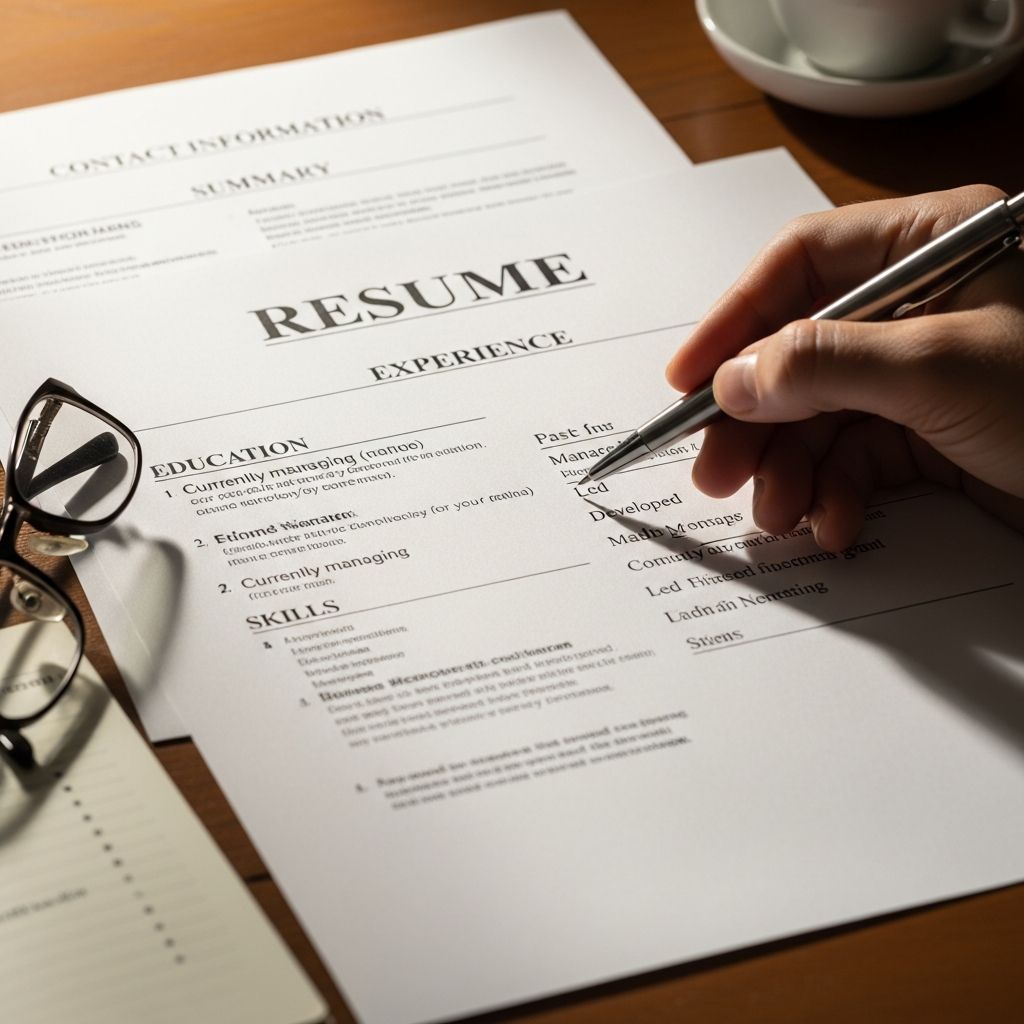
Many strong candidates lose points before a recruiter even finishes the first section of their resume—not for lack of experience, but because their verb tenses are confusing. Using past vs. present tense correctly makes your experience easier to understand and signals attention to detail, a trait employers consistently value in hiring decisions.
This guide explains, in simple terms, which tense to use where, how to handle your current job, and how to clean up an inconsistent resume.
Why Resume Verb Tense Matters More Than You Think
Verb tense on a resume does two important things:
- Sets the timeline for your experience so employers can instantly see what you do now vs. what you did in the past.
- Shows your writing accuracy, which hiring managers often interpret as a proxy for overall professionalism and care.
Career centers and resume experts routinely emphasize consistent tense as a basic standard for a polished resume, alongside spelling and formatting.
The Core Rule: Match Tense to Time
Almost every tense decision on a resume comes back to one simple rule:
- Use past tense for anything that is finished: former jobs, completed projects, completed degrees, previous leadership roles.
- Use present tense for responsibilities and activities you are doing right now in your current role or ongoing commitments.
If you are unsure which tense to choose, ask: “Is this something I still do regularly, or is it something I did and completed?”
Where to Use Past Tense on Your Resume
A large portion of your resume will naturally be in the past tense because you are describing experience you have already completed.
1. Previous jobs in your work history
Whenever you describe a job that has ended, each bullet under that role should start with a past-tense action verb, such as:
- Managed
- Developed
- Implemented
- Analyzed
- Improved
- Led
Using past tense here makes it clear to the reader that these duties and accomplishments are from a prior chapter in your career.
2. Completed education and training
Your education section usually includes static information (degrees, institutions, dates). Where verbs do appear, they should be in the past:
- Completed Bachelor of Science in Mechanical Engineering
- Earned certification in Data Analytics
This avoids confusion about whether you are still pursuing a credential that is already finished.
3. Past leadership, volunteer work, and projects
Any extracurricular roles or projects that have ended should also use past tense, even if they were unpaid or part-time:
- Coordinated weekly tutoring sessions for 25 students
- Organized fundraising event that raised $10K
- Designed and tested prototype as part of capstone project
Where to Use Present Tense on Your Resume
Present tense highlights what you are doing right now, which helps employers understand your current scope of responsibility.
1. Ongoing responsibilities in your current job
In your current position, use present tense for routine, continuing duties, especially those that match the job you want next:
- Lead cross-functional team meetings
- Manage monthly budget and reporting
- Collaborate with clients to define requirements
- Mentor junior staff members
Career services guidelines commonly recommend present tense for an active role because it accurately reflects what you still do.
2. Summary or profile section
Many resumes open with a short summary or profile. Because it describes your professional identity as it exists today, you can safely use present tense there, for example:
- “Results-driven analyst who delivers data-backed insights for business strategy.”
- “Marketing professional who builds multi-channel campaigns to increase brand awareness.”
3. Headline or professional title
If you include a short headline below your name (e.g., “Product Manager specializing in B2B SaaS”), this is also effectively present tense: it states who you are professionally at this point in time.
Can You Mix Past and Present Tense for the Same Job?
This is where many candidates get stuck. The answer is:
You may mix tenses within your current job description, but only for a clear reason.
Within your current role:
- Use present tense for ongoing responsibilities you still perform.
- Use past tense for one-time accomplishments or finished projects in that same role.
This approach is widely accepted by resume experts because it keeps your timeline accurate while still highlighting completed achievements.
Common Resume Tense Patterns (With Examples)
| Resume Section | Typical Tense | Reason |
|---|---|---|
| Contact information | None | Purely factual data (no verbs needed). |
| Headline / Title | Present | Describes who you are professionally now. |
| Summary / Profile | Present (with occasional past) | Highlights current strengths; may reference past wins. |
| Current job – ongoing duties | Present | Indicates what you currently do day to day. |
| Current job – completed projects | Past | Shows that specific initiatives are finished. |
| Previous jobs | Past | All responsibilities and results are in the past. |
| Finished degrees / certifications | Past | Clearly separates completed study from in-progress learning. |
| Current volunteer roles | Present | These are still active commitments. |
How to Fix Inconsistent Tense on Your Resume
If you have revised your resume many times, it is easy to end up with a mixture of past and present tense in the wrong places. Use this quick process to clean it up.
Step 1: Review each section separately
- Scan your current job first: mark each bullet as either an ongoing responsibility or a completed achievement.
- Check all previous roles: every bullet should start with a past-tense verb.
- Look at education and certifications: ensure completed credentials are in the past tense.
Step 2: Standardize your verbs
For each section, decide the dominant tense and adjust every bullet to match that decision, only making exceptions for completed projects within your current role.
For example, if you find bullets like:
- “Manage client accounts and implemented new reporting process”
Revise to one of the following, depending on meaning:
- “Manage client accounts and implement reporting process” (if still implementing regularly)
- “Managed client accounts and implemented reporting process” (if all activities are in the past)
Step 3: Read through from top to bottom
Once you edit individual sections, read your resume straight through, paying attention only to verbs. Look for jarring tense shifts, such as a bullet list that jumps from “Develop” to “Developed” without any reason.
Helpful Action Verbs for Each Tense
Strong resumes use concise, energetic verbs rather than weak phrases (like “was responsible for”). Many university career centers publish lists of “power verbs” to help students describe experience clearly and specifically.
Present-tense verbs for current responsibilities
- Lead
- Coordinate
- Analyze
- Design
- Negotiate
- Collaborate
- Optimize
- Train
Past-tense verbs for prior roles and completed work
- Led
- Coordinated
- Analyzed
- Designed
- Negotiated
- Collaborated
- Optimized
- Trained
Notice that many present-tense verbs simply add -ed in the past. Irregular verbs (such as “lead/led” or “grow/grew”) are worth double-checking when you proofread.
Advanced Question: Can I Use Only Past Tense for Everything?
Some career advisors note that you can choose to keep your entire resume in past tense for uniformity, even for your current job, especially if you want a very simple and consistent style.
This approach can work when:
- You have recently left your most recent role and want to emphasize a coherent story of what you did.
- Your current job is about to end, and you are positioning the resume as a snapshot of a complete chapter.
However, many modern resume-writing guidelines still prefer present tense for active roles because it better reflects your current scope of responsibility.
Proofreading Checklist for Resume Tense
Before you send your resume, use this brief checklist to catch tense errors that automated spell-check tools may miss.
- Every previous job uses past tense in all bullets.
- Your current job uses present tense for ongoing work and past tense only for clearly finished projects.
- Your summary and headline reflect your current identity and skills in present tense.
- Education clearly distinguishes completed vs. in-progress programs.
- No bullet point mixes past and present tense in the same sentence without a clear reason.
Frequently Asked Questions (FAQs)
Q: Should I ever use future tense on my resume?
No. A resume focuses on what you have done and what you are doing now, not on promises about what you will do. Stick to past and present tense, as recommended by resume-writing experts.
Q: What tense should I use if I still work somewhere but a specific project is over?
Use present tense for your ongoing responsibilities in that job, and past tense for that particular project because it is finished. This is one of the few places where mixing tenses is not only acceptable but more accurate.
Q: My degree is in progress. Do I use past or present tense?
For an in-progress program, you can list it without verbs (e.g., degree name, institution, expected graduation date). If you do use a verb, use present tense, such as “Pursuing Master of Science in…”
Q: Is it wrong to switch everything in my current job to past tense?
It is not strictly wrong, but you should be consistent throughout that section. Many career centers prefer present tense for active roles because it gives a more accurate sense of what you handle now.
Q: Do hiring managers really care about verb tense?
Hiring managers often review many resumes quickly. Clear, correct tense helps them process your experience faster and demonstrates that you pay attention to detail—an important signal in competitive hiring processes.
References
- Should You Use Past or Present Tense on Your Resume? — Jobscan. 2022-08-10. https://www.jobscan.co/blog/resume-tenses-plurals-keywords/
- Resume Verb Tense Tips to Use in 2025 — ResumeNerd. 2024-01-05. https://www.resumenerd.com/blog/resume-tense
- Past vs. Present Tense on Resumes: Best Practices — TopResume. 2023-06-15. https://topresume.com/career-advice/resume-in-past-or-present-tense
- Should I Write My Resume in Past or Present Tense? — Pongo Blog. 2010-03-19. https://www.pongoresume.com/blogPosts/425/should-i-write-my-resume-in-past-or-present-tense-.cfm
- Resume Grammar Guide — Wentworth Institute of Technology Co-ops + Careers. 2022-09-01. https://coopsandcareers.wit.edu/resources/10476/
- Resume Writing Power Verbs — University of Iowa Pomerantz Career Center. 2021-08-20. https://careers.uiowa.edu/resume-writing-power-verbs
- Resumes: General Guidelines — UC Davis Career Center. 2023-02-10. https://careercenter.ucdavis.edu/resumes-and-materials/resumes

- Integrated M.A. in Applied Linguistics, University of Hyderabad
- 5+ years in editorial, instructional, SEO, and research-based writing
Sneha is a relationships and lifestyle writer with a strong foundation in applied linguistics and certified training in relationship coaching. She brings over five years of writing experience to theskillvault, crafting thoughtful, research-driven content that empowers readers to build healthier relationships, boost emotional well-being, and embrace holistic living. Her writing and insights reflect the belief that beauty, happiness, and wellness…