
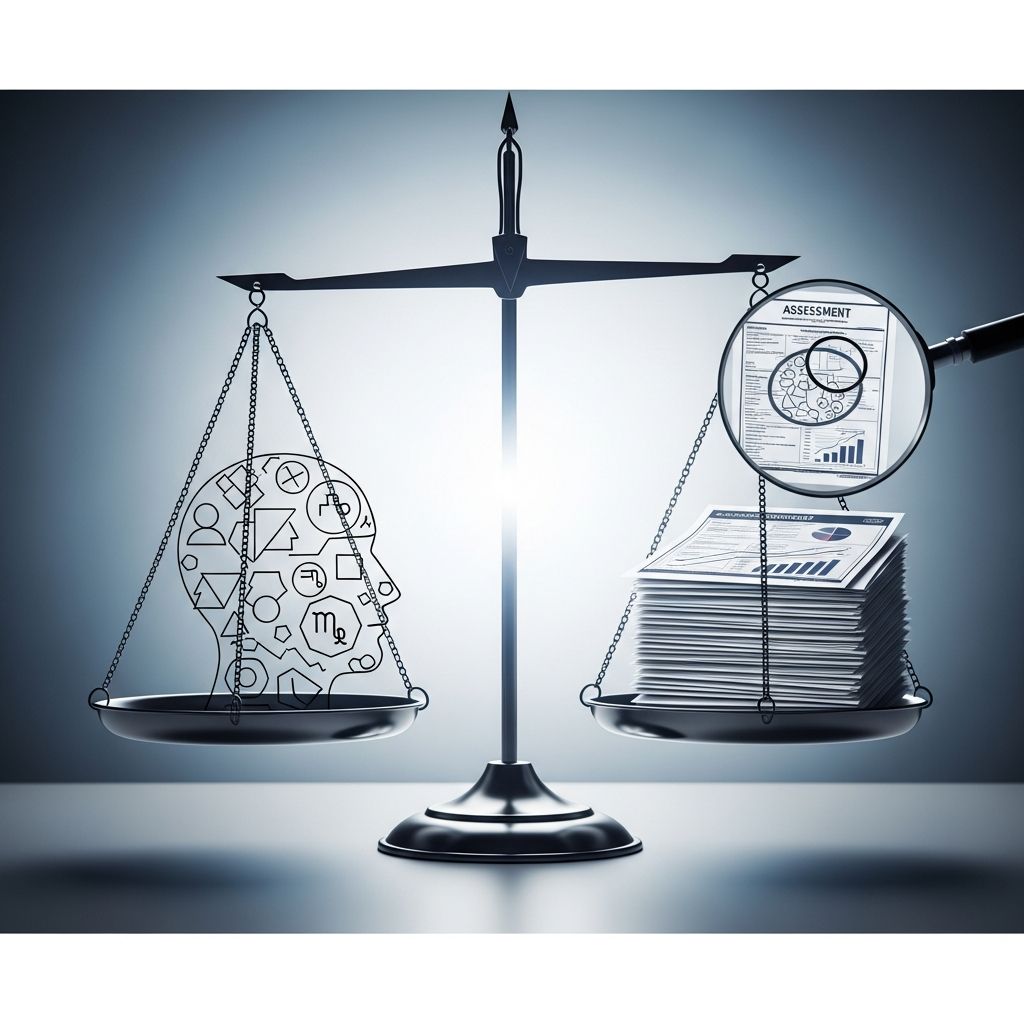
Personality tests promise insight into how we think, feel, and behave. Yet those insights are only as strong as the scientific foundations of the tools behind them. Two core concepts define this foundation: reliability and validity. Understanding these ideas helps you judge whether a personality assessment deserves your trust and how seriously to take the results.
Why Reliability and Validity Matter for Personality Tests
Psychologists treat personality assessments as measurements, in much the same way that a scale measures weight or a thermometer measures temperature. For any measurement tool to be useful, it must be:
- Consistent when used more than once under similar conditions (reliable).
- Accurate in capturing what it claims to measure (valid).
If a personality test is unreliable, its scores shift unpredictably. If it is invalid, it may measure something, but not the trait it claims to measure. In both cases, the practical value of the test—whether for self-reflection, counseling, education, or hiring—quickly erodes.
Defining Reliability: Consistency Over Time and Across Items
In psychometrics, reliability refers to the degree to which test scores are stable, consistent, and repeatable. Technically, reliability is the proportion of score variance that reflects the “true” trait rather than random error.
Main Types of Reliability in Personality Tests
Several kinds of reliability are commonly examined in personality research:
- Test–retest reliability: Do people get similar scores when they take the same test again after a reasonable time interval?
- Internal consistency: Do items that claim to measure the same trait (e.g., extraversion) hang together statistically?
- Split-half reliability: If you divide the test items into two halves, do both halves yield comparable results?
In practice, reliability is often expressed as a correlation coefficient between 0 and 1. Values of about 0.70 or higher are usually considered acceptable for research, and higher thresholds are expected when tests inform important decisions.
How Reliable Are Modern Personality Instruments?
Many widely used questionnaire-based tools, such as Big Five inventories, report internal consistency and test–retest reliability coefficients around or above the 0.70 to 0.80 range in large samples, indicating generally good stability. Meta-analytic work on established instruments like the Myers–Briggs Type Indicator (MBTI) similarly reports typical reliability values at or above common benchmarks, though with some variation across subscales and samples.
Machine-learning–based personality models (for example, those that infer traits from gait or digital behavior) are now being evaluated using analogous metrics. Studies using such models often report split-half reliability coefficients above 0.80 for core traits, suggesting that even non-questionnaire methods can achieve strong consistency when well designed.
Defining Validity: Are We Measuring What We Think We Are?
Validity concerns the extent to which test scores reflect the construct they are supposed to represent—such as extraversion, conscientiousness, or emotional stability. A test can be very reliable yet lack validity if it consistently measures the wrong thing.
Key Forms of Validity in Personality Assessment
- Content validity: Do the items adequately cover the theoretical domain of the trait (for example, sociability, activity level, and assertiveness for extraversion)?
- Construct validity: Do scores behave as theory predicts—showing the right pattern of correlations with other traits, attitudes, or behaviors?
- Criterion-related validity: Do scores meaningfully predict relevant outcomes, such as job performance, academic achievement, or well-being?
- Convergent and discriminant validity: Do scores correlate strongly with other measures of the same construct (convergent) and weakly with measures of different constructs (discriminant)?
Validity is always about evidence and argument. No single statistic proves that a test is valid; researchers assemble evidence across studies, samples, and contexts.
How Reliability and Validity Interact
Reliability and validity are related but not interchangeable. Their relationship can be summarized as follows:
| Reliability | Validity | Interpretation |
|---|---|---|
| High | High | Scores are consistent and meaningfully tied to the intended trait—ideal scenario. |
| High | Low | The test is consistent but may be measuring the wrong construct. |
| Low | High | Theoretically impossible: a measure cannot be valid on average if it is not at least reasonably reliable. |
| Low | Low | Scores are unstable and not interpretable; the test is not useful. |
Because validity places a ceiling on how useful a test can be, and reliability places a ceiling on validity, both must be evaluated together.
Factors That Influence the Reliability of Personality Scores
Personality tests are not used in a vacuum. Multiple influences shape how reliable scores will be in a given setting:
- Length and quality of the test: All else equal, longer and well-constructed scales tend to yield more reliable scores by averaging out random fluctuations.
- Clarity of items: Ambiguous or culturally specific phrasing can introduce noise, lowering reliability across diverse groups.
- Respondent characteristics: Fatigue, mood, motivation, or misunderstanding of instructions can affect item responses, especially in long surveys.
- Time interval between assessments: Shorter intervals usually produce higher test–retest correlations because true personality change is limited over brief periods.
Some sources of variation are not flaws but reflections of genuine changes in people’s lives and environments. No personality measure can or should filter out all of this meaningful change.
What Validity Looks Like in Real-World Applications
A central question for users is whether personality measures help predict real outcomes. In employment contexts, for instance, personality traits such as conscientiousness often show small-to-moderate correlations with job performance ratings and objective performance indicators. However, validity is not constant across situations.
Low-Stakes vs. High-Stakes Testing
Researchers distinguish between:
- Low-stakes settings: Participants have little incentive to distort answers (e.g., online self-discovery tools, classroom exercises).
- High-stakes settings: Results have tangible consequences (e.g., hiring, promotion, selection for programs), creating motivation to answer strategically.
Studies comparing personality test validity across contexts find that validity coefficients tend to be higher in low-stakes applications than in high-stakes ones, where impression management and faking can weaken the link between traits and outcomes. This does not mean personality tests are useless in high-stakes decisions, but it does mean results should be interpreted cautiously and supplemented with additional information.
Common Critiques of Personality Tests and How Evidence Responds
Personality assessments attract both enthusiasm and skepticism. Common critiques include the following:
- “People’s types or traits change too much to measure.” Personality is not perfectly stable, but longitudinal studies show that broad traits tend to be moderately stable from adolescence into adulthood, especially after major developmental periods. Reliability estimates typically reflect both true change and random error, and many instruments still reach accepted reliability standards.
- “Tests are just pseudoscience or entertainment.” Not all instruments are equally evidence-based. Some are primarily commercial products with limited published research. Others, including many Big Five inventories and well-documented type instruments, have manuals, peer-reviewed studies, and decades of accumulated data.
- “Results are too simplistic to capture real people.” Any structured test is a model of reality, not reality itself. Modern approaches acknowledge this by reporting scores on multiple dimensions, using continuous scales, and integrating narrative or contextual feedback to avoid overgeneralization.
The key is to differentiate between tools with documented psychometric properties and those with minimal supporting evidence. Users should look for technical manuals, independent research, and transparent discussion of limitations rather than relying solely on marketing claims.
Using Personality Tests Responsibly
Even robust instruments can be misused if their scores are treated as absolute truths. Evidence-based guidelines emphasize that personality assessments should be:
- One input among many: Especially in employment or clinical settings, test scores should complement, not replace, interviews, references, behavioral samples, or other assessments.
- Interpreted probabilistically: A score raises the likelihood that certain patterns will appear, but it does not guarantee specific behavior in every situation.
- Contextualized: The same trait can be helpful or problematic depending on job demands, culture, and situational norms.
- Explained clearly to test takers: Ethical practice includes offering understandable feedback, acknowledging uncertainty, and avoiding deterministic labels.
When used thoughtfully, personality tests can prompt self-reflection, improve communication, and inform decisions. When used rigidly, they risk stereotyping and oversimplifying complex individuals.
Practical Tips for Evaluating a Personality Test
If you are considering taking, purchasing, or relying on a personality test, the following questions can help you judge its reliability and validity:
- Does the publisher provide a technical manual or research summary that reports reliability and validity statistics?
- Have independent researchers (not only the test authors) published studies using the instrument?
- Are scales clearly defined and grounded in recognized psychological theory (such as the Big Five model)?
- Does the documentation discuss limitations, such as reduced validity in high-stakes settings, potential biases, or populations for which the test is not appropriate?
- Is the test updated periodically to reflect new findings and to improve items, scoring, or norms?
Positive answers to these questions do not guarantee perfect measurement, but they strongly suggest that the test is supported by serious psychometric work rather than being purely speculative.
Frequently Asked Questions (FAQs)
Q1: Can a personality test be valid if its reliability is only moderate?
A personality test generally needs at least moderate reliability for its scores to support valid interpretations. Low reliability adds noise, which weakens correlations with external criteria and limits how strongly you can trust the results. However, beyond a certain point, improving reliability yields diminishing returns if validity evidence is weak.
Q2: Why do my results sometimes change when I retake a test?
Score changes over time can reflect multiple factors: normal fluctuations in mood or motivation, genuine development or life changes, and measurement error. Short, poorly constructed, or highly contextual tests are more vulnerable to such variability. Well-validated instruments tend to show more stable patterns, especially over short time spans, though some change is expected.
Q3: Are employment personality tests scientifically supported?
Some employment-focused tests are grounded in robust research; others are not. Studies show that personality traits such as conscientiousness and emotional stability can predict job performance, but the strength of this prediction varies by job, industry, and stakes. Employers are encouraged to use instruments with published evidence, combine them with other methods, and avoid overreliance on any single score.
Q4: Can people fake personality tests?
Yes. In high-stakes situations, individuals sometimes present themselves in an overly favorable way. Research indicates that this can reduce the observed validity of tests in such contexts compared with lower-stakes uses. Some instruments incorporate validity indicators or response-style checks, but no method completely eliminates the possibility of faking.
Q5: How should I use my results from an online personality assessment?
Treat your scores as structured feedback rather than a fixed label. Use them to reflect on your preferences, strengths, and growth areas, and compare them with your own experiences and feedback from others. If the test is backed by research, its insights can be a valuable starting point for personal development, not a definitive verdict on who you are.
References
- Reliability and Validity of the Myers-Briggs Type Indicator® Instrument — The Myers & Briggs Foundation. 2023-01-01. https://www.myersbriggs.org/research-and-library/validity-reliability/
- Reliability and validity analysis of personality assessment model based on gait video — Ding et al., Frontiers in Psychology. 2022-07-07. https://www.ncbi.nlm.nih.gov/pmc/articles/PMC9380895/
- Reliability and External Validity of Personality Test Scores: The Role of Person and Item Error — Ferrando et al., Psicothema. 2022-01-01. https://www.psicothema.com/pdf/4672.pdf
- Can You Trust Personality Tests? — Scott Barry Kaufman, Psychology Today. 2022-02-16. https://www.psychologytoday.com/us/blog/people-unexplained/202202/can-you-trust-personality-tests
- The Psychology Behind Personality Tests — Excelsior University. 2021-10-20. https://www.excelsior.edu/article/pyschology-of-personality-tests/
- Personality Test Validity Differs Between Low-Stakes and High-Stakes Settings — Sánchez et al., International Journal of Selection and Assessment. 2020-12-01. https://onlinelibrary.wiley.com/doi/10.1111/ijsa.12290

- Integrated M.A. in Applied Linguistics, University of Hyderabad
- 5+ years in editorial, instructional, SEO, and research-based writing
Sneha is a relationships and lifestyle writer with a strong foundation in applied linguistics and certified training in relationship coaching. She brings over five years of writing experience to theskillvault, crafting thoughtful, research-driven content that empowers readers to build healthier relationships, boost emotional well-being, and embrace holistic living. Her writing and insights reflect the belief that beauty, happiness, and wellness…