
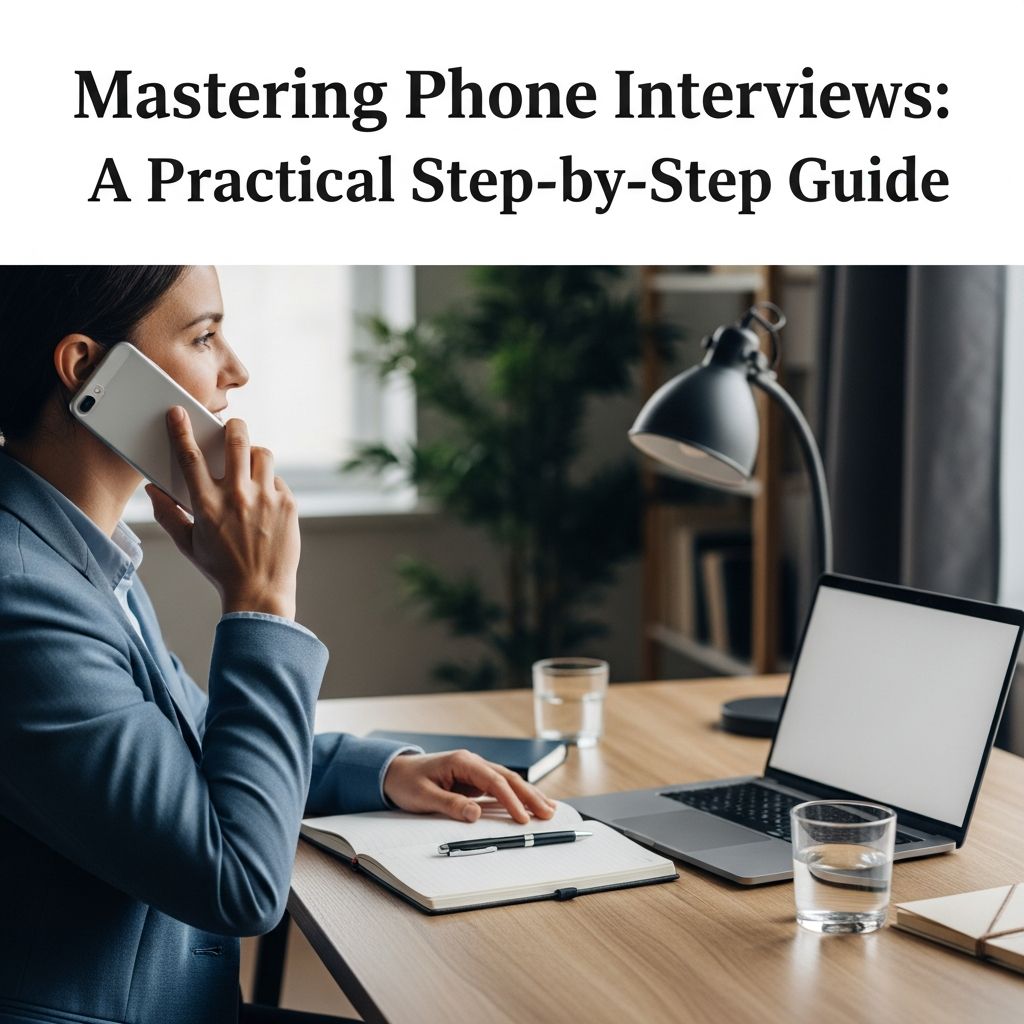
Phone interviews are often the first real conversation you have with an employer—and they frequently decide whether you advance to the next stage. Treating them as casually as a quick chat can cost you opportunities, but with the right preparation and mindset, they can become one of your strengths.
This guide walks you through how to prepare before the call, what to do during the conversation, and how to follow up afterward so you present yourself as a focused, thoughtful, and well-qualified candidate.
Why Phone Interviews Matter More Than You Think
Many employers use phone interviews to efficiently screen large pools of applicants and narrow down candidates for more time-intensive onsite or video interviews. Recruiters are often evaluating whether you meet basic qualifications, can communicate clearly, and genuinely understand and want the role.
Because this stage is comparatively short and structured, small choices—where you take the call, whether you prepared examples in advance, how clearly you speak—can make an outsized difference in how you are evaluated.
Stage 1: Preparing Before the Phone Rings
Thoughtful preparation reduces anxiety and frees up mental energy so you can listen carefully and respond convincingly. Use this checklist to get ready.
Clarify the Logistics
Start by eliminating preventable confusion about when and how the call will happen. Confirm the basics in writing if possible:
- Interview date and exact time, including time zone
- Who is calling (name, role, and pronunciation if you can find it)
- Which phone number will be used for the call
- Expected duration of the conversation
- Whether it will be audio only or include video or screensharing
Knowing these details ahead of time helps you avoid last-minute scrambling and presents you as organized and reliable.
Research the Role and Employer
Recruiters and hiring managers expect you to have a basic understanding of the organization and position. Candidates who have done even moderate research stand out as more engaged and better prepared.
Focus on:
- Organization overview: mission, products or services, size, and locations
- Recent developments: major announcements, funding news, or strategic initiatives from credible news outlets
- Role specifics: required skills, responsibilities, and how success is measured, based on the job posting
- Team context: where the role likely sits in the organization (look at official org or department pages if available)
As you research, note language the organization uses to describe its goals and culture, and think about where your experience aligns with those themes.
Build a One-Page Interview Guide
Instead of scattered notes, create a concise reference sheet you can glance at during the call without losing focus. Aim for one page (digital or printed) with:
- 3–5 bullet points summarizing why you are a strong fit for this specific role
- Short bullet reminders of key accomplishments matched to the job requirements
- Quick facts about the company and role that you want to mention
- Prepared questions you plan to ask at the end
A brief guide keeps you grounded but still forces you to speak naturally rather than reading verbatim.
Prepare Answers to Core Questions
Phone interviews often cover a predictable set of topics: your background, interest in the role, and evidence that you meet the requirements. University and career-services guidance recommends preparing for common questions like:
- “Tell me about yourself”
- “Why are you interested in this position and our organization?”
- “What are your strengths and areas for growth?”
- “Can you describe a recent accomplishment that is relevant to this role?”
- “What are your salary expectations?” (depending on local regulations)
Use a structured approach—such as the STAR method (Situation, Task, Action, Result)—to organize your examples so they are specific and concise. Practice out loud until your responses feel clear, confident, and not over-rehearsed.
Set Up a Professional Environment
Because you cannot rely on body language or eye contact, distractions and background noise become more noticeable. Career centers and professional staffing agencies consistently advise choosing a quiet, private location for telephone interviews.
Before the scheduled time:
- Pick a space with a strong phone signal or reliable landline
- Close doors and windows to reduce noise from traffic or roommates
- Silence other devices and disable notifications
- Let others in your home know you will be unavailable
If you have pets or other potential distractions, plan ahead so they will not interrupt your conversation.
Gather Tools and Documents
Have everything you might need within arm’s reach so you are not rustling through papers mid-call.
- Copy of the job description
- Current resume and any portfolio or project list
- Your one-page interview guide
- Notepad and pen or a blank document for quick notes
- Charged phone, headset or headphones if preferred, and a glass of water
Many candidates find that using a headset frees their hands for note-taking and improves audio clarity, which can help you focus more fully on the discussion.
Test Your Technology
A dropped call or poor audio can disrupt the flow of the interview and create unnecessary stress. Basic tech checks—like confirming that your phone is fully charged, your ringer is on, and your microphone is working—are strongly recommended by university career services and professional recruiters.
About 30–60 minutes before the call:
- Ensure your phone is charged and plugged in if possible
- Test your signal by making a short call to a friend or family member
- Confirm that your voicemail is set up and has a clear, professional greeting
- If you will use an app or VOIP service, test it in the same location
Stage 2: Showing Up Strong During the Call
Once the phone rings, your focus shifts from preparation to execution. The goal is to communicate clearly, listen actively, and demonstrate that you understand and can succeed in the role.
Start With a Polished Introduction
Your first few seconds set the tone of the conversation. When you answer, sit or stand upright and respond professionally. For example, you might answer with your name and a friendly greeting. Recruiters often infer enthusiasm and confidence from your opening moments.
Be ready for common opening prompts such as “How are you today?” or “Did I catch you at a good time?” Respond briefly, then transition to the interview itself so the conversation begins smoothly.
Use Your Voice Intentionally
On the phone, your voice carries nearly all of your nonverbal communication. Research in communication studies has shown that tone, pace, and emphasis strongly influence how listeners perceive confidence and warmth, even when they cannot see you.
Practical techniques include:
- Sit or stand up straight: This naturally opens your lungs and helps you project.
- Smile while you speak: Listeners often report that smiling is audible and conveys approachability.
- Control your pace: Slightly slower than everyday conversation usually sounds clearer.
- Pause deliberately: Brief pauses before answering allow you to think and signal that you are considering the question carefully.
Answer Questions With Clear, Structured Stories
Instead of vague statements, provide concrete examples that demonstrate your skills. Hiring guidance from universities and professional organizations encourages candidates to use specific past experiences to show how they meet the job requirements.
A simple structure you can use for behavioral questions:
- Context: Set the scene briefly (where you were, what the situation was).
- Challenge: Describe the problem or objective you faced.
- Action: Explain what you did, emphasizing your contribution.
- Result: Share the outcome and, if possible, quantify it.
End by connecting the story back to the role: explain how the skills you demonstrated are directly relevant to what this employer needs.
Practice Active Listening
Strong listening skills are often as important as strong speaking skills. Career services resources emphasize that candidates should avoid multitasking, repeat or paraphrase key points, and ask clarifying questions when needed.
During the call:
- Give verbal cues (“I see,” “That makes sense”) to show you are engaged
- Write down important phrases the interviewer uses about priorities or challenges
- Confirm your understanding before answering complex questions
- Avoid interrupting; wait for a clear pause before responding
Your notes will also help you tailor later answers and shape thoughtful follow-up emails.
Handle Challenging Topics Professionally
Certain topics—such as gaps in employment, reasons for leaving a job, or salary expectations—can feel stressful. Plan a simple, honest framing ahead of time. Many public-sector and academic career guides recommend focusing on what you learned, how you have grown, and how you are now prepared to contribute, rather than dwelling on setbacks.
For salary questions, be aware of any local laws affecting what employers can ask, and consider offering a researched range when appropriate, based on credible compensation data sources.
Ask Insightful Questions
Toward the end of the call, you will usually have an opportunity to ask your own questions. This is not just a formality; your questions signal how thoughtfully you are approaching the role.
Consider asking about:
- How success in the role will be evaluated in the first 6–12 months
- Key projects or priorities for the team this year
- How this position interacts with other teams or departments
- The typical next steps and timeline for the hiring process
Have more questions prepared than you expect to use, then choose the most relevant based on what you have learned during the conversation.
Stage 3: Following Up After the Interview
What you do after the call can reinforce a positive impression and clarify any points you wish you had expressed differently.
Organize Your Notes Immediately
Soon after you hang up, take a few minutes to expand your quick notes into something more complete while the details are still fresh. Include:
- Names and roles of everyone you spoke with
- Responsibilities or priorities they emphasized
- Any skills or experiences they seemed particularly interested in
- Clarifications you might want to offer in a later round
This record will be extremely useful if you advance to subsequent interviews or if you apply for another role at the same organization later.
Send a Thoughtful Thank-You Message
Many career services offices advise sending a brief thank-you note within 24 hours of an interview, expressing appreciation for the interviewer’s time and reaffirming your interest.
In your message:
- Thank the interviewer for speaking with you
- Mention a specific topic or insight from the conversation
- Restate one or two reasons you believe you are a strong fit
- Indicate that you look forward to hearing about next steps
Keep the tone professional but warm, and proofread carefully for spelling and grammar errors.
Evaluate the Opportunity for Yourself
The interview is not only about the employer evaluating you; it is also your chance to evaluate whether the position aligns with your goals and values. After the call, reflect on:
- Whether the responsibilities match what you are looking for
- How the interviewer described the team culture and management style
- Any potential concerns you may want to raise in later stages
Writing down your impressions can help you make clear decisions if you receive multiple offers or invitations to proceed.
Quick Comparison: In-Person vs. Phone Interview Strategy
| Aspect | In-Person Interview | Phone Interview |
|---|---|---|
| Nonverbal communication | Body language, eye contact, appearance | Tone of voice, pacing, word choice |
| Environment control | Employer’s space; less control for candidate | Candidate’s chosen space; must manage noise and signal |
| Use of notes | Limited; visible note-reading can be distracting | Extensive; notes are invisible but must not be read word-for-word |
| Energy management | Physical presence and gestures help show enthusiasm | Must convey enthusiasm entirely through voice |
| Technical risks | Minimal, aside from rare disruptions | Call quality, dropped calls, or device issues must be managed |
Frequently Asked Questions About Phone Interviews
Q: How long does a typical phone interview last?
A: Many initial phone screens last between 20 and 45 minutes, though some can be shorter or longer depending on the role and number of questions.
Q: Is it acceptable to refer to notes during a phone interview?
A: Yes. One advantage of phone interviews is that you can have notes in front of you. Keep them to concise bullet points and avoid reading full sentences so you still sound natural and conversational.
Q: What should I do if the connection is poor or the call drops?
A: If audio quality is bad, politely mention that you are having trouble hearing and suggest calling back or switching numbers. If the call disconnects, wait briefly for the interviewer to reconnect; if they do not, call or email using the contact information provided in your invitation.
Q: How early should I be ready for the interview?
A: Being fully set up 10–15 minutes before the scheduled time gives you a buffer to settle in, review your notes, and handle any last-minute issues without feeling rushed.
Q: Can I take the call from my car?
A: While a parked car can sometimes be a quiet space, it introduces risks such as unstable cellular reception and background noise. Whenever possible, choose an indoor location with reliable signal and minimal distractions.
References
- Phone Interview Tips — Ohio Northern University Career & Professional Development. 2020-01-01. https://my.onu.edu/sites/default/files/phone_interview_tips.pdf
- 25 Phone Interview Tips To Get You to the Next Round — Indeed Editorial Team. 2022-08-12. https://www.indeed.com/career-advice/interviewing/phone-interview-tips-to-get-you-to-the-next-round
- Phone Interview — San José State University School of Information. 2018-09-01. https://ischool.sjsu.edu/phone-interview
- Phone interview tips and preparation advice — Hays Recruitment. 2021-04-15. https://www.hays.com.au/career-advice/interview-tips/phone-interview-tips
- Interview tips: How to nail a phone screen — NRG Consulting Group. 2020-06-10. https://www.nrgconsulting.group/nrg-newsletter/interview-tips-how-to-nail-a-phone-screen
- Communication in Organizations — R. L. Daft, Organization Theory and Design, Cengage Learning. 2015-01-01. https://doi.org/10.4324/9781315662932
- 22 Phone Interview Tips to Help You Nail the Call — The Muse. 2021-03-03. https://www.themuse.com/advice/phone-interview-tips-preparation

- Integrated M.A. in Applied Linguistics, University of Hyderabad
- 5+ years in editorial, instructional, SEO, and research-based writing
Sneha is a relationships and lifestyle writer with a strong foundation in applied linguistics and certified training in relationship coaching. She brings over five years of writing experience to theskillvault, crafting thoughtful, research-driven content that empowers readers to build healthier relationships, boost emotional well-being, and embrace holistic living. Her writing and insights reflect the belief that beauty, happiness, and wellness…