
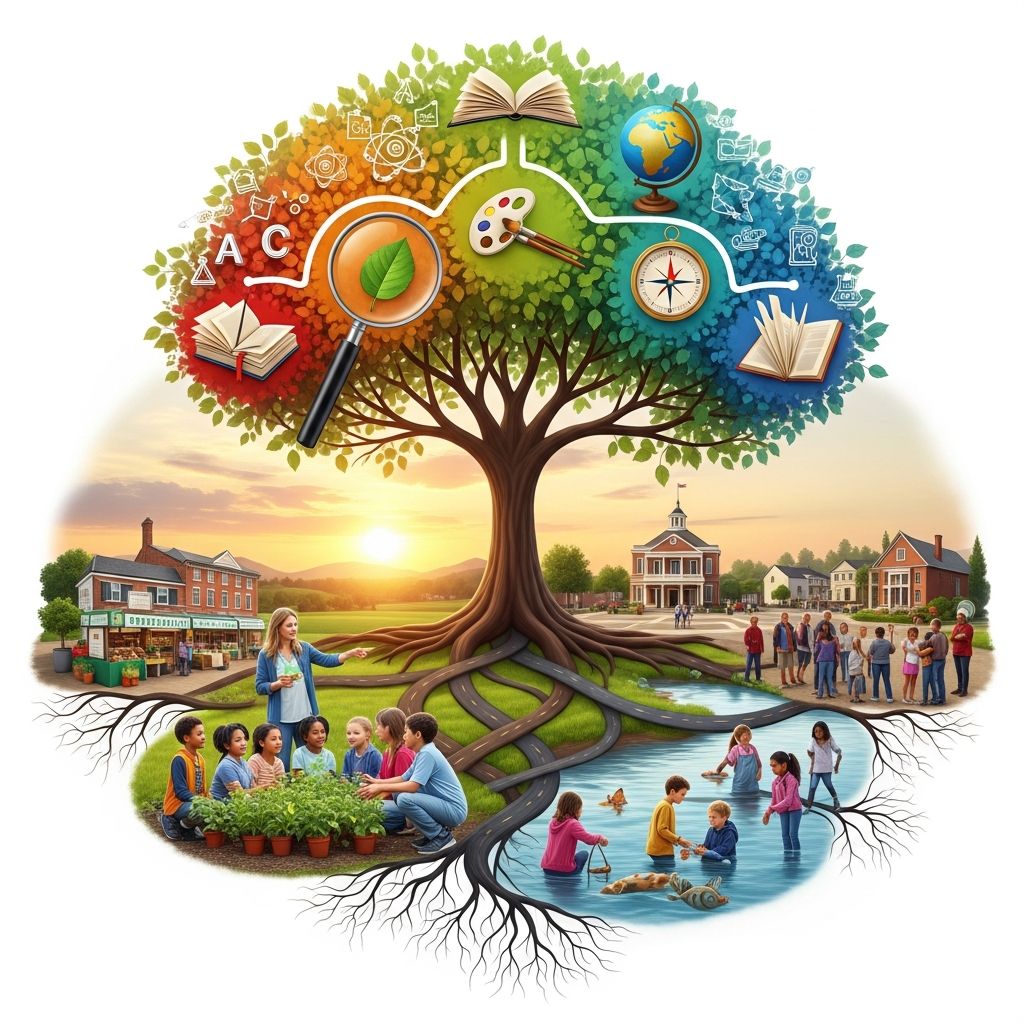
Understanding Place-Based Education and Its Importance
Place-based education represents a transformative approach to teaching that anchors learning experiences in the tangible environments and communities where students live. Also recognized as localized learning or the pedagogy of place, this educational methodology emerged prominently in the 1990s and has experienced renewed interest, particularly following the COVID-19 pandemic when outdoor and community spaces became essential learning environments.
This educational framework fundamentally reimagines the traditional classroom by replacing generic, distant scenarios with immediate, relevant local contexts. Rather than treating knowledge as abstract information to be memorized, place-based education positions students as active explorers of their own surroundings, discovering how academic concepts directly apply to the places they inhabit and the communities they belong to.
The core premise rests on a simple yet powerful principle: when students see tangible connections between their education and their immediate world, learning becomes more meaningful, engaging, and retained. This approach transcends grade levels, working effectively across K-12 institutions and higher education settings.
How Place-Based Learning Empowers Student Agency
One of the most significant advantages of place-based education lies in its capacity to restore genuine voice and choice to learners. Rather than passively receiving information dictated by curriculum standards or textbook publishers, students participate actively in determining what subjects fascinate them, how they wish to investigate these topics, when they engage in learning activities, and where their investigations will take place.
This student-centered approach fundamentally alters the teacher’s role from knowledge deliverer to learning facilitator. Educators shift into positions where they guide inquiry, connect students with community resources, and help learners navigate their investigations—rather than controlling every aspect of instruction.
The personalization inherent in place-based education ensures that learning pathways align with each individual student’s strengths, interests, and needs. This tailored approach maintains academic rigor and ensures students master high academic standards while experiencing education as personally relevant rather than generic or imposed.
Implementing a Concentric Rings Framework
Understanding how to launch place-based initiatives becomes less daunting when educators conceptualize implementation through a concentric-rings model, often called the Local-to-Global Model. This framework suggests that exploration of “place” begins intimately with students reflecting on themselves and their individual roles within their immediate surroundings.
The implementation process expands outward through successive circles:
- Students first develop awareness of their personal identity and agency
- Learning extends to their immediate classroom environments
- Understanding broadens to encompass their schools and local institutions
- Perspective widens to include their neighborhoods and communities
- Awareness eventually reaches regional and global scales
A practical illustration of this model involves students examining their school’s electricity consumption across different seasons. Through observation and interviews, they discover elevated energy use during winter months. This observation leads to experimentation with insulation materials and ultimately results in students designing and installing door insulators—a tangible solution that emerged from their investigation of a local place-based problem.
Core Design Principles That Guide Place-Based Learning
Effective place-based learning initiatives rest upon foundational design principles that inform how educators structure experiences. These principles ensure that place-based activities remain rigorous, inclusive, and genuinely connected to meaningful community engagement.
Community as Extended Classroom: This principle reconceptualizes the notion of “classroom” itself. Rather than confining learning to four walls, communities become learning ecosystems where local experts, authentic experiences, and specific places form an expanded educational environment. Local business owners, environmental specialists, community leaders, and other professionals serve as educators alongside classroom teachers.
Integration Across Traditional Subjects: Place-based learning naturally mirrors how knowledge operates in real-world contexts—not compartmentalized into separate subjects but integrated across disciplines. An investigation into local water quality, for example, weaves together biology, chemistry, mathematics, writing, civic engagement, and social science simultaneously. This interdisciplinary approach ensures that traditional subject-area content, skills, and dispositions emerge authentically through project-based work where all learners participate actively.
Additional design principles include inquiry-based investigation, service learning components, sustainable connections with places, and structures that ensure equitable access and inclusion for all learners.
Pathways to Getting Started With Place-Based Initiatives
Educators beginning their place-based journey often feel overwhelmed by the infinite possibilities for implementation. Breaking the process into manageable first steps provides clarity and direction.
Step One: Clarify Your Starting Point
Recognize that place-based education manifests differently across diverse contexts—urban classrooms look entirely different from rural schools, which differ from museum-based programs or international implementations. Rather than attempting to replicate someone else’s vision, identify what already exists in your specific context that can serve as a foundation.
Consider the assets, challenges, and unique characteristics of your particular place. What environmental features define your area? What community organizations already exist? What issues matter most to your students and their families? Answering these questions helps educators build place-based initiatives that genuinely reflect their specific communities rather than generic templates.
Step Two: Study the Foundational Principles
Before designing specific units or projects, educators benefit from deep familiarity with place-based learning design principles. These principles serve as guardrails, ensuring that place-based activities remain educationally sound while maintaining authentic community connections. Reviewing project examples for each principle helps educators envision concrete applications.
Step Three: Construct Your Community Partnership Infrastructure
Successful place-based learning depends on genuine relationships with community members and organizations. Rather than leaving this to chance, educators intentionally build networks of potential collaborators. This might involve reaching out to local businesses, nonprofits, government agencies, parent volunteers, and individual experts. Creating templates for initial outreach, involving students in relationship-building, and maintaining organized records of potential partners transforms this task from overwhelming to manageable.
Finding collaborators requires deliberate effort and time investment, but the resulting community partner database becomes an invaluable resource for future initiatives. Many educators discover that involving students in identifying and contacting potential partners serves as an educational experience in itself.
Building Sustainable Community Partnerships
Place-based education fundamentally depends on authentic relationships with community members who serve as educators, experts, and collaborators. Moving beyond surface-level guest speakers to genuine partnerships requires intentional structures and ongoing communication.
Educators implementing place-based approaches benefit from:
- Creating dedicated time for team building among school staff, students, and community partners
- Engaging in professional learning together to deepen shared understanding of place-based approaches
- Implementing bias-checking processes that ensure diverse perspectives inform program design
- Connecting with other educators pursuing similar work for inspiration and problem-solving support
- Fundraising strategically to support in-person community visits and virtual connections
Researching established place-based programs—whether nearby or distant—provides valuable insights. Conversations with educators leading similar initiatives can reveal both possibilities and potential obstacles, helping new programs avoid common pitfalls.
Diverse Applications Across Settings and Contexts
Place-based education adapts remarkably well across varied environments and educational contexts. Implementation might involve outdoor field experiences in parks or nature preserves, urban investigations of city systems and institutions, museum-based explorations, state and national park collaborations, early childhood outdoor play, collegiate research projects, or even virtual experiences that connect distant communities.
In urban settings, students might investigate local food systems, analyze water infrastructure, examine architectural history, or engage in community service projects. Rural programs might emphasize agricultural science, wildlife management, water conservation, or local economic development. Regardless of geographic context, place-based learning leverages local characteristics and expertise.
Integrating Indoor and Outdoor Learning Experiences
A common misconception suggests that place-based education requires constant outdoor activity. In reality, effective programs seamlessly blend indoor and outdoor experiences, each reinforcing the other.
Indoor classroom time might involve analyzing maps of the local area before field investigations, processing data collected during community work, developing presentations of findings, or creating written analyses of observations. These activities build essential academic skills and theoretical understanding that make outdoor investigations richer and more purposeful. Conversely, outdoor experiences provide authentic contexts that illuminate concepts initially explored indoors.
This hybrid approach ensures that place-based learning remains academically rigorous while maintaining authentic community connections. Students develop both conceptual understanding and practical skills through varied environments and learning modalities.
Citizen Science and Broader Community Engagement
Place-based education frequently incorporates citizen science initiatives that extend learning beyond individual classrooms into broader community scientific efforts. Students using applications like iNaturalist document local flora and fauna, contributing observations to global databases while developing place-based knowledge. Similarly, programs like Monarch Watch invite students to submit monarch tagging data, connecting their investigations to international conservation efforts.
These initiatives simultaneously serve educational and scientific purposes—students develop research skills and ecological understanding while contributing to genuine scientific endeavors that benefit their communities and the broader environment.
Frequently Asked Questions
Q: How does place-based education differ from traditional project-based learning?
A: While both approaches emphasize active student engagement through projects, place-based education specifically anchors learning in local communities and environments. Project-based learning can employ any context, whereas place-based learning intentionally uses the immediate place—its geography, culture, institutions, and challenges—as the curriculum foundation.
Q: Can place-based education work effectively in urban environments?
A: Absolutely. Urban settings offer rich opportunities for place-based learning through investigations of city systems, local institutions, neighborhood history, environmental challenges, and community organizations. Urban place-based education looks different from rural approaches but proves equally effective.
Q: What role do teachers play in place-based education?
A: Teachers transition from knowledge deliverers to learning facilitators. They help students formulate meaningful questions, connect with community experts, navigate investigations, and synthesize learning. Teachers remain actively engaged but guide rather than control student inquiry.
Q: How does place-based education maintain academic rigor?
A: Place-based learning ensures mastery of high academic standards by embedding subject-area content, skills, and dispositions within authentic, interdisciplinary investigations. Students develop stronger conceptual understanding because they see direct applications and relevance.
Q: Can place-based education work for younger elementary students?
A: Yes, place-based education works effectively across K-12 levels. Early childhood programs benefit from outdoor play and environmental exploration that develop sensory awareness and foundational ecological understanding.
Q: What if my school lacks nearby natural areas?
A: Place-based education adapts to any context. Urban schools investigate city systems, neighborhoods, and institutions. All communities possess local characteristics, businesses, organizations, and challenges that can become curriculum foundations.
Q: How much time does place-based learning require for implementation?
A: Place-based education exists on a continuum from small classroom activities featuring local landscapes or species to full semester programs immersing students in community investigations. Educators can start small with individual lessons or projects and gradually expand scope.
References
- Place-Based Learning — Solution Tree. 2024. https://www.solutiontree.com/place-based-learning.html
- Getting Started With Place-Based Education, Step-by-Step — Teton Science Schools. 2024. https://www.tetonscience.org/getting-started-with-place-based-education-step-by-step/
- Quick Start Guide to Implementing Place-Based Education — Getting Smart/Teton Science Schools. 2017. http://www.gettingsmart.com/wp-content/uploads/2017/02/Quick-Start-Guide-to-Implementing-Place-Based-Education.pdf
- 4 Steps to Establishing a Place-Based Learning Program — Edutopia. 2024. https://www.edutopia.org/article/creating-place-based-learning-program/
- What is Place-Based Education? A Beginner’s Guide for Teachers — Population Education. 2024. https://populationeducation.org/what-is-place-based-education-a-beginners-guide-for-teachers/
- Place-Based Learning — Environmental Education Alliance of Georgia. 2024. https://www.eealliance.org/place-based-learning.html
- Place-Based Education — David Sobel. 2024. https://www.davidsobelauthor.com/place-based-education

Medha Deb is an editor with a master's degree in Applied Linguistics from the University of Hyderabad. She believes that her qualification has helped her develop a deep understanding of language and its application in various contexts. Medha specializes in the areas of beauty, health, sports, and wellness and is committed to ensuring that the content on the website is…