
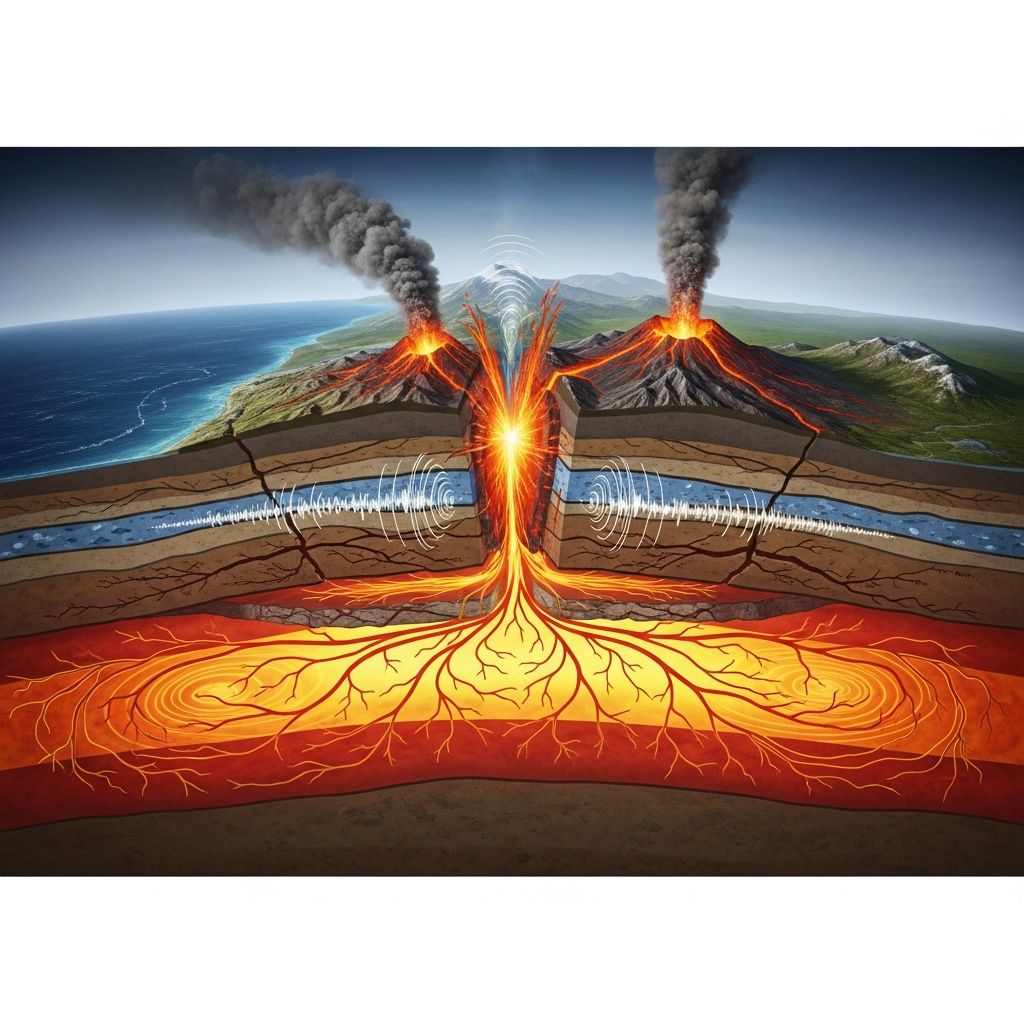
Plate tectonics is the unifying theory explaining the movement of Earth’s outer shell, responsible for shaping continents, oceans, mountains, and triggering most geological hazards. This framework reveals why our planet’s surface is in constant, slow motion, with plates drifting at rates comparable to human nail growth.
The Lithosphere and Its Fragmented Plates
Earth’s outermost layer, known as the **lithosphere**, consists of the crust and the uppermost mantle, forming a rigid shell approximately 50 to 100 kilometers thick. This layer is broken into about a dozen large plates and several smaller ones, which float atop the softer, ductile **asthenosphere** beneath.
These tectonic plates vary in size; major ones like the Pacific Plate span vast ocean basins, while others carry continents. Oceanic plates, underlain by thinner basaltic crust, are denser and younger, contrasting with thicker, less dense continental plates topped by granitic crust. Plates move relative to each other at 1 to 16 centimeters per year, driven by mantle processes.
- Major Plates: African, Antarctic, Eurasian, Indo-Australian, North American, Pacific, South American.
- Key Minor Plates: Arabian, Caribbean, Nazca, Scotia.
- Plate boundaries define interaction zones, hosting 90% of earthquakes and most volcanoes.
Mechanisms Powering Plate Movement
The primary driver of plate motion is **mantle convection**, where heat from Earth’s core—mainly from radioactive decay—causes hot mantle material to rise, cool, and sink in cyclical currents. This ‘conveyor belt’ propels plates across the surface.
Two dominant forces amplify this: slab pull, where dense, cooling oceanic lithosphere sinks into the mantle at subduction zones, dragging the plate behind; and ridge push, where elevated mid-ocean ridges gravitationally slide plates apart. These mechanisms outweigh basal drag from the asthenosphere.
| Driving Force | Description | Impact on Motion |
|---|---|---|
| Mantle Convection | Heat-induced circulation in asthenosphere | Primary global driver |
| Slab Pull | Sinking of cold oceanic slabs | Strongest force, up to 70% of motion |
| Ridge Push | Gravity on new crust at ridges | Secondary pusher |
Three Core Types of Plate Boundaries
Interactions at plate edges create distinct boundaries, each producing unique geological features. These zones recycle crust, maintaining Earth’s surface area constant via a balance of creation and destruction.
Divergent Boundaries: Birth of New Crust
At divergent boundaries, plates pull apart, allowing magma to rise and form new oceanic crust through **seafloor spreading**. The Mid-Atlantic Ridge exemplifies this, where the Eurasian and North American plates separate, widening the Atlantic Ocean at 2.5 cm/year.
- Rift valleys form on continents, like East Africa’s Great Rift Valley.
- Underwater, they create ridge systems with frequent shallow earthquakes and basaltic volcanism.
Convergent Boundaries: Collision and Subduction
Convergent boundaries occur where plates collide. Denser oceanic plates subduct beneath lighter ones, forming deep trenches and volcanic arcs. Examples include the Peru-Chile Trench and Cascade volcanoes.
Continental collisions, sans subduction due to buoyancy, crumple crust into towering ranges like the Himalayas, where India indents Eurasia at 5 cm/year.
- Ocean-Ocean: Island arcs (e.g., Japan, Aleutians).
- Ocean-Continent: Andean volcanoes, trenches.
- Continent-Continent: Fold mountains, no subduction.
Transform Boundaries: Lateral Sliding
Transform boundaries feature plates grinding sideways, neither creating nor destroying crust. The San Andreas Fault in California marks the Pacific-North American plate boundary, causing destructive quakes like 1906 San Francisco.
These faults offset ridges and produce shallow, high-magnitude earthquakes with minimal volcanism.
Geological Consequences and Hazards
Plate tectonics orchestrates Earth’s dynamic geology. Over millions of years, it has reassembled supercontinents like Pangaea and sculpted modern geography.
- Mountain Building (Orogeny): Compression folds rock into ranges.
- Volcanism: Subduction melts mantle, feeding stratovolcanoes.
- Earthquakes: Sudden stress release along faults.
- Ocean Basins: Spreading widens seas; subduction narrows them.
The ‘Ring of Fire’ encircling the Pacific hosts 75% of active volcanoes and 90% of earthquakes due to dense plate interactions.
Historical Evolution of the Theory
Alfred Wegener proposed **continental drift** in 1912, noting jigsaw-fit continents, fossil matches, and rock correlations. Dismissed initially for lacking a mechanism, the theory revived post-WWII with seafloor mapping.
Harry Hess’s 1960s seafloor spreading idea, coupled with symmetrical magnetic stripes on ocean floors (vine-matthews hypothesis), and J. Tuzo Wilson’s transform faults solidified plate tectonics by 1968. Today, GPS confirms motions precisely.
Plate Tectonics and Life on Earth
Beyond geology, tectonics influences climate, evolution, and habitability. Continental positions affect ocean currents and weather; mountains drive erosion, nutrient cycling, and biodiversity hotspots.
Long-term carbon cycling via subduction-volcanism regulates CO2, stabilizing climate. Abrupt events like supervolcanoes or megathrust quakes impact societies, underscoring monitoring needs.
Frequently Asked Questions (FAQs)
What causes Earth’s plates to move?
Mantle convection from internal heat, aided by slab pull and ridge push, drives plate motion at 1-16 cm/year.
How many major tectonic plates exist?
Seven to eight primary plates, plus numerous minor ones, comprise the lithosphere.
Why is the Pacific Ring of Fire so active?
Multiple plates subduct around the Pacific, fueling intense seismicity and volcanism.
Can plate tectonics predict earthquakes?
Not precisely, but boundaries forecast high-risk zones; monitoring tracks strain buildup.
Will continents merge again?
Yes, models predict a future supercontinent in 250 million years as the Atlantic closes.
References
- Plate tectonics – Wikipedia — Wikipedia contributors. 2026 (continuously updated). https://en.wikipedia.org/wiki/Plate_tectonics
- Plate tectonics | Definition, Theory, Facts, & Evidence — Encyclopædia Britannica. 2026 (accessed). https://www.britannica.com/science/plate-tectonics
- This Dynamic Planet — U.S. Geological Survey. 2024-04-01. https://volcanoes.usgs.gov/about/edu/dynamicplanet/nutshell.php
- Plate Tectonics – Understanding Global Change — University of California, Berkeley. 2023-09-15. https://ugc.berkeley.edu/background-content/plate-tectonics/
- Continental Movement by Plate Tectonics — University of Hawai’i at Mānoa. 2025-02-20. https://manoa.hawaii.edu/exploringourfluidearth/physical/ocean-floor/continental-movement-plate-tectonics

- Integrated M.A. in Applied Linguistics, University of Hyderabad
- 5+ years in editorial, instructional, SEO, and research-based writing
Sneha is a relationships and lifestyle writer with a strong foundation in applied linguistics and certified training in relationship coaching. She brings over five years of writing experience to theskillvault, crafting thoughtful, research-driven content that empowers readers to build healthier relationships, boost emotional well-being, and embrace holistic living. Her writing and insights reflect the belief that beauty, happiness, and wellness…