
Understanding the Foundation of Strategic Task Organization
In today’s fast-paced work environment, professionals face an overwhelming number of demands competing for their attention. Without a structured approach to managing these demands, even the most capable individuals can find themselves scattered, reactive, and ultimately less productive. A priority matrix serves as a powerful antidote to this chaos by providing a systematic visual framework for organizing and categorizing work based on meaningful criteria.
At its essence, a priority matrix is a two-dimensional grid that plots tasks or projects against two carefully selected variables. This visual tool transforms vague notions of importance into concrete, objective assessments that enable more strategic decision-making. Rather than relying on gut feelings or external pressures to determine what deserves your attention, a priority matrix forces thoughtful evaluation of each item on your plate.
The Mechanics Behind Effective Prioritization Frameworks
The fundamental strength of priority matrices lies in their ability to organize information visually. Most matrices operate on a four-quadrant system, though some sophisticated variations expand to accommodate more nuanced categorization. Each quadrant represents a distinct combination of your two chosen criteria, creating natural groupings that suggest different action strategies.
The beauty of this approach is its flexibility. Depending on your specific context and challenges, you can choose virtually any pair of variables to serve as your axes. Some professionals prioritize based on urgency versus importance, while others might focus on effort required versus potential impact. A marketing team might use value versus complexity, while a technology department could employ business criticality against current performance gaps.
The Four-Quadrant System Explained
The standard four-quadrant matrix creates natural categories that map directly to action strategies:
High-Value, Low-Resource Quadrant: These represent your most attractive opportunities. They promise significant returns while requiring minimal investment of time, money, or energy. These quick-win tasks should typically receive your immediate attention because they offer disproportionate value relative to effort. Examples might include implementing a simple website update, scheduling a high-value meeting, or fixing a known issue that affects multiple team members.
High-Value, High-Resource Quadrant: Strategic initiatives fall into this category. While they demand substantial effort, time, and resources, their completion generates meaningful organizational or personal benefits. These major projects require careful planning, sequencing, and often longer timelines. They form the backbone of long-term success and typically involve cross-functional collaboration or significant individual commitment.
Low-Value, Low-Resource Quadrant: Routine maintenance tasks inhabit this space. While they don’t require much effort, they also don’t drive significant results. These items should be scheduled and completed but shouldn’t consume prime decision-making energy. They’re often perfect for batching or delegating to maintain workflow without distraction.
Low-Value, High-Resource Quadrant: These are the energy drains that organizations and individuals should carefully evaluate. Tasks requiring substantial effort but yielding minimal returns often deserve elimination or significant restructuring. However, occasionally some items fall into this category due to compliance requirements or stakeholder expectations, in which case you might seek ways to reduce their resource demands.
Popular Prioritization Frameworks and Their Applications
Different prioritization matrices have evolved to address specific decision-making contexts. Understanding the landscape helps you select the most appropriate tool for your situation.
The Urgency-Importance Framework
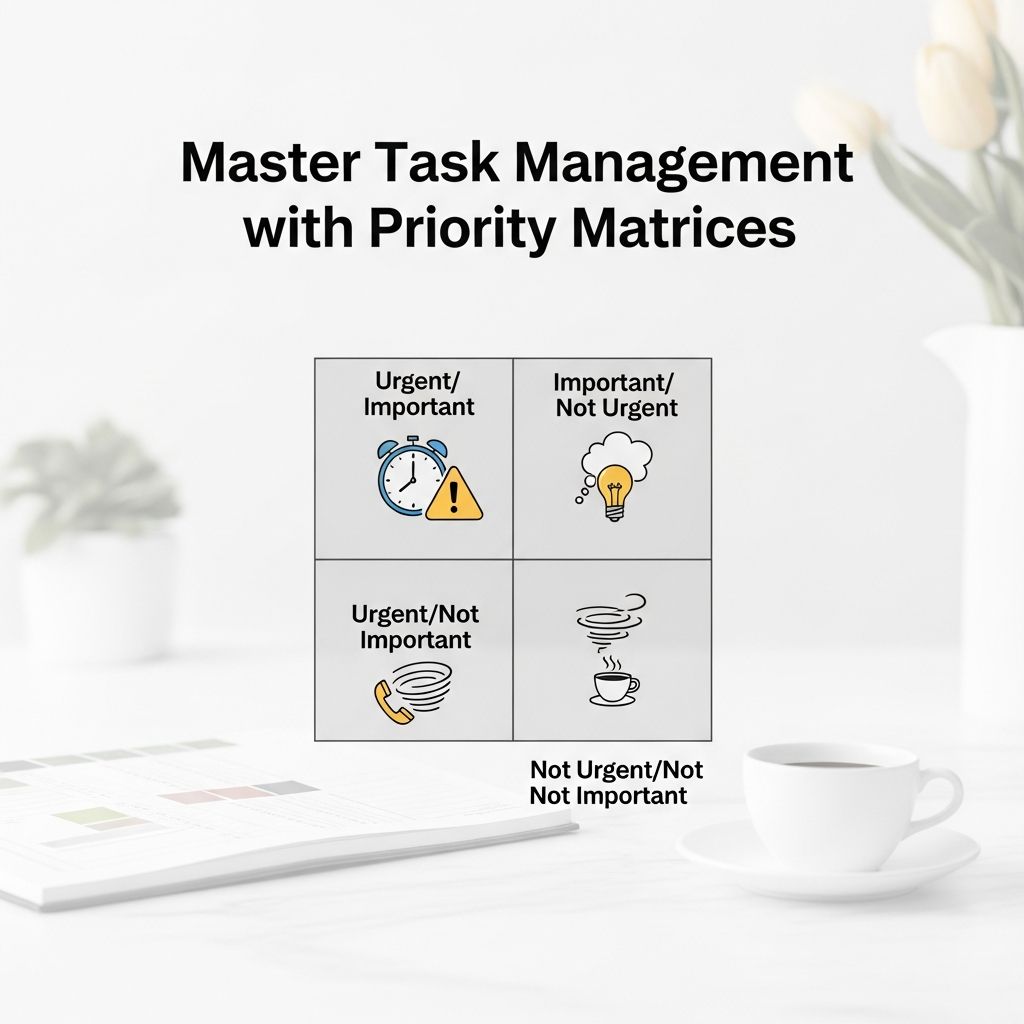
This foundational approach categorizes tasks by two timeless dimensions: whether they require immediate attention and whether they matter for your long-term objectives. Items that are both urgent and important demand your immediate action—these are your crises and hard deadlines. Important but non-urgent tasks deserve scheduled planning because they advance your strategic goals. Urgent but unimportant items often represent others’ priorities that may warrant delegation. Items that are neither urgent nor important frequently deserve elimination from your workload entirely.
The Impact-Effort Matrix
This framework shifts focus from temporal pressure to tangible outcomes. By evaluating the magnitude of impact against the resources required for implementation, teams can identify which efforts deliver the most value relative to investment. This approach proves particularly valuable for product development, process improvement initiatives, and portfolio management where understanding return on effort matters immensely.
The Value-Complexity Framework
Organizations sometimes need to assess initiatives based on their strategic worth against the complexity of execution. This matrix helps balance ambition with feasibility, ensuring resources flow toward efforts that combine meaningful business value with achievable implementation paths. It’s particularly useful when evaluating feature additions, technology upgrades, or organizational change initiatives.
Alternative Prioritization Approaches
Beyond these classics, specialized matrices serve particular contexts. Risk-value matrices help organizations balance growth opportunities against potential downsides. Financial matrices might plot projects by revenue impact against implementation cost. Technology teams sometimes use criticality-frequency matrices to determine which systems require the most attention and maintenance focus. The key principle remains consistent: choose dimensions that illuminate the decision you’re trying to make.
Constructing Your Own Priority Matrix
Creating an effective priority matrix requires moving through several deliberate steps, each contributing to the tool’s ultimate utility.
Step One: Comprehensive Inventory
Begin by capturing every item requiring prioritization. This might include projects, tasks, meetings, requests, or initiatives—whatever constitutes your decision set. Write each item clearly, creating a complete list without filtering or judgment. The goal is capturing what currently consumes or competes for your attention. Include both ongoing responsibilities and new demands. This inventory step proves crucial because it prevents important items from being overlooked due to mental bandwidth limitations.
Step Two: Criteria Selection
Evaluate your situation and select two criteria that best illuminate your decision landscape. If you’re overwhelmed by competing demands with varying timelines, urgency-importance makes sense. If you’re managing a portfolio of initiatives, impact-effort provides better guidance. Consider what information would most help you distinguish between your items. The best criteria are those where different items truly spread across the matrix—if everything clusters into one quadrant, your criteria aren’t differentiating effectively.
Step Three: Axis Configuration
Physically create your matrix by drawing a grid with your two criteria clearly labeled on each axis. You might use simple low-to-high scales, or for more sophisticated analysis, numerical scales from one to five. Some teams use continuous axes allowing items to plot anywhere on the grid, while others prefer discrete quadrants with clear boundaries. The format matters less than clarity—ensure anyone viewing your matrix understands what each dimension represents.
Step Four: Plotting and Analysis
For each item on your inventory, assess where it falls on both dimensions and plot it on your matrix. This process often reveals surprising insights. Items you assumed mattered greatly might actually cluster in lower-value areas. Conversely, some tasks you’d been postponing might deserve immediate attention. Visual representation frequently sparks productive discussions, especially in team settings, because it forces explicit conversation about why items belong in particular positions.
Step Five: Action Planning
Transform your matrix into actionable guidance. Items in high-priority quadrants deserve immediate scheduling. Strategic initiatives require planning meetings and resource allocation. Routine items should be batched or delegated. Lower-priority items warrant elimination or deferral. This final step ensures your matrix doesn’t become merely an interesting visualization but actually changes how you allocate your effort.
Tailoring Prioritization to Your Context
Individual Application
Professionals managing their own workload should typically focus intensively on one or two priority levels at a time. Attempting to simultaneously address everything labeled high-priority leads to diffusion and reduced execution quality. By narrowing focus to your top priority category, you can give appropriate attention to each item and actually move them to completion. This requires discipline to resist the temptation to multitask or context-switch.
Team and Organizational Scale
Larger teams and organizations often expand their active priority set to three or sometimes four levels, depending on their size and complexity. A team of three might maintain only two active priority levels while a department of fifty might manage four. The principle remains: focus your primary energy on your top one or two categories while systematically advancing lower-tier work. This prevents paralysis while acknowledging that organizations need to maintain multiple work streams simultaneously.
Real-World Applications Across Functions
Product Development Scenarios
Product teams frequently use impact-effort matrices to guide feature prioritization. Adding a search function to an existing interface typically represents a quick win—modest development effort with high user value. Building a completely new mobile application represents a strategic project requiring substantial investment. Updating help documentation sits in the routine maintenance quadrant. Understanding these distinctions helps product managers communicate with engineering teams and stakeholders about sequencing decisions.
Service and Support Operations
Customer support teams benefit from matrices that plot issues by impact on business operations against current performance gaps. A system outage affecting all customers represents critical urgency. A feature request from a single user represents lower priority. By visualizing this landscape, support leaders can allocate limited resources toward addressing the issues creating the most organizational pain.
Individual Productivity Scenarios
A professional might use an urgency-importance matrix to structure their day. Preparing for a critical client presentation at 2 PM clearly belongs in the do-first quadrant. Completing performance reviews by week’s end fits the schedule-this category. Data entry for routine reporting might be delegated. Browsing social media belongs in the eliminate category. This simple framework prevents important work from being crowded out by urgent but less critical demands.
Advanced Techniques and Variations
Weighted Scoring Matrices
More sophisticated organizations sometimes employ weighted scoring approaches where multiple criteria can be simultaneously evaluated. Rather than just two dimensions, a weighted matrix might score items across five criteria—strategic alignment, customer impact, revenue potential, resource availability, and risk level. Each criterion receives a weight reflecting its importance to your specific decision. Items are scored on each criterion, multiplied by their weights, and ranked by total score. This approach accommodates greater complexity but requires more discipline in setup and evaluation.
Dynamic Matrix Evolution
As circumstances change, your priority matrix should evolve. An issue initially marked low-priority might suddenly demand attention when new information emerges. Strategic initiatives might accelerate or decelerate based on business conditions. Review your matrix regularly—weekly for highly volatile environments, monthly for more stable contexts. This prevents your matrix from becoming an artifact rather than a living decision tool.
Collaborative Matrix Development
When teams create priority matrices together, the discussion often proves as valuable as the final output. Getting stakeholders to explicitly agree on criteria and where items should plot generates alignment and understanding. This collaborative process often surfaces hidden disagreements about strategy or priorities that benefit from open conversation rather than silent resentment.
Common Mistakes to Avoid
Organizations frequently stumble when implementing priority matrices. Many teams choose criteria that don’t meaningfully differentiate their items, resulting in clustering and limited practical guidance. Others fail to actually use their matrices for resource allocation decisions, treating them as interesting exercises rather than operational tools. Some teams become overly attached to initial placements rather than regularly reassessing as circumstances change.
Perhaps most commonly, teams overestimate their capacity by maintaining too many high-priority items simultaneously. Genuinely treating multiple items as first-priority means none receive appropriate attention. Effective prioritization requires making trade-offs and accepting that not everything can be addressed immediately.
Frequently Asked Questions About Priority Matrices
Q: How often should I update my priority matrix?
A: This depends on your environment’s volatility. Fast-moving organizations might review weekly or even daily, while stable environments might review monthly. At minimum, review whenever significant new requests arrive or circumstances change substantially. The matrix should reflect current reality, not outdated assumptions.
Q: Can I use a priority matrix for long-term strategic planning?
A: Absolutely. Matrices work at multiple time horizons. You might maintain a strategic matrix for major initiatives alongside a tactical matrix for weekly task management. The principles apply regardless of timeframe—you’re always asking which items deserve limited resources.
Q: What if everything seems equally important?
A: This typically indicates either that your criteria aren’t differentiating effectively or that you need to challenge underlying assumptions about what truly matters. Force yourself to make distinctions. If truly everything matters equally, that’s valuable information suggesting you need to add more resources or fundamentally reconsider your commitments.
Q: Should I share my priority matrix with my team or manager?
A: Generally yes. Transparency about your prioritization helps others understand your decision-making, enables better coordination, and can surface important information you might not have considered. Shared matrices also facilitate conversations about resource constraints and trade-offs.
Q: How do I handle items that don’t clearly fit into one quadrant?
A: Items near boundaries are often the most interesting to discuss. They typically represent uncertainties worth exploring more deeply. You might gather additional information before finalizing placement, or you might intentionally place them between quadrants to acknowledge the ambiguity. The discussion itself often proves more valuable than achieving perfect clarity.
References
- Priority Matrix: Definition, Examples & How to Use It — Freshworks. Accessed December 2025. https://www.freshworks.com/priority-matrix/
- Make Your Tasks Compete: 2025 Prioritization Matrix Guide — The Digital Project Manager. Accessed December 2025. https://thedigitalprojectmanager.com/productivity/prioritization-matrix/
- Eisenhower Matrix: Prioritization Framework — ProductPlan. Accessed December 2025. https://www.productplan.com/glossary/eisenhower-matrix/
- Project Prioritization Matrix in Lean Six Sigma: Complete Guide — 6Sigma.us. Accessed December 2025. https://www.6sigma.us/project-management/project-prioritization-matrix-lean-six-sigma/
- A Simple Guide to Mastering the Prioritization Matrix — Nulab. Accessed December 2025. https://nulab.com/learn/project-management/prioritization-matrix/

- Integrated M.A. in Applied Linguistics, University of Hyderabad
- 5+ years in editorial, instructional, SEO, and research-based writing
Sneha is a relationships and lifestyle writer with a strong foundation in applied linguistics and certified training in relationship coaching. She brings over five years of writing experience to theskillvault, crafting thoughtful, research-driven content that empowers readers to build healthier relationships, boost emotional well-being, and embrace holistic living. Her writing and insights reflect the belief that beauty, happiness, and wellness…