
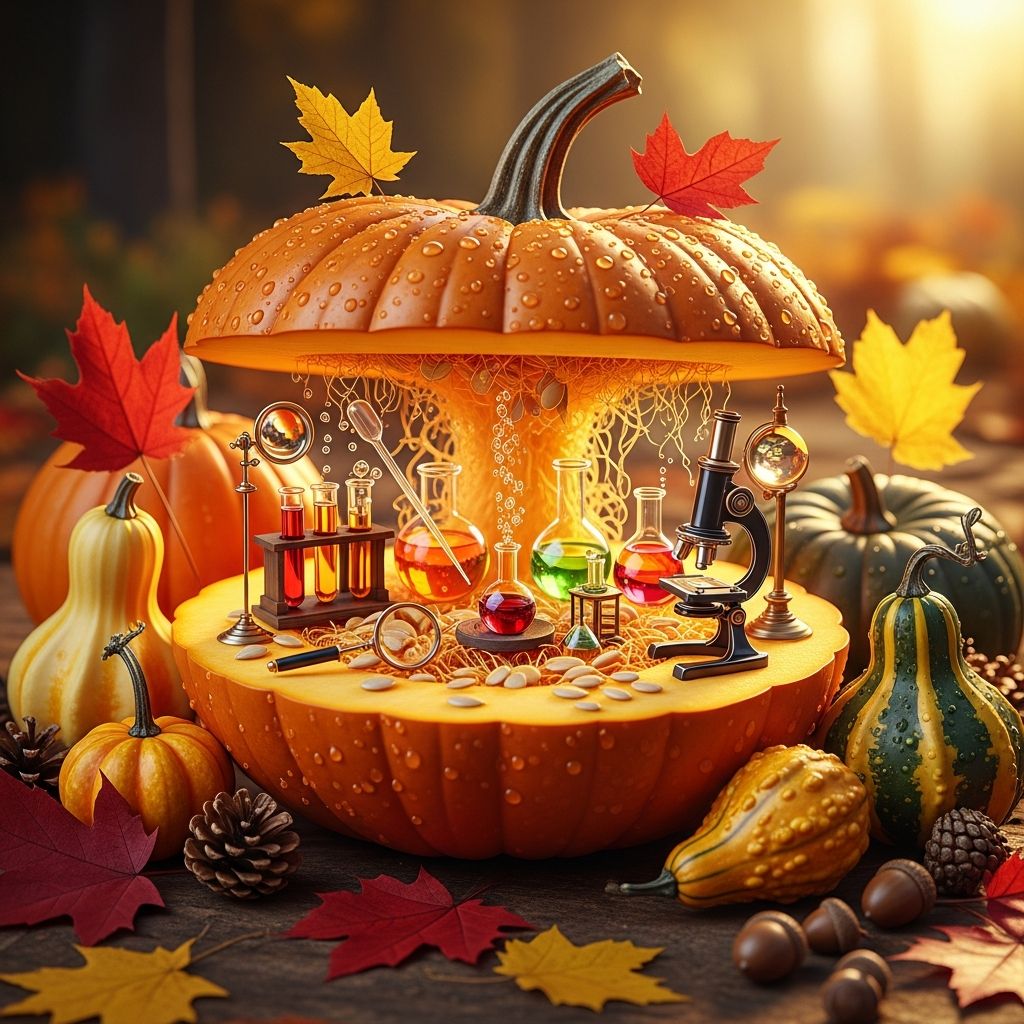
Pumpkins transform from simple fall decorations into powerful teaching tools when used in science experiments. These activities blend seasonal excitement with core scientific principles, making learning memorable for children of all ages. From testing buoyancy to creating fizzy eruptions, each experiment encourages observation, prediction, and discovery.
Dissecting the Pumpkin: Anatomy Exploration
Begin your pumpkin science journey by examining the internal structure of a pumpkin. This activity introduces biology concepts like plant parts and life cycles in an interactive way. Select a medium-sized pumpkin for easy handling. Carefully slice it open to reveal the vibrant orange flesh, stringy pulp, seeds, and sturdy stem.
- Observe and Label: Provide magnifying glasses, trays, and printable labels for parts like rind, pulp, seeds, and stem. Children can sort and identify each component.
- Sensory Investigation: Touch the slimy strands, count seeds in groups of ten, and note textures and colors to build descriptive vocabulary.
- Life Cycle Discussion: Connect findings to how pumpkins grow from vines, emphasizing pollination and seed dispersal.
This hands-on dissection fosters curiosity about botany. Younger kids delight in the messiness, while older ones can sketch diagrams or hypothesize seed counts.
Buoyancy Basics: Do Pumpkins Float?
Challenge assumptions about weight and water with a sink-or-float test using pumpkins. Density—mass per unit volume—determines buoyancy; objects less dense than water float. Pumpkins, despite their size, contain air pockets making them buoyant.
Materials: Water tub, small/medium/large pumpkins (one gutted), prediction sheets.
- Have kids predict outcomes by drawing pumpkins above or below water lines.
- Test each: surprisingly, all float due to internal air.
- Discuss: Compare to dense rocks that sink.
| Pumpkin Type | Prediction | Result | Why? |
|---|---|---|---|
| Small | Sink | Float | Air inside |
| Large | Sink | Float | Low density |
| Gutted | Float | Float | Even lighter |
Extend by adding fall items like acorns or leaves for comparative testing.
Chemical Reactions Unleashed: Pumpkin Volcano Eruptions
Harness acid-base chemistry for a spectacular volcano inside a hollowed pumpkin. Baking soda (base) reacts with vinegar (acid) to produce carbon dioxide gas, causing foam overflow.
Setup Steps:
- Hollow pumpkin, add baking soda, dish soap, food coloring.
- Pour vinegar to trigger fizzing reaction.
- Watch foam erupt like lava!
Safety note: Supervise closely; use eye protection. Vary colors for multiple eruptions. Explain the reaction: CH₃COOH + NaHCO₃ → CH₃COONa + H₂O + CO₂. This demonstrates gas production visibly.
Gooey Creations: Pumpkin Seed Slime and Oobleck
Polymer science comes alive with slime made from pumpkin elements. Mix glue, activator (borax solution), and pureed pumpkin pulp or seeds for textured, stretchy slime.
Recipe:
- 1/2 cup glue, 1/2 cup water, food coloring, 1 tsp baking soda.
- Add pumpkin puree for orange tint and chunks.
- Stir in contact lens solution until slime forms.
Explore non-Newtonian fluids with oobleck: cornstarch + water inside pumpkin halves. It hardens under pressure, flows when still—perfect for sensory play and physics talks.
Density Layers: Sorting Pumpkin Parts in a Jar
Visualize density gradients using a jar with layered liquids: corn syrup (densest), water, oil (least dense). Drop in pumpkin bits—stem floats highest, pulp sinks lowest.

Observation chart helps track movements, teaching relative densities qualitatively.
Engineering Challenges: Pumpkin Catapults and Towers
Apply physics to STEM builds. Construct catapults from popsicle sticks, rubber bands, spoons to launch seeds or mini pumpkins. Measure distances, tweak designs for optimization.
Tower Challenge: Stack pumpkins or use seeds on platforms to test stability, introducing balance and gravity.
Electrifying Experiment: The Pumpkin Battery Clock
Pumpkins conduct electricity mildly due to electrolytes in pulp. Insert zinc nails and copper pennies into halves, connect wires to a clock—watch it tick!
This bio-battery intro covers circuits, voltage, and chemical energy conversion safely.
Biology in Action: Rotting Pumpkin Time-Lapse
Track decomposition outdoors. Carve a pumpkin, observe daily changes: mold growth, shrinkage, insect visitors. Ties to ecosystems, fungi, bacteria roles in nutrient cycling.
- Weigh weekly, photograph for time-lapse.
- Compare carved vs. intact pumpkins.
Effervescent Spectacles: Pumpkin Elephant Toothpaste
For dramatic chemistry, fill hollow pumpkin with yeast, warm water, dish soap, food coloring. Add 6-12% hydrogen peroxide for rapid oxygen foam “toothpaste” eruption.
Chem Equation: 2H₂O₂ → 2H₂O + O₂ (catalyzed by yeast). Mesmerizing for all ages; use higher peroxide cautiously with supervision.
Pumpkin Bubbles: Surfactant Science
Mix dish soap, water, glycerin in pumpkin for mega bubbles. Explore surface tension—soap reduces it, allowing bubble films. Wand shapes yield giant spheres on windy days.
STEM Extensions and Classroom Tips
Incorporate math: graph seed counts, calculate densities (mass/volume). Literacy: read pumpkin books, journal hypotheses. Differentiate for ages—simple predictions for preschool, data analysis for elementary.
Supply lists economical; source pumpkins post-patch. Clean-up friendly with trays.
Frequently Asked Questions (FAQs)
What age group suits these experiments?
Preschool to elementary (3-12 years). Simplify for youngers, add measurements for olders.
Are materials safe and accessible?
Yes, household items mostly. Supervise cuts, chemicals; gloves advised.
Can these fit in classrooms?
Perfectly—group stations rotate, minimal mess with prep.
How to store slime or leftovers?
Air-tight bags; slime lasts 1-2 weeks refrigerated.
Alternatives for allergies or mess-phobia?
Use gloves, virtual sims, or dry ice for fog effects.
References
- National Center for Education Statistics – STEM Education Data — U.S. Department of Education. 2023-10-15. https://nces.ed.gov/programs/coe/indicator/ctr
- Journal of Chemical Education – Acid-Base Demonstrations — American Chemical Society. 2022-05-01. https://pubs.acs.org/doi/10.1021/acs.jchemed.2c00123
- Buoyancy and Density Principles — National Oceanic and Atmospheric Administration (NOAA). 2024-01-12. https://oceanservice.noaa.gov/education/tutorial_currents/03buoyancy1.html
- Plant Anatomy Resources — USDA Agricultural Research Service. 2023-08-20. https://www.ars.usda.gov/research/docs.htm?docid=2290
- Electrolyte Batteries in Fruits — Journal of Physics Education. 2021-11-05. https://iopscience.iop.org/article/10.1088/1361-6552/ac2f45

- Integrated M.A. in Applied Linguistics, University of Hyderabad
- 5+ years in editorial, instructional, SEO, and research-based writing
Sneha is a relationships and lifestyle writer with a strong foundation in applied linguistics and certified training in relationship coaching. She brings over five years of writing experience to theskillvault, crafting thoughtful, research-driven content that empowers readers to build healthier relationships, boost emotional well-being, and embrace holistic living. Her writing and insights reflect the belief that beauty, happiness, and wellness…