
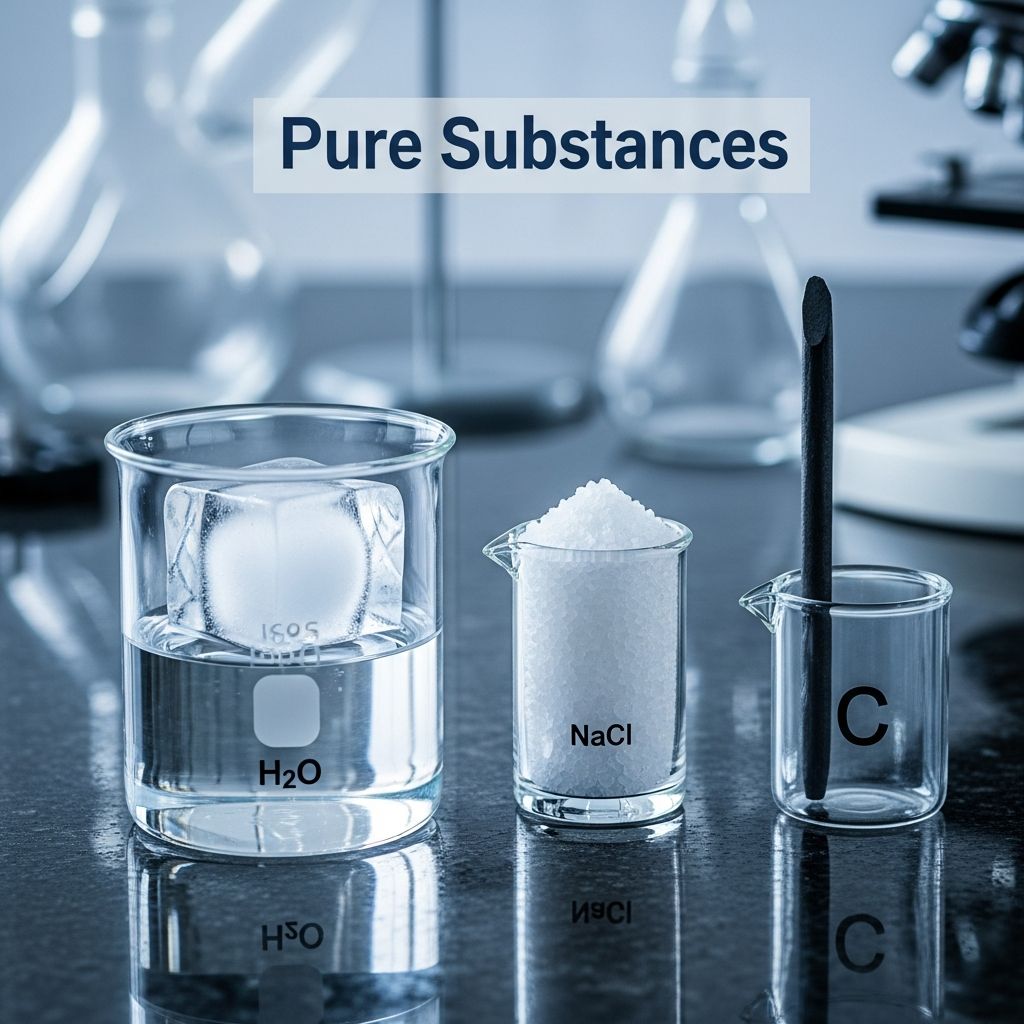
Pure substances form the cornerstone of chemical classification, representing materials composed of a single type of particle with uniform composition and predictable properties. Unlike mixtures, these substances cannot be separated by physical means into simpler components, making them essential for understanding matter at its most fundamental level.
Defining Pure Substances: The Building Blocks of Matter
In chemistry, a pure substance consists exclusively of one kind of particle, either atoms of a single element or molecules of a single compound. This uniformity ensures consistent physical and chemical behaviors across any sample size. Pure substances exhibit homogeneous nature, meaning their composition remains constant regardless of the portion examined.
The concept hinges on homogeneity and definite chemical makeup. For instance, distilled water qualifies as a pure substance because it contains only H2O molecules, while air does not due to its blend of gases. This distinction is crucial in labs and industries where precision dictates outcomes.
Classification of Pure Substances: Elements and Compounds
Pure substances divide into two primary categories: elements and compounds. Each category has distinct characteristics that influence their roles in chemical reactions and applications.
Elements: The Simplest Form of Matter
Elements represent the most basic pure substances, comprising identical atoms that cannot be broken down further by chemical means. The periodic table lists 118 known elements, from hydrogen to oganesson, categorized as metals, non-metals, or metalloids.
- Metals like iron (Fe) and gold (Au) conduct electricity and heat well, exhibiting malleability and ductility.
- Non-metals such as oxygen (O2) and carbon (C) often form brittle solids or gases, poor conductors.
- Metalloids including silicon (Si) display hybrid properties, vital for semiconductors.
Pure elemental oxygen gas, for example, consists solely of O2 molecules, retaining elemental status despite molecular form.
Compounds: Unified Molecules from Multiple Elements
Compounds arise when two or more elements chemically bond in fixed ratios, forming new substances with properties unlike their constituents. Water (H2O), table salt (NaCl), and ammonia (NH3) exemplify compounds.
Unlike mixtures, compounds require chemical reactions for decomposition. Sodium chloride’s ionic bonds yield sodium and chlorine only through electrolysis, not filtration. This fixed stoichiometry defines compounds, ensuring every molecule matches the formula.
Key Properties That Characterize Pure Substances
Pure substances boast distinctive traits setting them apart from mixtures, aiding identification and purification.
- Fixed Melting and Boiling Points: They transition phases at precise temperatures under standard pressure. Pure water melts at 0°C and boils at 100°C, sharpening with increased purity.
- Uniform Composition: Consistent throughout, enabling reproducible results in experiments.
- Definite Chemical Reactivity: Predictable products in reactions due to single particle type, minimizing side effects.
- Homogeneous Structure: No visible variations, even microscopically.
These properties underpin analytical techniques like chromatography, where deviations signal impurities.
Real-World Examples of Pure Substances
Everyday items often embody pure substances, refined for specific uses.
| Pure Substance | Type | Composition | Common Use |
|---|---|---|---|
| Gold (Au) | Element | Au atoms | Jewelry, electronics |
| Diamond (C) | Element | C atoms | Gemstones, cutting tools |
| Water (H2O) | Compound | H2O molecules | Solvent, hydration |
| Sodium Chloride (NaCl) | Compound | Na+Cl– ions | Food seasoning, de-icing |
| Carbon Dioxide (CO2) | Compound | CO2 molecules | Beverages, fire extinguishers |
These examples highlight purity’s practical value, from 99.9% refined salt to lab-grade reagents approaching 100%.
Pure Substances vs. Mixtures: Critical Distinctions
Mixtures combine pure substances physically, retaining individual identities without fixed ratios. This contrasts sharply with pure substances.
| Aspect | Pure Substance | Mixture |
|---|---|---|
| Composition | Fixed, uniform | Variable |
| Separation | Chemical means only | Physical means (filtration, distillation) |
| Properties | Definite melting/boiling points | Range of transition temperatures |
| Examples | Iron, sucrose | Air, saltwater |
Homogeneous mixtures like alloys appear uniform but lack pure substance definiteness, while heterogeneous ones like salads show clear components. Saltwater’s variable salinity disqualifies it as pure.
Purity in Practice: Achieving and Measuring It
Absolute purity is ideal but rare; real-world samples reach 99.9% via refining. Distillation purifies water by vaporizing and condensing, leaving impurities. Spectroscopy and chromatography quantify purity, detecting trace contaminants.
In thermodynamics, pure substances like steam power cycles assume single-phase or equilibrium multi-phase states for property predictions. Industries refine metals electrolytically, ensuring performance.
Applications Across Science and Industry
Pure substances drive advancements. Pharmaceuticals demand compound purity for efficacy; electronics rely on elemental silicon. Environmental monitoring uses pure substance standards for calibration.
Thermodynamics models pure substances for efficiency calculations in engines and refrigerators. Food science distinguishes pure sucrose from syrup mixtures.
Frequently Asked Questions (FAQs)
What qualifies as a pure substance?
A pure substance contains only one type of particle—either one element’s atoms or one compound’s molecules—with uniform composition and fixed properties.
Is table salt a pure substance?
Yes, NaCl is a pure compound of sodium and chloride ions in 1:1 ratio, separable only chemically.
Can pure substances exist in multiple phases?
Yes, like water as ice, liquid, or vapor, or mixtures in equilibrium, maintaining chemical uniformity.
How do pure substances differ from homogeneous mixtures?
Pure substances have fixed composition and single particle type; mixtures combine multiple substances physically, even if uniform.
Why are fixed melting points important for pure substances?
They indicate high purity; impurities broaden melting ranges, aiding quality assessment.
Challenges and Nuances in Purity Assessment
Conceptual purity demands 100% single component, but reality involves refining. Gold jewelry at 99.9% fineness suits most uses, yet labs seek higher. Analytical chemistry employs techniques like mass spectrometry for ppm-level detection.
Molecular elements like O2 challenge simplistic views, yet remain pure as identical molecules of one element. Multi-phase pure substances, as in boiling water, complicate but enrich thermodynamic studies.
Educational contexts simplify for clarity, emphasizing can’t-separate-by-physical-means as a hallmark. Advanced views incorporate phase rules and Gibbs phase law.
References
- Classification of Matter – Pure Substances and Mixtures — BYJU’S. 2023. https://byjus.com/chemistry/pure-substances-and-mixtures/
- Pure Substance in Chemistry | Definition, Properties & Examples — Study.com. 2023. https://study.com/learn/lesson/pure-substance-in-chemistry-overview-properties-examples.html
- What is a Pure Substance? — BCCampus Pressbooks (Engineering Thermodynamics). 2022. https://pressbooks.bccampus.ca/thermo1/chapter/what-is-a-pure-substance/
- Pure Substances and Mixtures — Physics LibreTexts. 2023. https://phys.libretexts.org/Courses/Coalinga_College/Physical_Science_for_Educators_(CID:_PHYS_14)/04:_Phases_and_Classification_of_Matter/4.03:_Pure_Substances_and_Mixtures

Medha Deb is an editor with a master's degree in Applied Linguistics from the University of Hyderabad. She believes that her qualification has helped her develop a deep understanding of language and its application in various contexts. Medha specializes in the areas of beauty, health, sports, and wellness and is committed to ensuring that the content on the website is…