
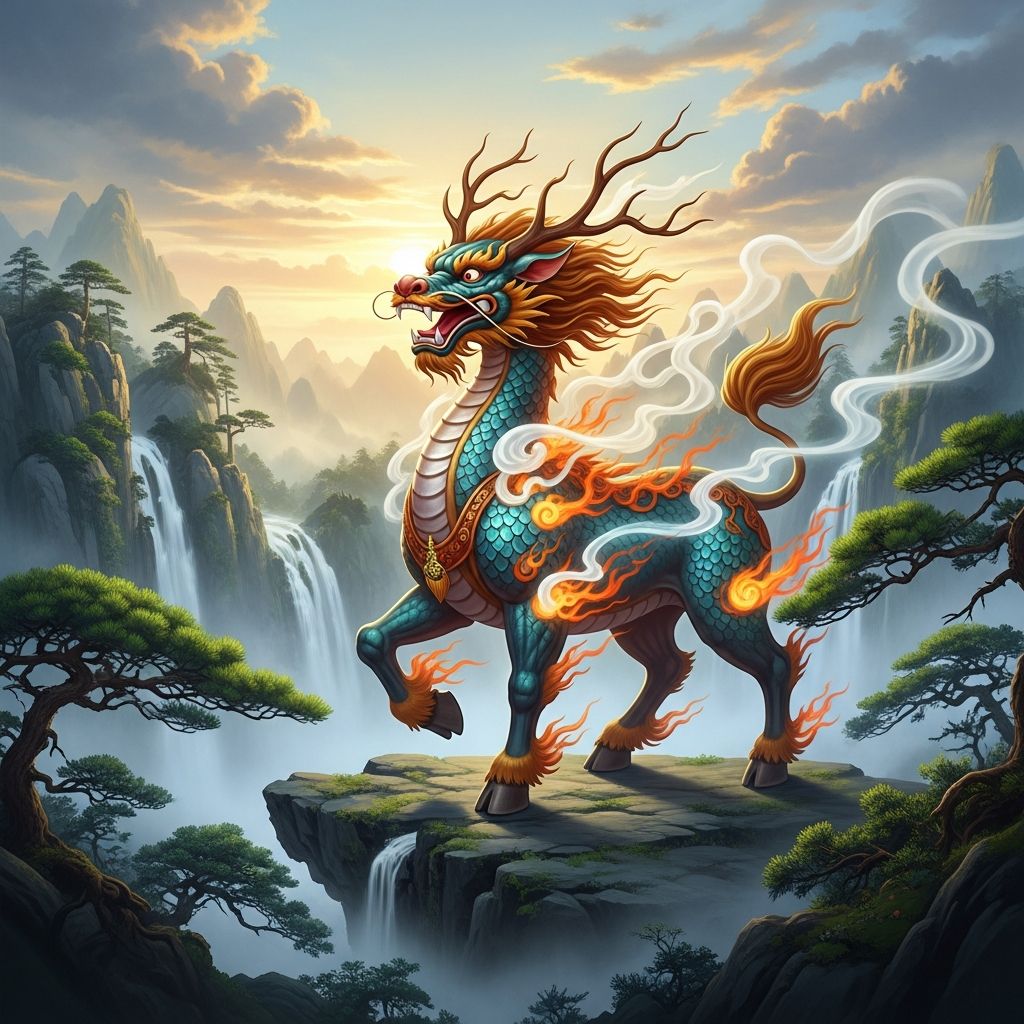
The qilin stands as one of the most revered figures in Chinese mythology, a chimeric beast embodying harmony, righteousness, and prophetic significance. Unlike aggressive dragons or fierce guardians in other traditions, this creature appears only during eras of profound peace or at pivotal moments tied to enlightened rulers and sages, signaling benevolence and moral uprightness.
Origins and Etymology of the Qilin Legend
The qilin’s roots trace back to ancient Chinese texts, where it emerges as a member of the ‘lin’ family of one-horned mythical beings. Its name derives from the characters ‘qi’ (male) and ‘lin’ (female), symbolizing a perfect yin-yang balance that underscores its role as a harmonious force in the cosmos.
Early references appear in classical works, positioning the qilin not as a common beast but as a rare omen. Legends describe it manifesting during times of sage births or deaths, such as the appearance before Confucius’s mother, who received a jade tablet foretelling her son’s destiny. This prophetic nature elevates the qilin beyond mere fantasy, embedding it in philosophical and historical narratives.
- Ancient texts link qilin sightings to moral governance and societal virtue.
- The creature’s duality reflects core Taoist and Confucian principles of equilibrium.
- Its scarcity in lore amplifies its status as a divine messenger.
Physical Appearance and Symbolic Features
Depictions of the qilin vary, but core traits paint a picture of majestic hybridity. It possesses the scaled body of a deer or goat, cloven hooves like a horse, an ox or lion tail, and a head resembling a dragon, wolf, or antelope, often crowned with one or two spiraling horns.
Its belly gleams yellow, while the back shimmers in multicolored scales, evoking rainbows or flames. This vivid palette signifies prosperity and purity. Gentle by disposition, the qilin avoids treading on fresh grass or consuming live plants, even reputedly walking on water to spare insects.
| Body Part | Description | Symbolic Meaning |
|---|---|---|
| Head | Dragon, sheep, or wolf-like | Wisdom and vigilance |
| Horns | One or two, spiraled | Discernment of good from evil |
| Body | Deer or ox-shaped, scaled | Grace and strength in harmony |
| Hooves | Cloven, horse-like | Purity and swift justice |
| Tail | Ox or lion | Protection and nobility |
These attributes distinguish the qilin from Western unicorns, which emphasize purity through a single horn alone. The qilin’s composite form draws from nature’s nobility, reinforcing its auspicious aura.
Role in Historical and Legendary Narratives
Throughout history, qilin appearances marked transformative events. In the 6th century BCE, one heralded Confucius’s birth by presenting a jade inscription to his mother, prophesying his sagehood. Conversely, its injury foreshadowed his death, illustrating its dual role as birth and end omen.
During the Ming Dynasty, a giraffe imported from Africa in 1414 was hailed as a live qilin by Emperor Yongle, who saw in its exotic form a sign of heavenly favor amid naval expeditions. This event blended myth with reality, influencing art and imperial symbolism.
In governance, qilins adorned Qing Dynasty badges for top military officials, denoting rank and virtue. Emperors invoked qilin imagery to legitimize rule, associating their reigns with cosmic benevolence.
Cultural Significance Across East Asia
Beyond China, the qilin permeates Korean (girin) and Japanese (kirin) mythologies, adapting to local contexts while retaining core traits. In Korea, it symbolizes peace; in Japan, it graces beer logos and imperial crests, evoking prosperity.
Feng shui practitioners place qilin statues facing entrances to ward off evil and invite fortune. Weddings feature qilin motifs for fertility and harmony, while its image adorns temples as a protector of scholars.
- In rituals, paired male (qi) and female (lin) qilins promote marital bliss.
- Literary tales portray qilins judging rulers’ hearts, bowing only to the pure.
- Modern festivals revive qilin dances, blending tradition with performance art.
The Qilin in Art, Literature, and Modern Media
Chinese porcelain, paintings, and sculptures immortalize the qilin, often in serene landscapes. Ming vases depict it amid clouds, symbolizing imperial longevity. Literature, from ‘Classic of Mountains and Seas’ to novels, weaves qilin tales into moral fables.
In contemporary pop culture, the qilin appears in fantasy like the Harry Potter universe, where a Chinese variant detects pure hearts via precognition, bowing to the worthy. Video games and animations further globalize its image, merging ancient lore with digital storytelling.
Today, qilin motifs trend in jewelry and tattoos, representing personal virtues like integrity and calm amid chaos.
Comparisons with Other Mythical Beasts
| Creature | Origin | Traits | Symbolism |
|---|---|---|---|
| Qilin | Chinese | Chimeric, gentle, horned | Peace, sage omens |
| Unicorn | Western | Single-horned horse | Purity, healing |
| Dragon | Chinese | Serpent-like, powerful | Power, rain, emperors |
| Phoenix | Chinese | Bird of fire | Rebirth, virtue |
While dragons embody raw imperial might, qilins offer subtle moral guidance. Paired with phoenixes, they form the ‘qilin-glance’ duo heralding righteous rule.
Frequently Asked Questions (FAQs)
What does a qilin sighting mean?
A qilin appearance foretells the birth or death of a great sage or ruler, indicating an era of prosperity and moral leadership.
Is the qilin the same as a unicorn?
No, though similar in having horns; the qilin is chimeric, multi-horned at times, and tied to Chinese auspiciousness rather than Western purity.
Why was a giraffe called a qilin in ancient China?
In 1414, Ming Emperor Yongle interpreted the giraffe’s spots, neck, and hooves as matching qilin descriptions, viewing it as a divine tribute.
How do qilins behave according to legend?
They are benevolent, avoiding harm to life, walking on water or grass-sparing paths, and discerning good from evil.
Where can qilin symbols be found today?
In feng shui decor, Japanese kirin beer, fantasy media, and cultural festivals across East Asia.
Preserving the Qilin’s Legacy
The qilin’s enduring appeal lies in its message of gentle power. In a turbulent world, it reminds us that true strength resides in compassion and foresight. As global interest in Eastern myths grows, the qilin continues to inspire art, ethics, and storytelling, bridging ancient wisdom with modern aspirations.
References
- Qilin | Definition & Facts — Britannica. Accessed 2026. https://www.britannica.com/topic/qilin
- Qilin, a Mythical Beast — Aronson Antiquairs. Accessed 2026. https://www.aronson.com/qilin-mythical-beast/
- Qilin — Wikipedia. Accessed 2026. https://en.wikipedia.org/wiki/Qilin
- GLOSSARY: Qilin (unicorn) — Gotheborg.com. Accessed 2026. https://www.gotheborg.com/glossary/qilin.shtml
- Qilin — Wizarding World (Harry Potter). Accessed 2026. https://www.harrypotter.com/fact-file/creatures/qilin

Medha Deb is an editor with a master's degree in Applied Linguistics from the University of Hyderabad. She believes that her qualification has helped her develop a deep understanding of language and its application in various contexts. Medha specializes in the areas of beauty, health, sports, and wellness and is committed to ensuring that the content on the website is…