
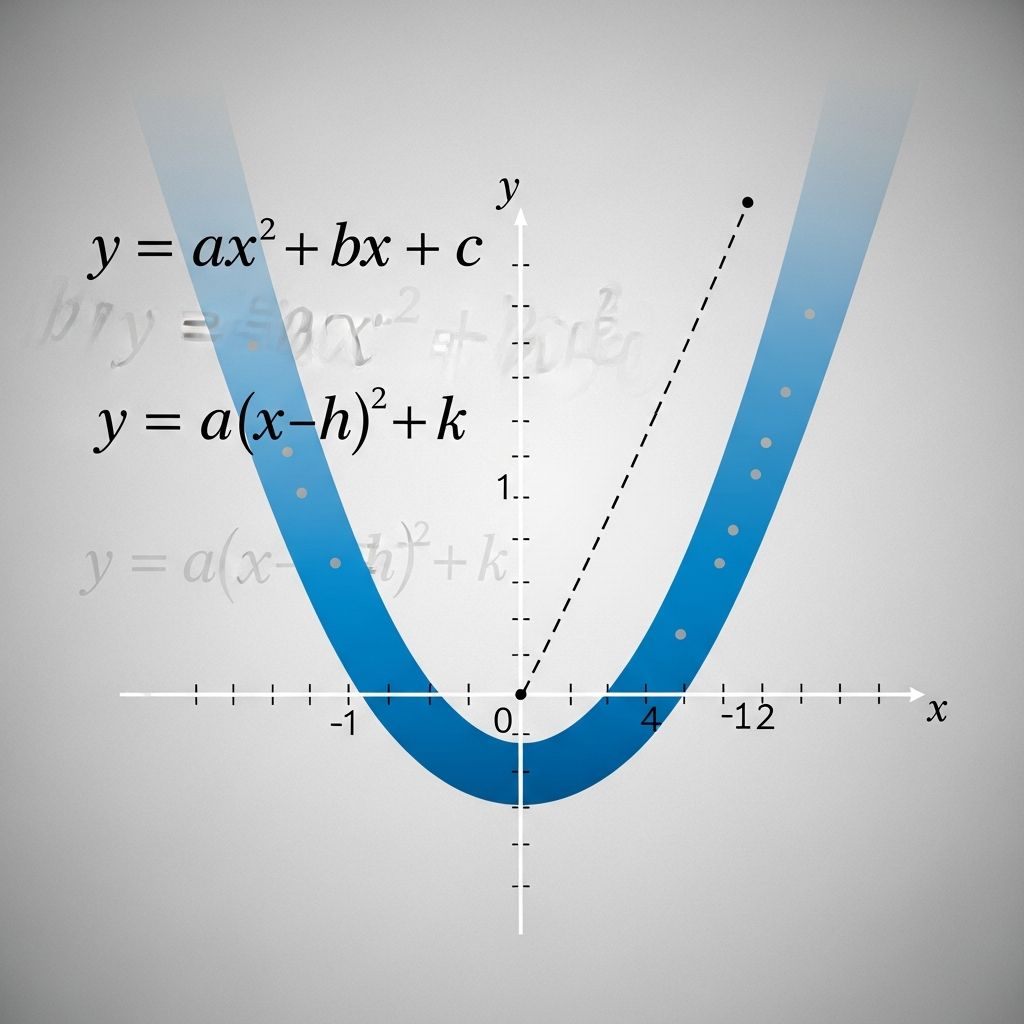
Quadratic functions form a cornerstone of algebra, representing relationships where the variable reaches a power of two. These functions produce parabolic graphs and appear in diverse fields like physics and economics. This article explores their definitions, multiple representations, graphical properties, solution methods, and practical applications, providing a complete resource for learners.
Defining Quadratic Functions
A quadratic function is a polynomial where the highest power of the variable is two, expressed generally as \( f(x) = ax^2 + bx + c \), with \( a eq 0 \). The coefficient \( a \) dictates the parabola’s direction: positive values open upward, indicating a minimum point, while negative values open downward, showing a maximum.
Unlike linear functions, quadratics curve, enabling modeling of phenomena with peaks or troughs. The constants \( b \) and \( c \) shift and adjust the parabola’s position. For instance, if \( a = 1 \), \( b = 0 \), and \( c = 0 \), the function simplifies to \( f(x) = x^2 \), the foundational parabola passing through (0,0).
Key Representations of Quadratic Functions
Quadratic functions can be written in several forms, each highlighting different features:
- Standard Form: \( f(x) = ax^2 + bx + c \). Ideal for identifying coefficients and using the quadratic formula.
- Vertex Form: \( f(x) = a(x – h)^2 + k \), where (h, k) is the vertex. This directly reveals the parabola’s turning point and simplifies graphing.
- Factored Form: \( f(x) = a(x – r_1)(x – r_2) \), exposing the roots or x-intercepts directly.
Converting between forms is essential. To shift from standard to vertex, complete the square: for \( f(x) = ax^2 + bx + c \), factor a from the x terms, add and subtract \( (b/(2a))^2 \), yielding the vertex form.
Graphing Quadratic Functions
The graph of any quadratic is a parabola, a symmetric U-shaped curve. Key elements include:
- Vertex: The peak or trough at \( x = -b/(2a) \), with y-coordinate \( f(-b/(2a)) \).
- Axis of Symmetry: Vertical line \( x = -b/(2a) \), mirroring the parabola’s arms.
- X-Intercepts (Roots): Where \( f(x) = 0 \), found via factoring or the quadratic formula.
- Y-Intercept: At \( x = 0 \), simply \( c \).
To graph, plot the vertex, y-intercept, and roots, then sketch symmetrically. Transformations like stretching (via |a| > 1), compressing (|a| < 1), or reflecting (a < 0) alter the basic \( y = x^2 \).
| Function | Vertex | Direction | Y-Intercept |
|---|---|---|---|
| \( f(x) = x^2 \) | (0,0) | Up | 0 |
| \( f(x) = -2(x-1)^2 + 3 \) | (1,3) | Down | 1 |
| \( f(x) = x^2 + 4x + 3 \) | Vertex: (-2, -1) | Up | 3 |
This table illustrates form impacts on graph features.
Solving Quadratic Equations
Setting \( f(x) = 0 \) yields quadratic equations \( ax^2 + bx + c = 0 \). Solutions depend on the discriminant \( d = b^2 – 4ac \):
- d > 0: Two distinct real roots.
- d = 0: One real root (vertex on x-axis).
- d < 0: No real roots; complex solutions.
Methods include:
- Factoring: \( ax^2 + bx + c = a(x – r)(x – s) \).
- Quadratic Formula: \( x = \frac{-b \pm \sqrt{b^2 – 4ac}}{2a} \).
- Completing the Square: Converts to vertex form for root extraction.
Example: Solve \( x^2 – 5x + 6 = 0 \). Factors to \( (x-2)(x-3) = 0 \), roots x=2,3.
Domain, Range, and Intervals
Quadratics are defined for all real x, so domain is \( (-\infty, \infty) \). Range varies: for upward parabolas, \( [k, \infty) \); downward, \( (-\infty, k] \), where k is the vertex’s y-value.
Analyze increasing/decreasing intervals using the vertex. Left of axis: downward parabolas increase, upward decrease; reverse rightward.
Applications in Real Life
Quadratics model trajectories, profit maximization, and optimization. In physics, projectile motion follows \( h(t) = -16t^2 + v_0 t + h_0 \), where height peaks at vertex.
Economics uses them for cost/revenue curves; vertex gives maximum profit. Engineering applies to bridge arches or satellite dishes, parabolic reflectors.
Consider a ball thrown upward: \( h(t) = -16t^2 + 64t + 6 \). Maximum height at t=2 seconds, h=70 feet. Roots show landing time.
Advanced Topics: Multivariate Quadratics
While single-variable quadratics graph as parabolas, bivariate forms \( f(x,y) = Ax^2 + By^2 + Cxy + Dx + Ey + F \) describe quadric surfaces like ellipsoids or hyperboloids. Setting to zero yields conic sections: ellipses, parabolas, hyperbolas.
These extend to optimization in calculus, finding minima/maxima via partial derivatives.
Common Mistakes and Tips
Learners often forget \( a eq 0 \), miscalculate vertices, or ignore discriminant signs. Tips:
- Memorize \( x = -b/(2a) \).
- Practice conversions between forms.
- Sketch roughly before precise plotting.
- Check solutions by plugging back.
Frequently Asked Questions
What distinguishes a quadratic from other polynomials?
A quadratic has degree 2, graphing as a parabola, unlike lines (degree 1) or cubics (degree 3).
How does ‘a’ affect the parabola?
‘a’ controls width and direction: larger |a| narrows it; sign determines opening.
Can quadratics have no real roots?
Yes, if discriminant < 0, roots are complex.
What’s the quadratic formula used for?
Solving \( ax^2 + bx + c = 0 \) when factoring fails.
Are quadratic functions continuous?
Yes, defined everywhere with smooth parabolas.
Practice Problems
Test understanding:
- Graph \( f(x) = 2x^2 – 4x + 1 \). Find vertex, intercepts.
- Solve \( 3x^2 + 6x – 9 = 0 \) using formula.
- Convert \( y = x^2 + 6x + 5 \) to vertex form.
Solutions: 1. Vertex (1, -1), x-int: 0.5,2; y-int:1. 2. x=-3,1. 3. y=(x+3)^2 -4.
References
- Quadratic Function – Standard Form, Formula, Examples — Cuemath. 2023. https://www.cuemath.com/calculus/quadratic-functions/
- Quadratic function — Wikipedia. 2024-04-01. https://en.wikipedia.org/wiki/Quadratic_function
- Quadratic Equations — Math is Fun. 2023. https://www.mathsisfun.com/algebra/quadratic-equation.html
- 3.2: Quadratic Functions — Mathematics LibreTexts (OpenStax Precalculus). 2023-08-15. https://math.libretexts.org/Bookshelves/Precalculus/Precalculus_1e_(OpenStax)/03:_Polynomial_and_Rational_Functions/3.02:_Quadratic_Functions
- Quadratic Functions – Explained, Simplified and Made Easy — StudyPug (YouTube). 2022. https://www.youtube.com/watch?v=KRwb4YhQPwA

- Integrated M.A. in Applied Linguistics, University of Hyderabad
- 5+ years in editorial, instructional, SEO, and research-based writing
Sneha is a relationships and lifestyle writer with a strong foundation in applied linguistics and certified training in relationship coaching. She brings over five years of writing experience to theskillvault, crafting thoughtful, research-driven content that empowers readers to build healthier relationships, boost emotional well-being, and embrace holistic living. Her writing and insights reflect the belief that beauty, happiness, and wellness…