
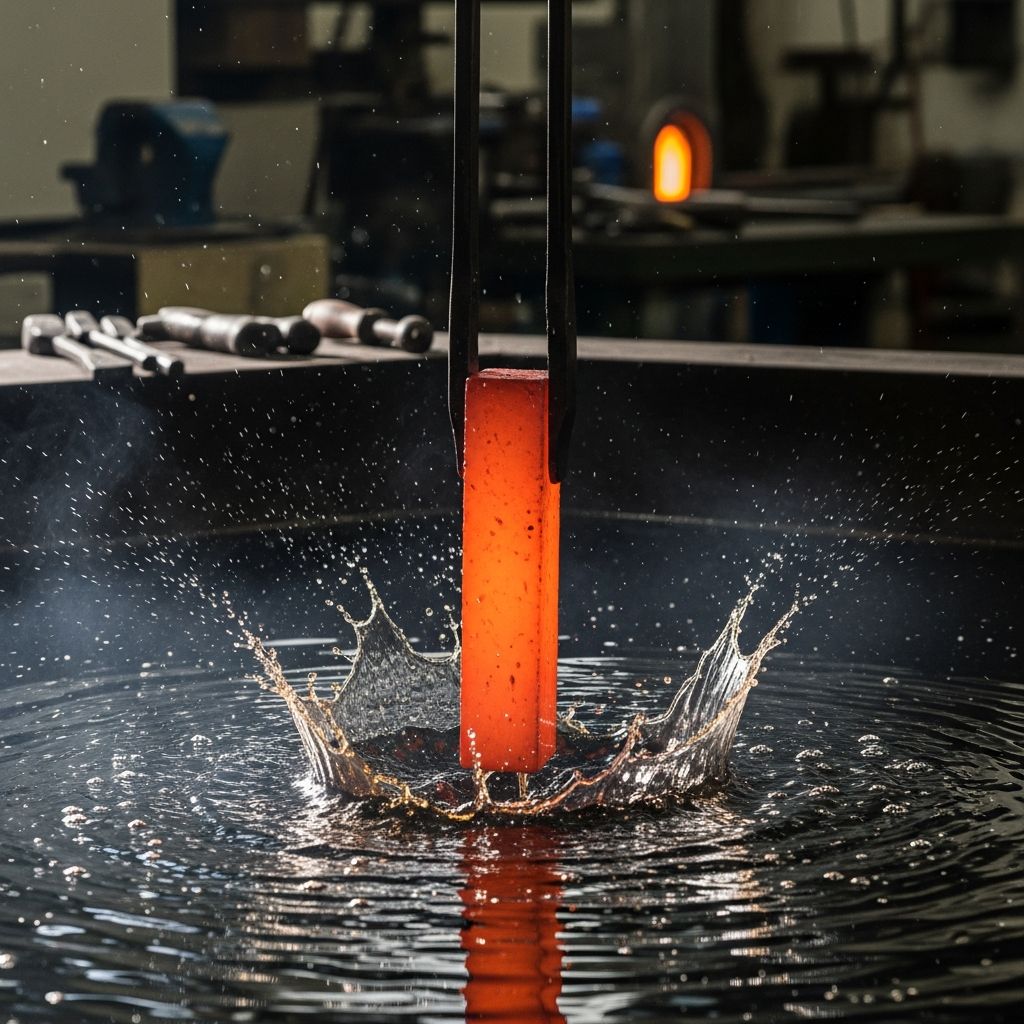
Quenching represents a cornerstone technique in metalworking, where heated metals undergo rapid cooling to achieve desired mechanical properties like increased hardness and strength. This process fundamentally alters the internal structure of alloys, particularly steel, making it indispensable in manufacturing tools, components, and machinery parts.
Understanding the Fundamentals of Quenching
At its core, quenching involves heating a metal workpiece to a high temperature—typically above its recrystallization point but below melting—and then swiftly cooling it using a medium such as water, oil, or air. This rapid temperature drop “locks” the atomic structure into a hardened state, preventing slower phase changes that would result in softer materials.
The primary goal is to induce a transformation from austenite, a high-temperature phase, to martensite, a hard, brittle microstructure. For carbon steels, this requires cooling through the eutectoid point quickly enough to bypass pearlite formation, which offers less hardness.
Historical Evolution of Quenching Techniques
Quenching has ancient roots, with evidence from early blacksmiths who plunged hot blades into water or urine to harden edges. Over centuries, the practice evolved from trial-and-error to a scientifically controlled process. Modern quenching draws from metallurgical research, incorporating precise temperature monitoring and advanced quenchants to minimize defects.
Today, industries rely on standardized protocols, often guided by phase diagrams like the iron-carbon system, to predict outcomes and optimize results.
Key Stages of the Quenching Process
The quenching sequence unfolds in distinct phases, each influencing heat extraction and material response. Understanding these stages is crucial for controlling outcomes and avoiding issues like cracking.
- Vapor Blanket Stage: Upon immersion, the hot metal creates a steam envelope around it, slowing initial heat transfer as vapor insulates the surface.
- Nucleate Boiling Stage: Bubbles form and collapse vigorously on the surface, dramatically accelerating cooling through latent heat absorption.
- Convection Stage: Once below the quenchant’s boiling point, heat dissipates via fluid movement, marking the slowest phase where distortion risks peak.
These stages vary by quenchant and part geometry, demanding careful selection for uniform results.
Types of Quenching Media and Their Properties
Choosing the right quenchant balances cooling speed with material integrity. Faster cooling boosts hardness but heightens brittleness and crack risk.
| Quenchant | Cooling Speed | Applications | Pros | Cons |
|---|---|---|---|---|
| Water | Very Fast | High-carbon steels, thin sections | Cost-effective, rapid hardening | High cracking risk, uneven cooling |
| Oil | Moderate | Medium-alloy steels, larger parts | Reduced distortion, smoother finish | Slower than water, fire hazard |
| Polymer Solutions | Adjustable | Complex geometries | Customizable rates, low viscosity | More expensive, maintenance needs |
| Air/Gas | Slow | Aluminum, low-carbon steels | No contamination, safe | Limited hardening, longer cycles |
Water delivers the harshest quench, ideal for simple shapes, while oils provide moderation for intricate components.
Mechanisms Behind Hardening During Quenching
During austenitization, steel’s face-centered cubic structure forms, solubilizing carbon. Rapid quenching traps carbon in a body-centered tetragonal lattice as martensite, distorting it and pinning dislocations for extreme hardness.
This supersaturated state, however, renders the metal brittle. Hence, quenching pairs with tempering: reheating to 150-650°C allows controlled defect relief, enhancing toughness without fully sacrificing hardness.
Advantages of Quenching in Industrial Contexts
Quenching elevates metal performance across sectors:
- Drastically increases surface and through-hardness for wear resistance in tools and dies.
- Enables selective hardening, like case hardening for gears needing tough cores with hard exteriors.
- Improves fatigue strength, vital for automotive and aerospace parts under cyclic loads.
- Supports mass production via continuous furnaces and automated quench systems.
Results include longer service life and reduced material use, cutting costs.
Challenges and Risks Associated with Quenching
Despite benefits, quenching poses hurdles:
- Cracking and Distortion: Thermal gradients cause internal stresses, leading to quench cracks or warping, especially in thick sections.
- Brittleness: Untempered martensite fractures easily under impact.
- Soft Spots: Poor agitation or geometry traps vapor, slowing local cooling.
- Environmental Concerns: Traditional quenchants like oils raise disposal issues;

- Integrated M.A. in Applied Linguistics, University of Hyderabad
- 5+ years in editorial, instructional, SEO, and research-based writing
Sneha is a relationships and lifestyle writer with a strong foundation in applied linguistics and certified training in relationship coaching. She brings over five years of writing experience to theskillvault, crafting thoughtful, research-driven content that empowers readers to build healthier relationships, boost emotional well-being, and embrace holistic living. Her writing and insights reflect the belief that beauty, happiness, and wellness…