
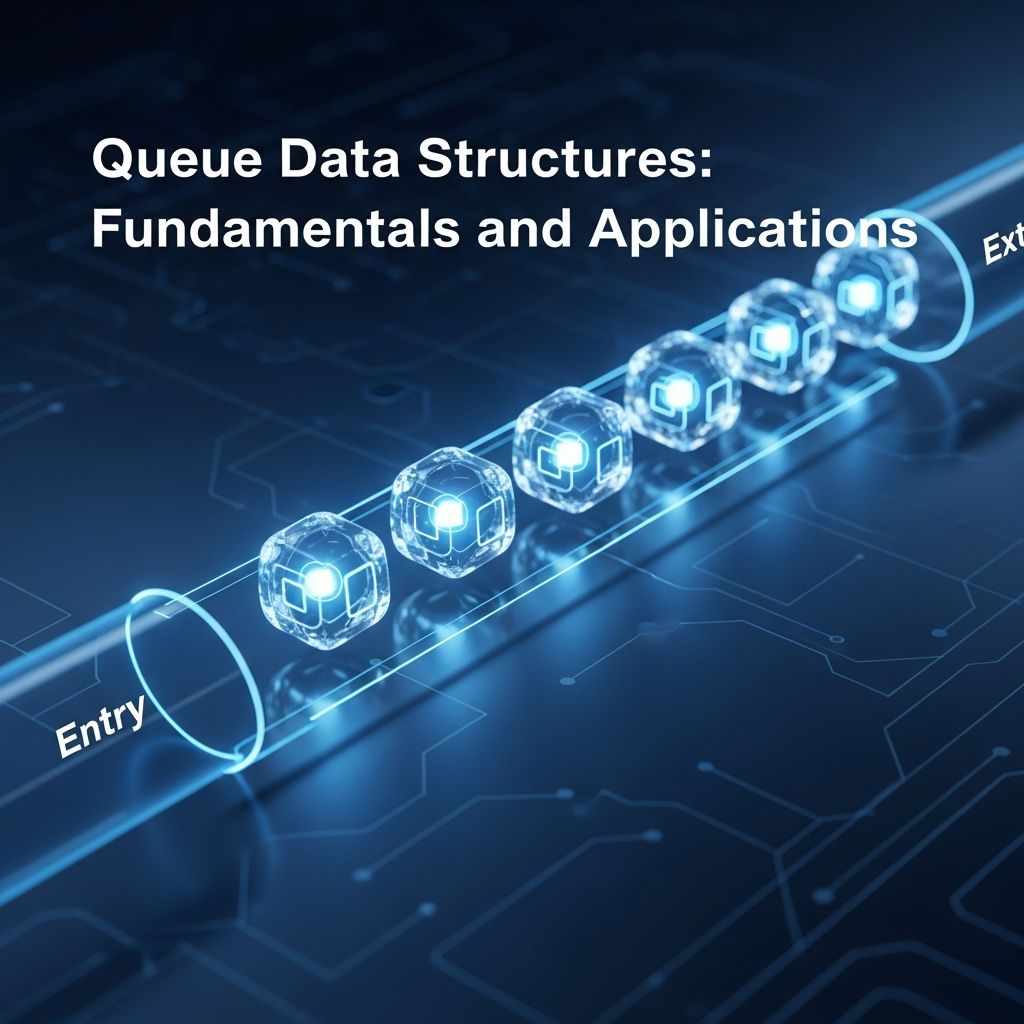
Understanding Queue Data Structures in Computing
A queue represents one of the most fundamental building blocks in computer science, functioning as a specialized data structure designed to manage collections of elements in a highly organized manner. At its core, a queue operates on a principle that mirrors everyday experiences—similar to standing in line at a grocery store or waiting in a customer service queue. The distinguishing characteristic of a queue lies in how it processes elements: items that arrive first are processed first, creating a systematic and predictable flow of data through the system.
The queue belongs to a category of data structures known as abstract data types (ADTs), which define operations and behavior without specifying exact implementation details. This abstraction allows programmers to work with queues in various programming environments using consistent logic while the underlying implementation may vary. Understanding queues is essential for anyone working in software development, systems programming, or computer science, as they form the foundation for countless algorithms and real-world applications.
The FIFO Principle and How Queues Operate
The fundamental operating principle behind queues is FIFO, an acronym standing for First In, First Out. This principle dictates that whichever element enters the queue first will be the first element to exit it. This ordering ensures a predictable, sequential processing pattern that proves invaluable in many computing scenarios.
Consider a practical analogy: when multiple customers arrive at a bank teller window, they form a line. The customer who arrives first gets served first, and only after they complete their transaction does the second customer proceed. Queues in computing follow this exact same logic. When data elements are added to a queue, they must wait their turn, and they are processed in the exact sequence in which they arrived. This temporal ordering creates fairness and predictability in data processing workflows.
The FIFO nature of queues contrasts sharply with other data structures like stacks, which follow a LIFO (Last In, First Out) principle. In a stack, the most recently added element is the first one removed—like a stack of plates in a cupboard where you remove the top plate first. Queues and stacks represent opposite approaches to organizing and accessing data, each suited to different computational problems.
Structural Characteristics and Access Points
A queue maintains a distinctive two-ended structure that differentiates it from many other data structures. One end of the queue serves as the entry point where new elements are inserted, while the opposite end functions as the exit point where elements are removed. This bidirectional accessibility is essential to the queue’s functionality and distinguishes it from linear structures that might only allow access from a single end.
Programmers refer to these two ends using specific terminology. The end where new elements are added is called the rear, tail, or back of the queue. Conversely, the end from which elements are removed is termed the front or head of the queue. This naming convention is consistent across most programming languages and computer science literature, making communication about queues clear and standardized.
The structural design of queues makes them naturally suited to managing workflows where orderly processing is critical. Whether distributing print jobs to a printer, managing incoming network packets, or scheduling processor tasks, the two-ended structure allows queues to maintain order while efficiently moving elements through the system.
Core Operations That Define Queue Functionality
Queue data structures support a focused set of operations designed to maintain the FIFO ordering while providing essential data management capabilities. These operations form the interface through which programmers interact with queues in their applications.
Primary Queue Operations
- Enqueue: This operation adds a new element to the queue, specifically inserting it at the rear end. When an element is enqueued, it joins the end of the line and must wait for all previously added elements to be processed first.
- Dequeue: This operation removes and returns the element currently at the front of the queue. The dequeue operation respects the FIFO principle by always removing the element that has been waiting the longest.
- Peek or Front: This non-destructive operation allows examination of the front element without actually removing it from the queue. Peek enables programs to check what data is next in line without altering the queue’s state.
- isEmpty: This status-checking operation determines whether the queue currently contains any elements. It proves useful before attempting dequeue operations to prevent errors when working with empty queues.
- isFull: In queue implementations with fixed maximum capacity, this operation checks whether the queue has reached its size limit and cannot accept additional elements.
- Size: This operation returns the count of elements currently stored in the queue, providing information about how many items are awaiting processing.
Implementation Approaches for Queue Structures
Queues can be implemented using several different underlying data structure approaches, each with distinct advantages and trade-offs regarding performance characteristics and memory usage.
Array-Based Implementation
One straightforward approach uses arrays to store queue elements. In this implementation, two index pointers—front and rear—track the positions of the queue’s ends within the array. When elements are enqueued, the rear pointer advances; when elements are dequeued, the front pointer advances. While simple to understand and implement, array-based queues can suffer from space inefficiency as the front pointer moves forward but the space behind it becomes unusable, creating what programmers call “wasted space.”
Linked List Implementation
A more flexible approach employs linked lists, where each queue element is contained in a node that maintains a reference to the next node in the sequence. The queue maintains pointers to both the front node (head) and rear node (tail), enabling efficient insertion at the rear and removal from the front. Linked list implementations eliminate the space waste problem inherent in arrays and allow queues to grow dynamically as needed, limited only by available system memory.
Circular Queue Implementation
To overcome array-based inefficiency, some implementations use circular queues where the array is treated as circular. When the rear pointer reaches the array’s end, it wraps around to the beginning. This approach reuses the space that earlier dequeue operations freed, making efficient use of the allocated memory while maintaining array-based performance characteristics.
Real-World Applications and Practical Uses
Queues are far from theoretical constructs—they solve genuine problems in modern computing systems and applications. Understanding these practical applications illustrates why mastering queue data structures matters for programmers and system designers.
Operating System Task Scheduling
Operating systems use queues to manage the flow of processes and threads waiting for processor time. When multiple programs request CPU resources simultaneously, the operating system places them in a ready queue ordered by arrival time. The processor then executes processes from the front of this queue, ensuring fair distribution of processing resources and preventing any single program from monopolizing the CPU.
Printer and Device Management
When multiple users send documents to a networked printer, print jobs form a queue. The printer processes these jobs in the order they arrived, completing them sequentially. This queue-based approach ensures predictable behavior and prevents document loss or confusion about print ordering.
Network Packet Handling
Routers and network devices use queues to manage incoming data packets. When packets arrive faster than they can be transmitted, they queue up, ensuring packets are processed in the order received and no data is lost due to overflow.
Customer Service Systems
Call centers and support systems frequently implement queues for managing incoming requests. Customers or requests join a queue, and available agents process them sequentially, maintaining order and fairness in service delivery.
Message Processing and Event Handling
In asynchronous programming and event-driven applications, queues manage events or messages that arrive at unpredictable times. The queue buffers these events, and application logic processes them systematically, preventing event loss and maintaining consistent behavior.
Performance Characteristics of Queue Operations
Understanding the computational efficiency of queue operations helps programmers select appropriate implementations for their specific applications. In well-implemented queues, most fundamental operations execute in constant time O(1), meaning they complete in the same time regardless of how many elements the queue contains.
Both enqueue and dequeue operations in linked list implementations simply adjust a few pointers and can execute extremely quickly. Array-based implementations offer similar performance when they avoid array resizing operations. Operations like isEmpty and size similarly execute in constant time for most implementations, making queues exceptionally efficient data structures for their intended purposes.
The efficiency of queue operations makes them suitable for performance-critical applications where system responsiveness is paramount. This performance advantage, combined with their inherent fairness through FIFO ordering, explains their ubiquity in operating systems and network infrastructure.
Common Challenges and Design Considerations
While queues are straightforward conceptually, implementing and using them effectively involves several important considerations. Fixed-size array implementations must handle cases where the queue becomes full and cannot accept new elements. Different applications handle fullness differently—some reject new elements with an error, others expand the queue capacity dynamically, and still others block incoming requests until space becomes available.
Thread safety represents another critical consideration in multi-threaded programming environments. When multiple threads attempt to enqueue and dequeue simultaneously, the queue implementation must employ synchronization mechanisms like locks or atomic operations to prevent race conditions and data corruption. Many programming languages provide thread-safe queue implementations specifically designed for concurrent environments.
Memory management for very large queues can also present challenges. Linked list implementations might fragment memory across many small allocations, while array implementations might consume excessive memory if sized too conservatively. Developers must balance memory efficiency with performance requirements for their specific use cases.
Queue Variants and Extensions
Beyond the basic queue structure, computer scientists have developed specialized variants to handle specific use cases. Priority queues process elements based on priority levels rather than pure arrival order, allowing important items to be handled before less urgent ones. Double-ended queues (deques) permit insertion and removal from both ends, combining properties of queues and stacks. These variants demonstrate how the fundamental queue concept can be adapted and extended to solve diverse computational problems.
Frequently Asked Questions
Q: How does a queue differ from a stack?
A: The fundamental difference lies in the order of element removal. Queues use FIFO (First In, First Out) ordering where the first element added is the first removed, while stacks use LIFO (Last In, First Out) ordering where the most recently added element is removed first. Choose queues for scenarios requiring fair processing order and stacks for scenarios needing to reverse or undo recent actions.
Q: What happens when you try to dequeue from an empty queue?
A: Most queue implementations return an error or null value when dequeue is called on an empty queue. This is why checking isEmpty before dequeuing is a best practice. Some implementations may raise exceptions or block the calling thread until elements become available.
Q: Can a queue ever become full?
A: In array-based implementations with fixed sizes, yes—a queue reaches its maximum capacity. Linked list implementations theoretically never become full unless system memory is exhausted. Many modern programming languages provide dynamic queues that expand automatically as needed.
Q: Which is better: array or linked list implementation?
A: Each has trade-offs. Array implementations offer faster memory access and cache efficiency but waste space as elements are removed. Linked list implementations use memory efficiently and never waste space but involve pointer dereferencing overhead. Choice depends on specific application requirements for speed and memory usage.
Q: How are queues used in breadth-first search algorithms?
A: Breadth-first search (BFS) explores graph nodes level by level. A queue stores nodes waiting to be explored. Nodes are added to the queue as they’re discovered and removed in FIFO order for processing, ensuring nodes are explored by distance from the starting point.
References
- Queue Data Structure — TutorialsPoint. Accessed April 2026. https://www.tutorialspoint.com/data_structures_algorithms/dsa_queue.htm
- Queue (abstract data type) — Wikipedia. Accessed April 2026. https://en.wikipedia.org/wiki/Queue_(abstract_data_type)
- Queue Data Structure — GeeksforGeeks. Accessed April 2026. https://www.geeksforgeeks.org/dsa/queue-data-structure/
- Queue Data Structure and Implementation in Java, Python and C/C++ — Programiz. Accessed April 2026. https://www.programiz.com/dsa/queue
- DSA Queues — W3Schools. Accessed April 2026. https://www.w3schools.com/dsa/dsa_data_queues.php

- Integrated M.A. in Applied Linguistics, University of Hyderabad
- 5+ years in editorial, instructional, SEO, and research-based writing
Sneha is a relationships and lifestyle writer with a strong foundation in applied linguistics and certified training in relationship coaching. She brings over five years of writing experience to theskillvault, crafting thoughtful, research-driven content that empowers readers to build healthier relationships, boost emotional well-being, and embrace holistic living. Her writing and insights reflect the belief that beauty, happiness, and wellness…