
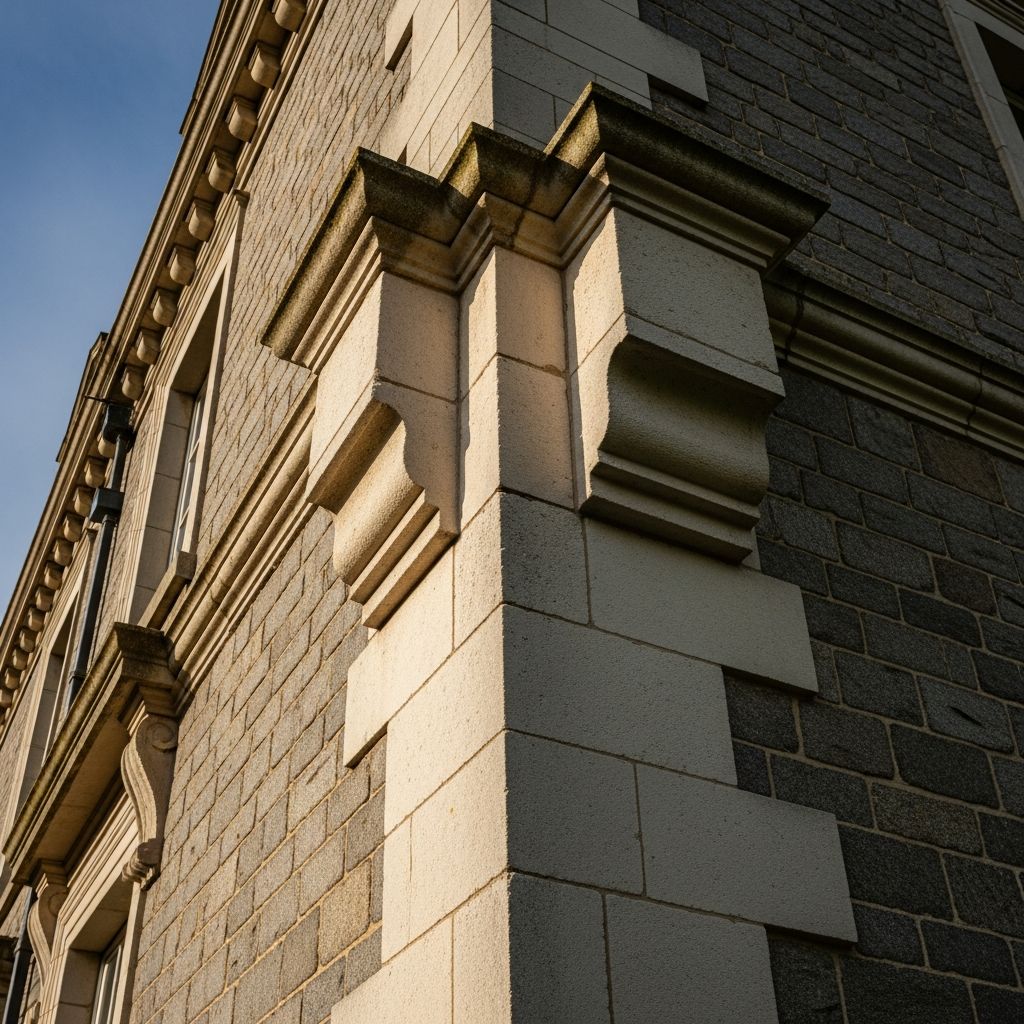
Quoins represent a fundamental yet often overlooked element in architectural design, serving as the masonry blocks or stones that define the external corners of buildings. These features not only provide essential structural support but also contribute significantly to the visual appeal of structures, distinguishing corners from the main wall surfaces through differences in material, color, texture, or projection.
The Essence and Definition of Quoins
In architectural terminology, a quoin refers to the solid exterior angle of a building, particularly the individual blocks forming that angle. According to standard definitions, quoins are differentiated from adjoining walls, often appearing larger, rusticated, or in contrasting hues to emphasize the building’s geometry. This practice dates back centuries, where quoins evolved from purely functional components to sophisticated decorative motifs.
Structurally, quoins reinforce vulnerable corner joints, especially in walls constructed from rubble or inferior stone, distributing loads more effectively. Aesthetically, they create a sense of solidity and permanence, signaling quality craftsmanship to observers. The term derives from ‘coin,’ an old spelling evoking a wedge or cornerstone, underscoring their role in anchoring a structure.
Historical Development of Quoins
Quoins trace their origins to ancient Western architecture, where cornerstones were essential for stability in stone masonry. Early examples appear in classical Greek and Roman buildings, though the term gained prominence in Renaissance and Gothic Revival styles. By the 19th century, encyclopedias noted quoins as symbols of strength and expense, enhancing a building’s imposing presence.
In medieval Europe, quoins were vital in castles and cathedrals, using large ashlar blocks to bind irregular rubble walls. The Gothic period introduced patterned quoins, with alternating long and short blocks creating a ‘toothed’ effect for visual rhythm. During the Georgian era, quoins became hallmarks of Palladian symmetry, adorning facades of grand estates and public edifices.
The Industrial Revolution shifted quoins toward brick construction, where molded or larger bricks simulated stone. Victorian architects employed polychromatic quoins, combining colored bricks for eclectic appeal. Today, quoins persist in neoclassical and postmodern designs, bridging historical authenticity with modern innovation.
Types and Variations of Quoins
Quoins vary widely in form and function, categorized by placement, pattern, and material. Understanding these distinctions aids architects and builders in selecting appropriate styles.
- Return Quoins: The classic type at building corners, featuring alternating bricks or stones with long and short exposures on each face, mimicking teeth for a dynamic outline.
- Reveal Quoins: Positioned along edges of openings like windows and doors, these extend the corner motif vertically, framing apertures elegantly.
- Chamfered Quoins: Adorned with beveled edges, these add refinement; applicable to any base type for a softened, sculpted appearance.
- Cladding Quoins: Non-structural overlays applied to existing walls, ideal for retrofits using precast concrete, stucco, or timber for cost-effective decoration.
Material choices expand options: stone for authenticity, brick for versatility, concrete for durability, and even terracotta for ornamental flair. Coursing patterns range from flush alignments to projecting profiles up to ¾ inch, ensuring harmony with wall planes.
Structural and Aesthetic Functions
Functionally, quoins bolster corner integrity by using superior masonry to interlock walls, preventing shear failures in seismic zones or under load. In brickwork, quoins of varying sizes—often two to three bricks long—create robust bonds, with heights spanning three to seven courses separated by one to three plain courses.
Aesthetically, quoins articulate form, guiding the eye along elevations and denoting hierarchy. Rusticated quoins, with rough-hewn surfaces, evoke ruggedness, while smooth ashlar variants suggest refinement. Color contrasts amplify impact, as seen in Federal-style homes where white stone quoins frame red brick walls.
| Type | Primary Function | Common Materials | Best Applications |
|---|---|---|---|
| Return | Corner reinforcement & emphasis | Stone, Brick | Freestanding walls, estates |
| Reveal | Opening framing | Brick, Stucco | Windows, Doors |
| Chamfered | Decorative beveling | Stone, Concrete | Modern facades |
| Cladding | Retrofit ornament | Precast, Timber | Renovations |
Construction Techniques for Quoins
Building quoins demands precision. For stone, select ashlar blocks larger than wall units, toothing them in alternating patterns. Brick quoins involve oversize or modular units, cut bricks for fits, and mortar joints matching wall gauges.
Installation steps include: laying base quoins level across corners; alternating stretchers and headers; projecting subtly if desired; and integrating with flashing for weatherproofing. Modern precast quoins simplify processes, cast off-site for uniformity.
Challenges arise in matching existing structures, requiring skilled cutting and bonding agents. Projections must not exceed code limits to avoid snagging hazards.
Quoins in Contemporary Architecture
Though less structural today, quoins thrive decoratively in residential, commercial, and institutional projects. They impart classical gravitas to suburban homes or delineate modern glass towers’ bases. Sustainable variants use recycled brick or low-cement concrete, aligning with green building standards.
In urban revitalization, quoins restore historic facades, qualifying for tax credits. Innovative designs incorporate LED lighting within quoins for nighttime drama or integrate sensors for smart buildings.
FAQ: Common Questions About Quoins
What materials are best for quoins?
Stone and brick remain ideal for authenticity and durability, while precast concrete suits budgets and speed.
Are quoins necessary for structural stability?
In modern reinforced construction, no; they primarily enhance aesthetics, though beneficial in unreinforced masonry.
How do quoins differ from regular corner blocks?
Quoins are distinctly larger, patterned, or contrasted, unlike uniform corner masonry.
Can quoins be added to existing buildings?
Yes, via cladding systems that bond securely without load-bearing demands.
What styles pair with quoins?
Classical, Georgian, Victorian, and Postmodern architectures favor quoins for symmetry and emphasis.
References
- QUOIN Definition & Meaning — Merriam-Webster. Accessed 2026. https://www.merriam-webster.com/dictionary/quoin
- Quoin – Definition, Meaning & Synonyms — Vocabulary.com. Accessed 2026. https://www.vocabulary.com/dictionary/quoin
- Quoin | Ancient, Building, Construction — Britannica. Accessed 2026. https://www.britannica.com/technology/quoin
- Quoin — Wikipedia. Accessed 2026. https://en.wikipedia.org/wiki/Quoin
- Types of Quoins and Where to Use Them — PW Profiles. Accessed 2026. https://pwprofiles.com/types-of-quoins-and-where-to-use-them/
- Brick Brief: Quoins — GoBrick (PDF). 2005-07. https://www.gobrick.com/media/file/quoins.pdf

Medha Deb is an editor with a master's degree in Applied Linguistics from the University of Hyderabad. She believes that her qualification has helped her develop a deep understanding of language and its application in various contexts. Medha specializes in the areas of beauty, health, sports, and wellness and is committed to ensuring that the content on the website is…