
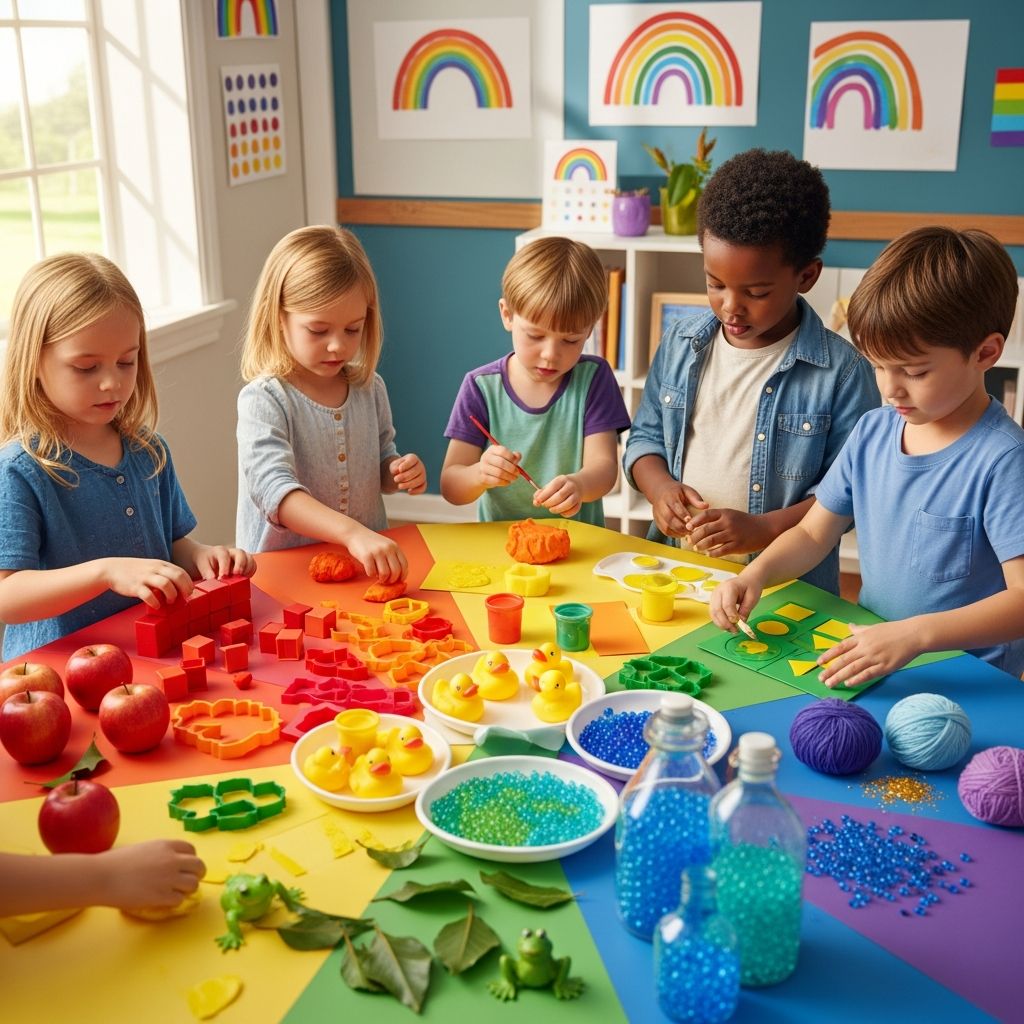
Introduction to Rainbow-Based Learning Experiences
Color perception and recognition form fundamental components of early childhood development, establishing the foundation for visual discrimination and cognitive growth. Incorporating rainbow-themed activities into preschool curricula provides educators and caregivers with multisensory opportunities to engage young learners across diverse developmental domains. These activities transcend simple color identification, fostering language development, mathematical reasoning, artistic expression, and social-emotional skills through playful exploration.
Rainbow activities leverage children’s natural fascination with vibrant colors and the wonder associated with weather phenomena, transforming ordinary learning moments into memorable experiences. By structuring lessons around this thematic approach, educators can create cohesive learning sequences that reinforce concepts across multiple subject areas while maintaining children’s engagement and enthusiasm.
Artistic Expression and Creative Exploration
Visual arts provide preschoolers with non-verbal channels for self-expression and creativity. Rainbow-centered art projects encourage children to experiment with colors, textures, and techniques while developing fine motor control and hand-eye coordination.
One foundational approach involves **rainbow handprinting activities**, where children paint their hands in the sequence of rainbow colors and create impressions on large paper surfaces. This tactile experience connects physical movement with color awareness, and children can enhance their prints by adding complementary elements such as clouds, raindrops, or landscape features. This activity also provides natural transitions to hygiene instruction, as handwashing becomes an integral component of the project completion process.
**Fingerprint-based rainbow compositions** offer alternative approaches for children who prefer less direct hand involvement in painting. Educators can outline rainbow arcs using markers or tape, allowing children to fill designated sections with fingerprints in corresponding colors. This technique introduces discussion opportunities regarding fingerprint uniqueness and the tactile variations children observe and create.
**Mixed-media rainbow collages** combine multiple materials and techniques, incorporating elements such as colored paper, tissue paper, fabric scraps, and natural materials. Children develop decision-making skills by selecting and arranging materials while creating three-dimensional compositions. These projects strengthen spatial reasoning and planning abilities as children contemplate color combinations and design arrangements.
Sensory and Tactile Learning Pathways
Sensory experiences engage children’s multiple neural pathways simultaneously, creating robust learning connections. Rainbow-themed sensory activities provide rich opportunities for exploration across different modalities.
**Contact paper rainbow window installations** create interactive visual experiences. By securing adhesive contact paper with the sticky side exposed to windows or walls and allowing children to arrange colored tissue paper pieces into rainbow formations, educators provide immediate visual feedback. Children observe how light interacts with their creations, gaining understanding of color transparency and light transmission while developing spatial arrangement skills.
**Sensory bin explorations** combine color sorting with discovery-based learning. Educators can fill containers with items such as colored pasta, pompoms, buttons, or plastic beads, encouraging children to categorize materials by color while experiencing different textures and weights. Adding tools such as tweezers, spoons, and cups extends the activity duration and introduces fine motor challenges.
**Shaving cream color investigations** provide tactile engagement combined with color mixing concepts. By layering shaving cream with food coloring or liquid watercolor in rainbow hues and allowing children to swirl and manipulate the medium, educators create opportunities for sensory exploration and spontaneous color theory learning. Children discover secondary colors through mixing while enjoying the sensory pleasure of soft, cool textures.
**Rainbow play dough compositions** offer extended creative engagement with manipulable materials. Educators can prepare colored play dough batches or provide children with commercial options in rainbow hues. Children develop fine motor strength through kneading, rolling, and sculpting while creating three-dimensional representations of rainbows or related imagery.
Motor Skill Development Through Rainbow Activities
Physical development constitutes a critical component of early childhood education. Rainbow-themed activities provide naturalistic contexts for strengthening both fine and gross motor capabilities.
**Threading and bracelet-making projects** using rainbow-colored cereal or beads present concentrated fine motor challenges. Children coordinate finger movements with visual tracking, developing the precision necessary for later writing and academic tasks. The edible nature of cereal creates multi-sensory experiences and provides natural taste rewards, increasing children’s motivation to persist through frustration.
**Rainbow cup stacking challenges** introduce progression levels accommodating diverse skill levels. Basic stacking requires coordination and balance, while more advanced variations incorporate color-matching prerequisites or speed components. These activities strengthen hand-eye coordination, bilateral coordination, and spatial awareness while introducing competitive or personal achievement frameworks.
**Rainbow hopscotch patterns** created on outdoor surfaces using chalk combine gross motor development with number recognition and color identification. Children navigate these patterns during free play, developing balance, coordination, and motor planning skills while reinforcing academic concepts in naturalistic contexts.
**Rainbow dance ribbon activities** integrate music, movement, and coordination. By attaching rainbow-colored ribbons or streamers to sticks or rings, educators provide visual feedback for children’s movement patterns. Dancing while manipulating ribbons develops bilateral coordination, body awareness, and rhythmic understanding.
Cognitive and Academic Integration
Rainbow themes provide authentic contexts for introducing and reinforcing foundational academic skills. By embedding mathematics, literacy, and science concepts within rainbow frameworks, educators increase engagement and meaning-making.
**Color-based sorting and categorization** activities develop classification skills fundamental to mathematical reasoning. Educators can provide mixed collections of objects and ask children to organize materials by color, then by size within color categories, and progressively by multiple attributes. These experiences build the logical thinking necessary for more complex mathematics.
**Number recognition and counting sequences** integrate naturally with rainbow imagery. Educators can create numbered rainbow cards, asking children to sequence cards from one through six, matching each number to its corresponding rainbow stripe. Variations include counting objects placed in rainbow color order or identifying quantities represented by different color groups.
**Pattern creation using rainbow colors** develops mathematical thinking related to sequences and predictability. Children can arrange pompoms, blocks, or other manipulatives in ROYGBIV patterns, then create more complex variations involving multiple attributes such as alternating colors and sizes.
**Story generation and narrative development** leveraging rainbow themes support language and literacy growth. Educators can prompt children to imagine scenarios beginning with “After the rain came a rainbow…” or provide story baskets containing items associated with rainbows and weather, asking children to create coherent narratives incorporating selected objects.
**Letter and sound recognition** connects to rainbows through songs and games. Adapting familiar melodies to include color names and initial sound repetitions creates memorable learning experiences. Educators can sing “Can you find the color red?” to well-known tunes, extending the activity by asking children to locate objects beginning with the “r” sound.
Science Exploration and Discovery
Rainbows represent visible demonstrations of light physics, providing concrete entry points for scientific inquiry. Age-appropriate investigations help preschoolers develop observational skills and curiosity about natural phenomena.
**Prism exploration** allows children to discover how light bends and separates into color components. Educators can provide optical prisms, positioning them in direct sunlight and inviting children to observe the resulting rainbow projections. Discussions about where rainbows appear in nature and why they only emerge under specific lighting conditions develop foundational understanding of light behavior.
**Water glass rainbow creation** provides accessible alternatives when prisms are unavailable. By filling clear glasses or jars partially with water and positioning them in sunlight on white paper surfaces, educators create similar light-refraction demonstrations. Children discover that water itself can create rainbows, expanding their conceptual understanding.
**Color mixing investigations** introduce concepts of primary and secondary colors through experimental processes. Using washable paints, food coloring in water, or other materials, children combine colors and observe resulting hues. Guided questioning helps children develop hypotheses about color combinations before observing outcomes.
Dramatic Play and Role-Based Learning
Imaginative play contexts provide opportunities for social development, language practice, and conceptual application. Rainbow-themed dramatic play scenarios encourage children to integrate learning across domains.
**Rainbow farmers markets** incorporate color sorting with dramatic play. Educators set up pretend market environments featuring colored play foods organized by color or requiring color-based categorization during transactions. Children practice social interactions, develop economic understanding, and reinforce color concepts through meaningful roleplay.
**Rainbow laundry stations** present similar opportunities using toy clothing or cloth items. Children sort items by color, practice matching sets, and engage in functional life skills while developing color discrimination abilities. Threading clothesline and hanging items provides fine motor challenges within purposeful contexts.
**Rainbow dress-up experiences** allow children to select and wear clothing items in specific colors or rainbow sequences. These activities support decision-making, color identification, and self-directed learning in low-pressure environments.
Music and Movement Integration
Musical experiences enhance memory, emotional development, and rhythmic awareness while providing enjoyable contexts for learning reinforcement. Rainbow-themed songs and movements offer multisensory engagement opportunities.
Educators can introduce traditional songs such as “Somewhere Over the Rainbow” or create original compositions emphasizing color names and sequences. Pairing songs with corresponding movements—such as reaching high for “red,” bending for “orange,” or spinning for “rainbow”—creates kinaesthetic learning anchors that reinforce concepts through physical memory.
**Rainbow color songs** adapted to familiar melodies like “Twinkle Twinkle Little Star” or “Bingo” provide repetitive reinforcement in engaging formats. These musical experiences support language acquisition, vocabulary retention, and emotional connection to learning content.
Inclusion and Accessibility Considerations
Effective rainbow activities accommodate diverse learner needs and abilities. Educators should provide multiple entry points and response options throughout implementations.
For children with fine motor challenges, educators can offer alternatives such as dot markers instead of fingerprinting, large-handle brushes instead of thin brushes, or pre-sorted materials requiring only arrangement rather than detailed manipulation. Children with sensory sensitivities might participate in rainbow activities using non-tactile methods such as pointing, identifying, or verbal participation rather than direct contact with materials.
Visual impairments require adaptations emphasizing tactile and auditory elements. Textured rainbow compositions, sound-based color identification games, or scented rainbow experiences accommodate different sensory capabilities while maintaining engagement and learning objectives.
Frequently Asked Questions
Q: At what age can children begin rainbow-focused activities?
A: Rainbow activities can be adapted for children from infancy through early elementary grades. Toddlers benefit from simple color exploration and sensory experiences, while preschoolers engage with more complex sorting, patterning, and conceptual activities. Teachers should adjust complexity and materials based on developmental levels.
Q: How can educators integrate rainbow activities with existing curricula?
A: Rainbow themes naturally intersect with most early childhood curricula. Educators can incorporate rainbow activities during color unit instruction, weather studies, art periods, or as transition activities throughout the day. Activities address multiple learning standards simultaneously, making them efficient curricular choices.
Q: What materials and supplies are essential for rainbow activities?
A: Basic supplies include washable markers, construction paper, paint, glue, and common household items. Many activities use inexpensive or recycled materials such as colored tissue paper, fabric scraps, or plastic containers. Educators can supplement with specialty items as budgets allow, but creativity and imagination substitute effectively for expensive resources.
Q: How do rainbow activities support children with different learning styles?
A: Rainbow activities inherently address multiple intelligences and learning preferences. Visual learners benefit from color-focused activities, kinesthetic learners engage through movement and manipulation, auditory learners connect through songs and discussions, and interpersonal learners thrive in collaborative group activities. The versatility of rainbow themes accommodates diverse learning profiles naturally.
Q: Can rainbow activities extend learning beyond classroom time?
A: Absolutely. Educators can send home activity suggestions encouraging families to explore rainbows during outdoor play, photograph rainbows in nature, sort household items by color, or create simple rainbow crafts. These extensions reinforce learning, build family engagement, and create positive associations with educational concepts in home environments.
References
- Preschool Rainbow Lesson Planning Ideas — Pre-K Printable Fun. 2026. https://www.prekprintablefun.com/rainbow-lesson-planning-page.html
- 40+ Amazing Toddler Rainbow Activities — Teaching 2 and 3 Year Olds. 2026-02-18. https://teaching2and3yearolds.com/40-toddler-rainbow-activities/
- Rainbow Activities for Preschool — Mrs Mama Bird. 2023-03-13. https://mrsmamabird.com/2023/03/13/rainbow-activities-for-preschool-free-printable/
- Rainbow Activities for Toddlers & Preschoolers — Oh Hey Let’s Play. 2026. https://ohheyletsplay.com/home/rainbow-activities-for-toddlers-amp-preschoolers
- Early Childhood Color Development — National Association for the Education of Young Children (NAEYC). 2024. https://www.naeyc.org/

Medha Deb is an editor with a master's degree in Applied Linguistics from the University of Hyderabad. She believes that her qualification has helped her develop a deep understanding of language and its application in various contexts. Medha specializes in the areas of beauty, health, sports, and wellness and is committed to ensuring that the content on the website is…