
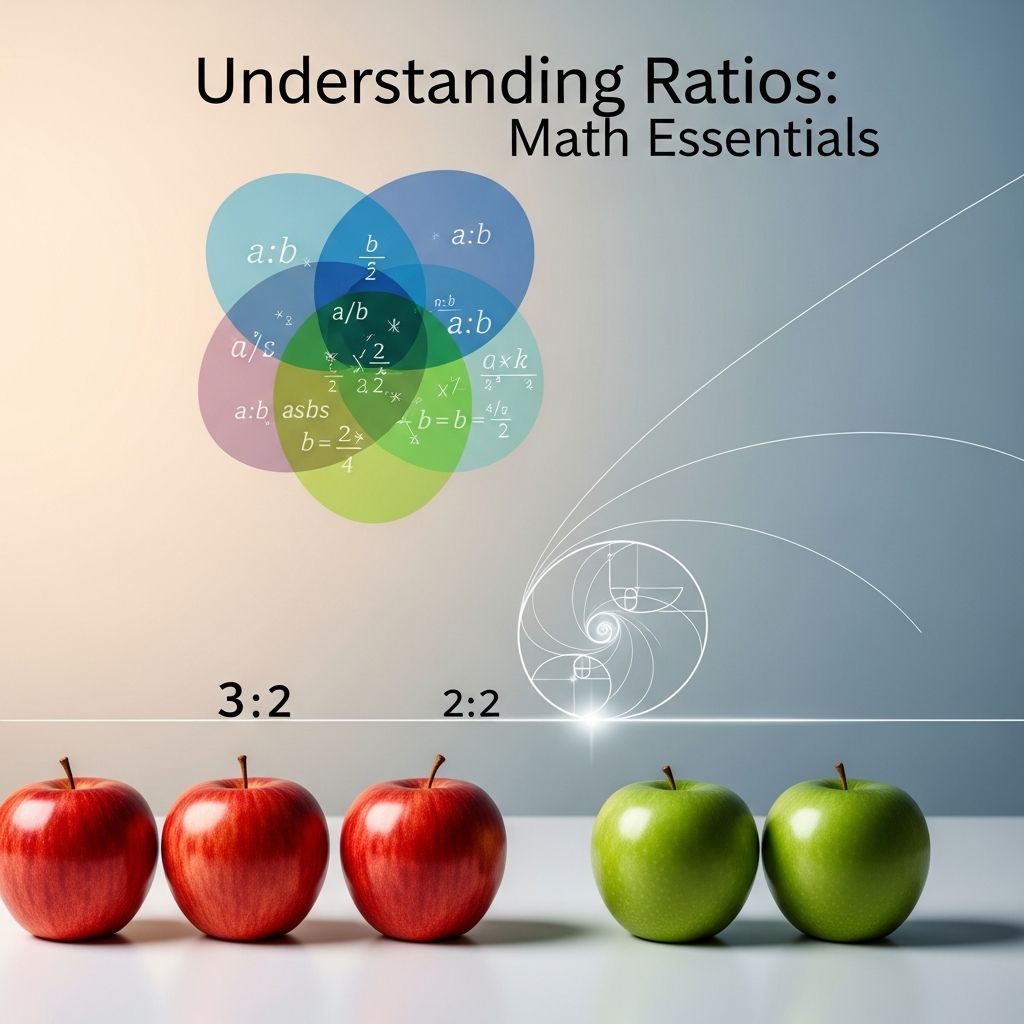
Ratios form a cornerstone of mathematics, enabling comparisons between quantities to reveal relationships and proportions. This guide explores ratios comprehensively, from basic definitions to advanced applications, using original explanations and examples.
Defining Ratios in Mathematics
A **ratio** compares two or more quantities of the same unit, showing how one relates to another through division. Expressed as a fraction (a/b), colon notation (a:b), or words (a to b), it quantifies relative sizes. For instance, in a group of 40 students with 24 girls, the girl-to-student ratio is 24:40, simplifying the relationship.
Ratios differ from fractions by emphasizing comparison over exact value. The first term, antecedent, divides into the second, consequent. This structure underpins rates, percentages, and scaling in math.
Types of Ratios: Part-to-Part and Part-to-Whole
Ratios fall into two primary categories: **part-to-part** and **part-to-whole**.
- Part-to-Part Ratio: Compares distinct groups within a whole. Example: In a class, boys to girls is 16:24, meaning for every 16 boys, there are 24 girls.
- Part-to-Whole Ratio: Relates one part to the total. Example: If 12 out of 30 fruits are apples, the ratio is 12:30, or 2:5 simplified.
These distinctions aid in analyzing data sets, like demographics or inventory.
Expressing Ratios: Formats and Conventions
Ratios appear in multiple forms for flexibility:
- Fraction: 3/4
- Colon: 3:4
- Words: 3 to 4
Consistency matters in context. Maps use scales like 1:100000 (1 unit to 100000 real units). Recipes specify 2:1 flour-to-sugar.
| Scenario | Fraction | Colon | Words |
|---|---|---|---|
| Apples to Oranges (5:8) | 5/8 | 5:8 | 5 to 8 |
| Miles per Gallon (25:1) | 25/1 | 25:1 | 25 to 1 |
| Students per Teacher (30:1) | 30/1 | 30:1 | 30 to 1 |
This table illustrates uniform representation across contexts.
Simplifying Ratios: Step-by-Step Process
Simplifying reduces ratios to lowest terms by dividing by the greatest common divisor (GCD). Steps:
- Write as fraction: e.g., 20/30.
- Find GCD (10).
- Divide both: 20÷10 / 30÷10 = 2/3.
Example: Simplify 36:48. GCD=12, so 36÷12:48÷12=3:4.
Practice table:
| Original Ratio | GCD | Simplified |
|---|---|---|
| 15:25 | 5 | 3:5 |
| 42:63 | 21 | 2:3 |
| 100:150 | 50 | 2:3 |
Ratio Tables: Visualizing Relationships
**Ratio tables** list equivalent ratios by scaling. For 2:3:
| Multiple | First Quantity | Second Quantity |
|---|---|---|
| 1 | 2 | 3 |
| 2 | 4 | 6 |
| 3 | 6 | 9 |
| 5 | 10 | 15 |
Tables predict outcomes, like scaling recipes: double 2:3 to 4:6 cups.
Ratios and Proportions: Solving Equations
A **proportion** equates two ratios: a:b = c:d, or a/b = c/d. Solve unknowns:
Example: If 2 apples cost $1, how much for 6? Set 2/1 = 6/x. Cross-multiply: 2x=6, x=3.
- Verify: Multiply by same factor to check equality.
Proportions apply to speeds (60 miles/2 hours = 30 mph) and concentrations.
Real-World Applications of Ratios
Ratios permeate life:
- Recipes: 3:1 oil-to-vinegar yields balance.
- Finance: Debt-to-income 28:36 ideal for loans.
- Science: Mixing solutions 1:10 acid-to-water.
- Sports: Wins-to-losses 7:3 season record.
- Maps: 1:50000 scale inches to miles.
In business, profit margins (revenue:costs) guide decisions.
Common Mistakes and Tips for Mastery
Avoid pitfalls:
- Confusing order: 3:4 ≠ 4:3.
- Forgetting units: Match apples to apples.
- Not simplifying: Always reduce.
Tips: Practice with visuals, use calculators for GCD, apply to daily scenarios like fuel efficiency (miles:gallons).
Advanced Ratio Concepts
Explore **rates** (different units, e.g., 60 mph) and **continued ratios** (a:b:c). In geometry, side ratios define similar triangles.
Statistics use ratios for odds (1:5 chance).
Frequently Asked Questions (FAQs)
What is the basic definition of a ratio?
A ratio compares two quantities of the same unit via division, written as a:b or a/b.
How do you simplify a ratio like 24:36?
Find GCD (12), divide: 24÷12:36÷12 = 2:3.
What’s the difference between ratio and proportion?
Ratio compares two quantities; proportion states two ratios are equal.
Can ratios have decimals or fractions?
Yes, e.g., 1.5:2 or 3/4:1, but simplify to lowest terms.
Why use ratio tables?
They generate equivalent ratios for scaling problems efficiently.
References
- What Is a Ratio? A Kid-Friendly Definition — Mathnasium. 2023. https://www.mathnasium.com/math-terms/ratio
- Ratio – Meaning, Simplification, Table, Examples — Cuemath. 2024-01-15. https://www.cuemath.com/commercial-math/ratio/
- Understanding Ratios: Definitions, Examples & Everyday Applications — DreamBox Learning. 2023. https://www.dreambox.com/math/skills/numbers/ratios
- 1.3: Ratios — Mathematics LibreTexts (Western Oregon University). 2022-08-10. https://math.libretexts.org/Courses/Western_Oregon_University/Math_110:_Applied_College_Mathematics/01:_Numbers_and_Relationships/1.03:_Ratios
- Ratios — MathsIsFun. 2023. https://www.mathsisfun.com/numbers/ratio.html
- Intro to ratios (video) — Khan Academy. 2022. https://www.khanacademy.org/math/cc-sixth-grade-math/cc-6th-ratios-prop-topic/intro-to-ratios/v/ratios-intro

Medha Deb is an editor with a master's degree in Applied Linguistics from the University of Hyderabad. She believes that her qualification has helped her develop a deep understanding of language and its application in various contexts. Medha specializes in the areas of beauty, health, sports, and wellness and is committed to ensuring that the content on the website is…