
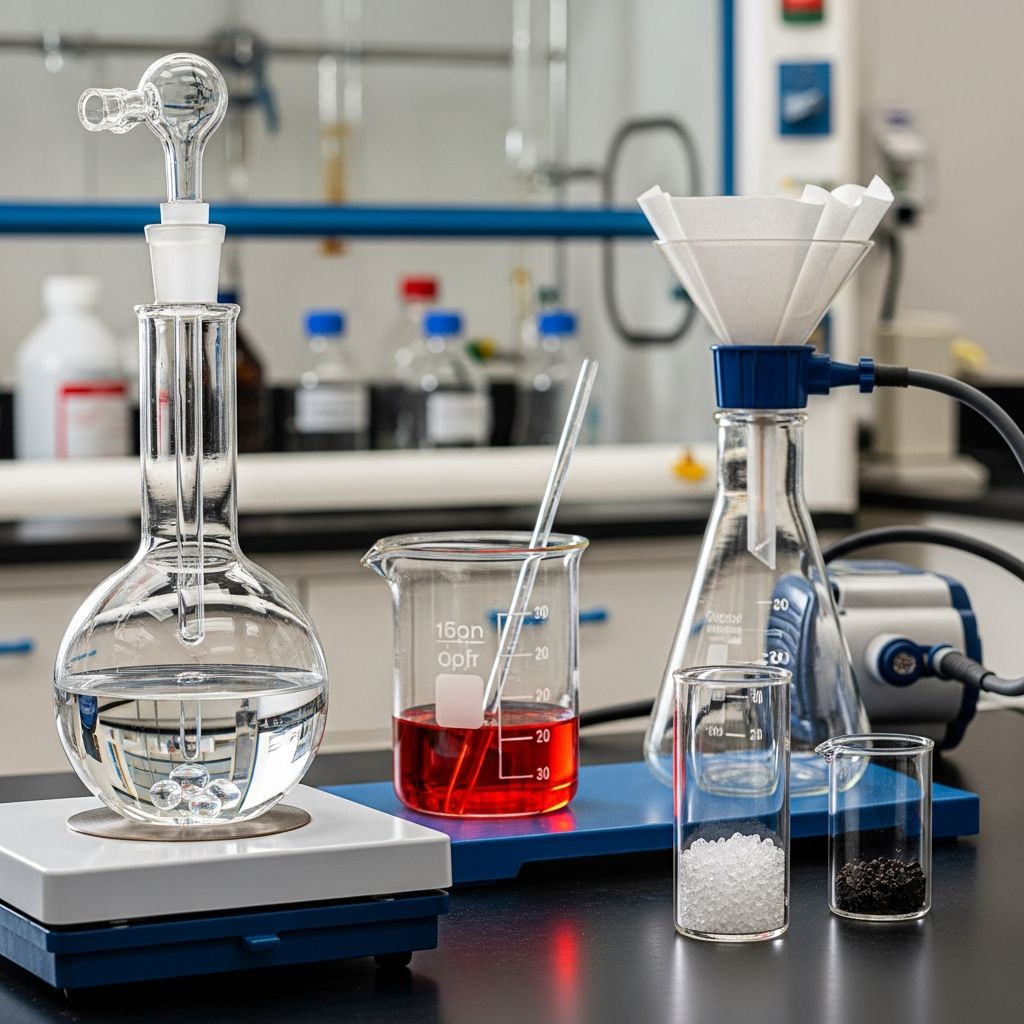
Understanding Recrystallization as a Purification Method
Recrystallization stands as one of the most fundamental and widely-used techniques in organic chemistry laboratories for achieving purified solid compounds. This purification method operates on a straightforward yet elegant principle: exploiting differences in solubility between desired compounds and their impurities across varying temperature ranges. By dissolving an impure solid in heated solvent and allowing it to cool gradually, chemists can achieve selective crystallization where pure compounds preferentially form while contaminants remain dissolved or separate from the crystal lattice.
The effectiveness of recrystallization relies on understanding that most compounds exhibit temperature-dependent solubility patterns. When a solution becomes supersaturated during cooling, the dissolved solute transitions from liquid to solid form, creating an opportunity to isolate pure crystals while leaving unwanted impurities behind. This technique has remained central to synthetic chemistry, pharmaceutical development, and materials science for over a century, making it essential knowledge for chemistry students and practicing chemists alike.
Selecting an Appropriate Recrystallization Solvent
The foundation of successful recrystallization rests entirely on choosing the correct solvent. This decision determines whether the entire procedure will succeed or fail, making solvent selection far more than a casual consideration. Several critical criteria must guide this choice.
The ideal recrystallization solvent should demonstrate a high temperature coefficient of solubility, meaning the compound dissolves substantially better at elevated temperatures compared to room temperature. This dramatic difference in solubility across the temperature range enables crystals to precipitate effectively as the solution cools. A solvent lacking this characteristic will either dissolve the compound poorly even when heated, or remain too soluble at low temperatures, preventing crystallization altogether.
Beyond temperature response, the solvent must interact appropriately with both the desired compound and impurities. Selectivity becomes paramount—the ideal solvent dissolves the target compound readily while leaving impurities either completely insoluble or only minimally soluble at all temperatures. This differential solubility ensures effective separation during cooling. Conversely, if impurities dissolve in the solvent with similar affinity to the desired compound, they will crystallize alongside it, undermining the entire purification goal.
Additional practical considerations include chemical inertness, ensuring the solvent doesn’t react with the compound being purified or introduce new impurities. The solvent should be relatively nonflammable and inexpensive, particularly important when working with large quantities. Volatility—the capacity to evaporate readily at modest temperatures—allows residual solvent to escape from collected crystals without requiring extreme heating that might damage the product. Low boiling point solvents prove especially valuable because they evaporate quickly and completely, leaving crystals uncontaminated by solvent residues.
Common Solvents and Selection Principles
The principle “like dissolves like” guides solvent selection, though with a counterintuitive twist: chemists often choose solvents with polarity that does NOT precisely match their target solute. This ensures moderate solubility that changes dramatically with temperature rather than uniform solubility across temperature ranges. Water, ethanol, acetone, and hexane represent commonly employed recrystallization solvents, each with distinct properties suited to different compound classes. Polar compounds often crystallize from polar solvents like water or ethanol, while nonpolar compounds respond better to nonpolar solvents such as hexane or benzene.
Dissolving the Compound and Managing Solvent Addition
Once an appropriate solvent has been identified, the dissolution phase begins. This step requires careful technique and patience to succeed. The selected solvent must be heated to its boiling point or near-boiling temperature before introduction to the impure compound. Using boiling stones during heating prevents bumping and ensures smooth, even temperature distribution. The heated solvent should then be added incrementally to the beaker containing the impure solid, with the key principle being to use the minimum volume necessary for complete dissolution.
As solvent is added, the mixture requires constant stirring or swirling to maximize contact between the solid and liquid phases. Operators should observe whether the solid dissolves completely, adding small additional portions of hot solvent only as needed. This conservative approach prevents oversaturation, which would reduce the driving force for crystallization during cooling. If excessive solvent is added, the resulting solution remains unsaturated even at low temperatures, and no crystals will form—a common mistake that requires the entire procedure to restart with fresh material.
The dissolution process sometimes produces solutions containing insoluble impurities—particles that simply won’t dissolve regardless of heating or solvent volume. These materials must be removed before proceeding to crystallization. This removal occurs through hot filtration, where the heated solution passes through filter paper while maintaining elevated temperature, allowing the solute to remain dissolved while solid impurities collect on the filter. The filtrate—the liquid passing through the filter—must be reheated immediately if any precipitation occurs during filtration, as cooling during this step causes premature crystallization.
Temperature Management During Cooling
The cooling phase represents perhaps the most critical stage in the entire recrystallization procedure. Cooling rate directly determines crystal size and purity, making this step absolutely central to success. Slow, deliberate cooling allows molecules to arrange themselves into orderly crystal lattices with minimal defects. When cooling occurs rapidly, molecules precipitate from solution in a chaotic manner, creating small, impure crystals with many impurity molecules trapped within the crystal structure.
The cooling sequence should follow a graduated approach. Initially, the hot solution should cool undisturbed at room temperature, remaining covered to prevent dust contamination while allowing solvent vapors to escape. Only after the solution has cooled completely to room temperature should additional cooling occur through placement in an ice bath for approximately five to ten minutes. This staged cooling prevents shock crystallization while maximizing the time available for large, well-formed crystals to develop.
Occasionally, solutions cool without crystallization occurring spontaneously, a situation called superheating. In these cases, crystallization can be induced by gentle mechanical disturbance—scratching the flask bottom with a glass rod creates a nucleation site where crystals can begin forming. Alternatively, seeding the solution with a tiny crystal of known pure product initiates crystallization by providing an established crystal surface. These induced crystallization methods prove invaluable when solutions refuse to cooperate with standard cooling protocols.
Removing Insoluble Impurities and Clarifying Solutions
Some crude materials contain considerable quantities of insoluble particles—dust, undissolved reagents, or byproducts from the synthesis. These materials must be separated from the solution before crystallization, as they would otherwise contaminate the final crystal product. Hot filtration achieves this separation while maintaining the solution in a dissolved state.
Two primary filtration approaches exist for removing insoluble impurities. Vacuum filtration employs an aspirator to draw air through filter paper at reduced pressure, accelerating solvent passage and preventing premature cooling. Gravity filtration relies on natural gravitational flow, allowing solvent to pass through filter paper at a slower but often more controlled rate. When vacuum filtration risk premature crystallization due to pressure reduction and temperature decrease, gravity filtration may prove preferable despite requiring more time.
In some cases, filtration introduces unwanted color or cloudiness to the solution—evidence of very finely suspended impurities or decomposition products. Activated carbon can remove these colored impurities through adsorption. The carbon is added to the hot solution, which is then boiled and rapidly filtered again. The carbon particles adsorb colored impurities while remaining trapped by the filter paper, yielding a clear, colorless solution ready for crystallization.
Crystal Formation and Collection Techniques
As the cooled solution reaches near-room temperature or lower temperatures through ice bath treatment, pure crystalline material begins precipitating from solution. These crystals represent the purified compound, separated from impurities that remain dissolved in the solvent. Collection of these crystals occurs through vacuum filtration using a Buchner funnel—a specialized filtering apparatus designed to work with reduced pressure.
The Buchner funnel, connected to an aspirator creating suction, draws the liquid through filter paper while retaining crystals on the paper surface. Care must be taken to ensure the solution has fully cooled to room temperature before vacuum filtration, preventing premature crystallization within the vacuum filter itself. Once filtration begins, residual solvent remaining with the crystals must be rinsed away using a small volume of cold recrystallization solvent, further purifying the product. This rinsing removes adhering solution and dissolved impurities clinging to the crystal surfaces.
Following filtration, collected crystals must be dried completely before further analysis or use. This drying can occur at room temperature through evaporation, or at elevated temperature if the compound proves thermally stable. Some laboratories employ vacuum desiccators for rapid drying. Melting point determination of the purified crystals provides objective evidence of purity—pure compounds exhibit sharp, narrow melting point ranges, while impure materials display broad melting ranges with lower melting points than pure standards.
Advanced Recrystallization Strategies and Modifications
Standard single-solvent recrystallization works effectively for many compounds, but some materials require modified approaches. Mixed-solvent recrystallization employs two solvents with differing polarities, offering greater selectivity in separating compounds from impurities. The compound dissolves in one solvent while impurities remain insoluble, then the second solvent is added to induce crystallization without further dissolving impurities.
Evaporative recrystallization removes solvent through evaporation rather than cooling to induce crystallization. This approach proves valuable when compounds remain soluble even at very low temperatures or when no suitable antisolvent can be identified for mixed-solvent approaches. Challenges include unpredictable nucleation points and difficulty scaling procedures, but evaporative methods provide alternatives when conventional cooling fails.
Repeated recrystallization cycles progressively increase purity when single passes prove insufficient. Each cycle removes additional impurities, though material loss accumulates with each repetition. For extremely demanding applications requiring extraordinary purity, multiple recrystallizations represent a worthwhile investment of time and material.
Optimizing Results and Troubleshooting Common Problems
Several factors can undermine recrystallization success. Crystallization failure to occur after cooling typically indicates oversaturation—too much solvent was used and the solution remains unsaturated even at low temperatures. Resolution requires starting over with fresh compound and less solvent. Small, impure crystals suggest overly rapid cooling or excessive nucleation site disturbance during crystallization. Remedy involves retrying with more gradual cooling and minimal solution disturbance. Complete dissolution failure indicates wrong solvent selection, requiring identification of alternative solvents meeting selection criteria.
Crystal yield represents another important consideration. Theoretical yield calculations based on compound mass rarely match actual crystallized mass due to solubility losses—some compound always remains dissolved in cold solvent after filtration. Achieving 70-80% recovery represents realistic expectation for well-executed recrystallization, with remaining material dissolved in filtrate rather than lost through decomposition or reaction.
Frequently Asked Questions
Q: Why is slow cooling critical for recrystallization success?
A: Slow cooling allows dissolved molecules to organize gradually into ordered crystal structures. Rapid cooling causes chaotic precipitation, trapping impurities within the crystal lattice and producing small, impure crystals. The slower the cooling rate, the larger and purer the resulting crystals typically become.
Q: How do I know if my solvent choice is correct?
A: Test solvents by attempting dissolution at room temperature (minimal dissolution desired) and boiling temperature (substantial dissolution desired). The compound should barely dissolve when cold but dissolve readily when heated. If dissolution occurs equally well at both temperatures, that solvent is unsuitable regardless of other properties.
Q: Can I reuse the filtrate solvent from recrystallization?
A: Generally no. The filtrate contains dissolved impurities removed from the crystals, and reusing this solvent would reintroduce those impurities. However, volatile solvents can be recovered through distillation for other laboratory uses if permitted by safety protocols.
Q: What temperature should the ice bath reach?
A: An ice bath reaches approximately 0°C (32°F) when ice and water are mixed. This temperature sufficiently lowers solubility for most recrystallization applications. Do not use dry ice unless the compound remains stable at temperatures below -78°C.
Q: How can I improve crystal size and quality?
A: Use minimal solvent volume so fewer total crystals form at larger individual sizes. Cool over extended periods (overnight if possible) rather than hours. Avoid disturbing the flask during crystallization. Use seed crystals to initiate ordered growth. These methods all promote formation of larger, higher-quality crystals.
Q: Does recrystallization work for all solid compounds?
A: Most organic compounds can be recrystallized with careful solvent selection, but some materials require alternative purification methods. Polymers, highly polar ionic compounds, and extremely insoluble materials sometimes respond better to other techniques such as chromatography or washing with selective solvents.
References
- Recrystallization Definition, Principle & Purpose — PraxiLabs. 2022-11-07. https://praxilabs.com/en/blog/2022/11/recrystallization/
- Recrystallization — University of Pittsburgh Department of Chemistry. Accessed 2026-04-04. https://sites.pitt.edu/~ceder/add_info/recrystallization.html
- Recrystallization Guide: Process, Procedure, Solvents — Mettler Toledo. Accessed 2026-04-04. https://www.mt.com/us/en/home/applications/L1_AutoChem_Applications/L2_Crystallization/recrystallization.html
- Recrystallization | Organic Chemistry I Lab — University of Richmond Department of Chemistry. Accessed 2026-04-04. https://blog.richmond.edu/chem205l/recrystallization/
- Recrystallization – Chemistry LibreTexts — LibreTexts Chemistry Education Platform. Accessed 2026-04-04. https://chem.libretexts.org/Bookshelves/Physical_and_Theoretical_Chemistry_Textbook_Maps/Supplemental_Modules_(Physical_and_Theoretical_Chemistry)/Physical_Properties_of_Matter/Solutions_and_Mixtures/Case_Studies/RECRYSTALLIZATION
- Organic Chemistry Lab: Recrystallization — YouTube, Dr. Scott Allen. Accessed 2026-04-04. https://www.youtube.com/watch?v=XK0MZk3Q4jk

- Integrated M.A. in Applied Linguistics, University of Hyderabad
- 5+ years in editorial, instructional, SEO, and research-based writing
Sneha is a relationships and lifestyle writer with a strong foundation in applied linguistics and certified training in relationship coaching. She brings over five years of writing experience to theskillvault, crafting thoughtful, research-driven content that empowers readers to build healthier relationships, boost emotional well-being, and embrace holistic living. Her writing and insights reflect the belief that beauty, happiness, and wellness…