
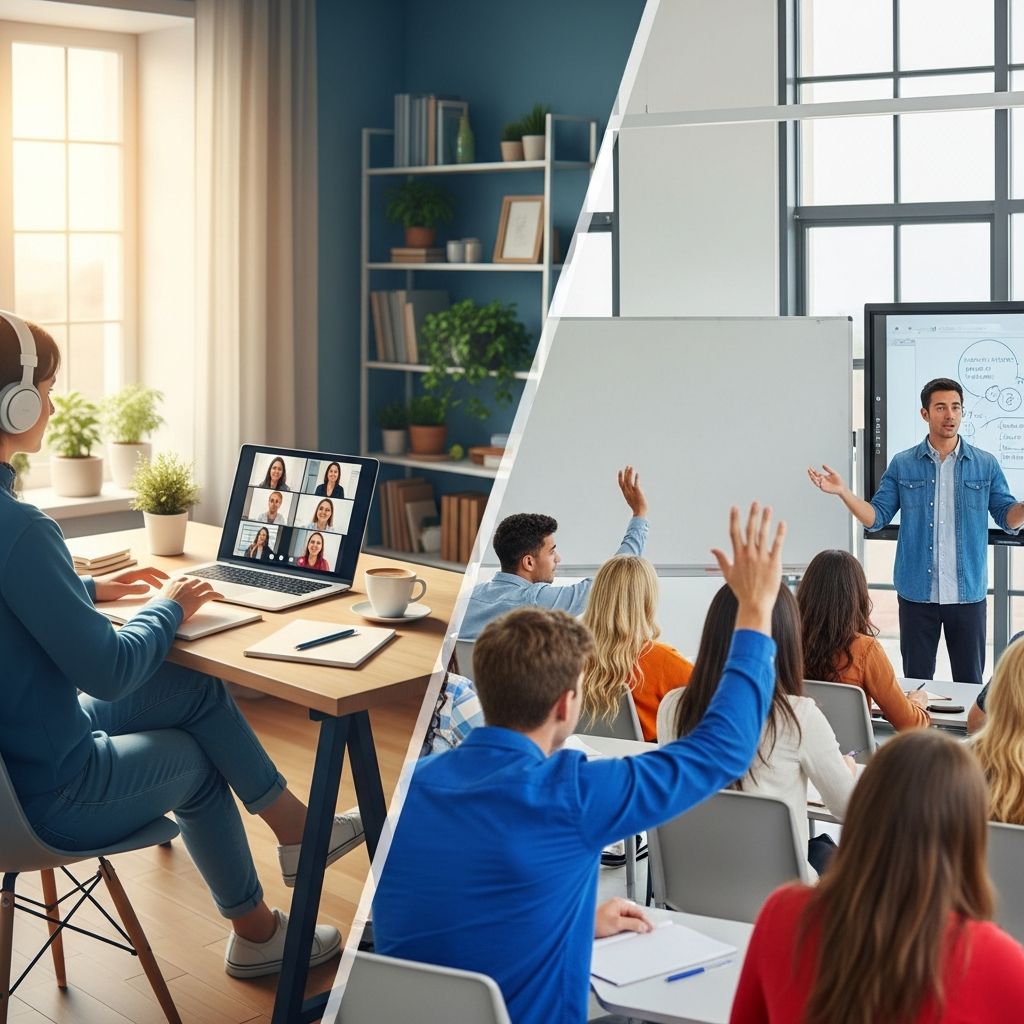
Remote learning, often conducted entirely online, empowers students to access education from any location with internet connectivity, while classroom learning relies on physical presence in structured environments for direct instruction. This comparison examines their core aspects to guide informed decisions in an evolving educational landscape.
Core Elements of Learning Delivery
Learning delivery forms the foundation of both approaches. In classroom settings, instruction happens synchronously in a designated space, fostering immediate feedback and group dynamics. Remote learning, by contrast, leverages digital platforms for asynchronous or synchronous sessions, allowing access to materials at the learner’s convenience.
Classroom education immerses students in a shared physical space where instructors lead live sessions, enabling real-time clarification of concepts. Remote formats distribute content via learning management systems (LMS) like Blackboard or Google Classroom, supporting self-paced progression. Key variances include lesson location, timing, pace, and required student independence.
Advantages of Remote Learning
Remote education shines in accessibility and adaptability. Students can engage from virtually anywhere, eliminating commutes and accommodating busy lifestyles, such as full-time jobs or family duties.
- Schedule Flexibility: Learners choose optimal study times, pausing videos or revisiting modules without constraints.
- Cost Savings: Reduced expenses on travel, housing, and materials make it more affordable than traditional options.
- Tech Proficiency: Exposure to tools like Zoom enhances digital skills, valuable in modern job markets.
- Global Reach: Access to diverse instructors and peers worldwide broadens perspectives.
These benefits particularly aid non-traditional students, with data showing about 30% of enrollments in online formats by 2014, a trend that continues.
Drawbacks of Remote Learning
Despite its perks, remote learning demands high self-discipline. Without physical oversight, procrastination risks rise, and technical glitches can disrupt progress.
- Limited Personal Interaction: Asynchronous elements reduce spontaneous discussions, potentially hindering deep understanding.
- Tech Barriers: Reliable internet and devices are essential; gaps exacerbate inequities.
- Motivation Challenges: Isolated environments may lead to lower engagement compared to communal classrooms.
Strengths of Classroom Education
Classroom learning excels in fostering direct human connections. Face-to-face interactions build community, with instructors providing instant guidance and peers offering collaborative energy.
- Immediate Feedback: Real-time Q&A sessions clarify doubts effectively.
- Social Development: Daily interactions hone soft skills like teamwork and communication.
- Structured Routine: Fixed schedules promote discipline and consistent progress.
- Hands-On Resources: Access to labs, libraries, and equipment enhances practical learning.
This model suits disciplines requiring experimentation or group work, maintaining a teacher-dominant environment that guides novices.
Limitations of Classroom Education
Traditional setups impose rigid structures. Fixed locations and times exclude those with geographic or scheduling constraints.
- Geographic Restrictions: Proximity to institutions is mandatory, disadvantaging rural students.
- Higher Costs: Tuition, commuting, and living expenses add up significantly.
- Less Personalization: Uniform pacing may not fit diverse learning speeds.
- Health Risks: In-person gatherings can spread illnesses, as seen in pandemics.
Student Engagement and Interaction Patterns
Engagement differs markedly. Classrooms enable synchronous, verbal exchanges with visual cues, creating dynamic discussions. Remote interactions blend synchronous (live calls) and asynchronous (forums) modes, offering recorded feedback but less immediacy.
Traditional settings form community-like bonds, though hierarchies may emerge. Online platforms reduce anxiety for shy participants, enabling thoughtful contributions via text. However, studies note potential gaps in relational depth.
Academic Performance: Evidence from Studies
Research on outcomes shows parity in many cases. Distance students often match or exceed traditional peers in exams and assignments, with one study reporting higher final grades (86 vs. 78 mean scores).
| Metric | Remote Learning | Classroom Learning |
|---|---|---|
| Pre/Post-Test Gains | 13.22 points | 10.03 points |
| Final Exam Mean | 86 | 78 |
| Overall Outcomes | Comparable or higher | Strong in interaction-heavy subjects |
Both groups improve similarly, though remote learners may start stronger. Factors like age and motivation influence results; older remote students often excel due to purpose-driven enrollment. No significant differences appear in homework or papers.
Financial Considerations
Costs vary substantially. Remote programs cut overheads, with lower tuition and no relocation needs. Traditional education incurs higher fees for facilities and staff, plus indirect costs like transport.
- Remote: Tech setup (~$500-1000 initial), but scalable savings.
- Classroom: Annual extras ($5,000+ for commuting/housing).
For working adults, remote’s ‘covenant lite’ model proves economical.
Technology’s Role in Modern Education
Digital tools bridge gaps in remote learning, from LMS for content delivery to AI for personalized quizzes. Classrooms increasingly adopt hybrids, blending in-person with online elements (30-79% digital). This evolution suggests integration over opposition.
Who Benefits Most from Each Model?
Choose based on lifestyle: Remote suits self-starters, parents, or remote residents. Classroom fits those needing structure, social immersion, or lab access. Hybrids offer balance.
Future Directions in Education
Trends point to blended models, leveraging remote flexibility with classroom interaction. Post-pandemic data affirms remote viability, with 3 million fully online U.S. students historically. AI and VR may further equalize experiences.
Frequently Asked Questions
Is remote learning as effective as classroom learning?
Studies indicate comparable or superior outcomes in many metrics, especially for motivated adults, though interaction varies.
Does remote education save money?
Yes, by reducing travel and housing costs, though tech investments are needed.
Can remote learning build social skills?
It fosters digital collaboration but lags in face-to-face nuances; hybrids help.
Who should pick classroom over remote?
Students in hands-on fields or seeking community thrive in traditional settings.
What about hybrid options?
They combine flexibility (online) with structure (in-person), ideal for diverse needs.
References
- Distance Learning vs. Traditional Learning: Pros and Cons — Western Governors University. 2022-10-01. https://www.wgu.edu/blog/distance-learning-traditional-learning-pros-cons2210.html
- Comparing of Distance Education and Traditional Education — ScholarWorks, University of Northern Iowa. 2017. https://scholarworks.uni.edu/cgi/viewcontent.cgi?article=4875&context=grp
- Online Learning vs Traditional — Hutchinson Community College. 2023. https://www.hutchcc.edu/online-vs-trad
- Better, Worse, Or As Good As Traditional Education? — Online Journal of Distance Learning Administration. 2011. https://ojdla.com/archive/winter44/tucker44.pdf
- Online classes versus traditional classes? Comparison during… — PMC (PubMed Central), National Library of Medicine. 2022-02-10. https://pmc.ncbi.nlm.nih.gov/articles/PMC8826787/

Medha Deb is an editor with a master's degree in Applied Linguistics from the University of Hyderabad. She believes that her qualification has helped her develop a deep understanding of language and its application in various contexts. Medha specializes in the areas of beauty, health, sports, and wellness and is committed to ensuring that the content on the website is…