
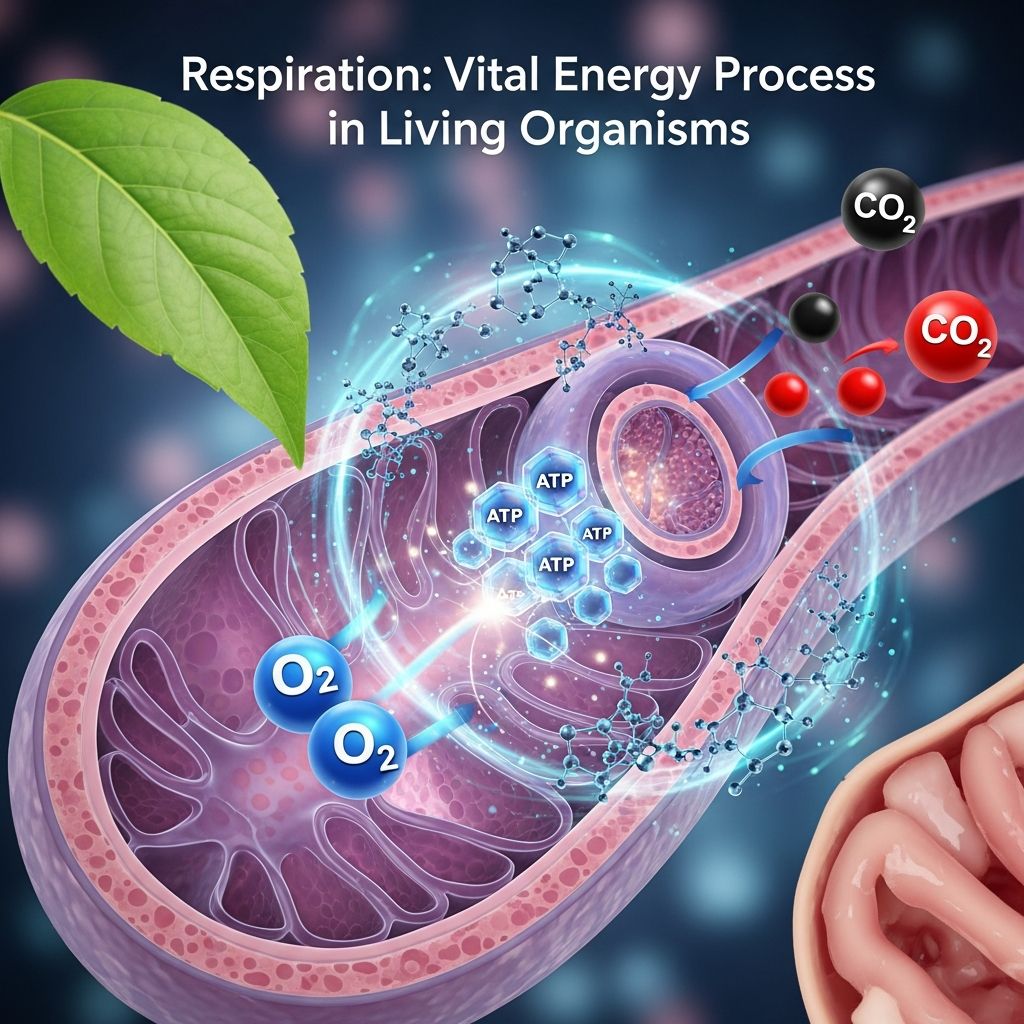
Respiration stands as a fundamental biological process enabling organisms to harness energy from nutrients, powering every cellular activity from movement to growth. Unlike casual references to breathing, true respiration encompasses intricate metabolic pathways that generate adenosine triphosphate (ATP), the universal energy currency of cells, while managing gas exchange and waste elimination.
Understanding the Dual Nature of Respiration
Respiration operates on multiple levels. At its physiological level, it involves the intake of oxygen and expulsion of carbon dioxide through breathing, facilitating gas exchange between the environment and blood. This external respiration occurs primarily in the lungs’ alveoli, where oxygen diffuses into the bloodstream and carbon dioxide moves outward due to partial pressure gradients.
Internally, respiration shifts to the tissues, where oxygen is delivered to cells for energy production, and carbon dioxide is picked up for exhalation—a process termed internal respiration. At the cellular core, respiration breaks down organic molecules like glucose to yield ATP, water, and carbon dioxide, distinguishing it sharply from mere ventilation.
Key Distinctions: Physiological vs. Cellular Respiration
- Physiological Respiration: Focuses on whole-body gas transport, involving lungs, blood, and tissues for oxygen delivery and CO2 removal.
- Cellular Respiration: Occurs inside cells, metabolizing nutrients with or without oxygen to produce usable energy.
These layers interconnect seamlessly: breathing supplies oxygen for cellular work, which in turn produces the CO2 exhaled during ventilation.
Aerobic Respiration: The Oxygen-Powered Pathway
Aerobic respiration, the predominant energy-producing mechanism in plants, animals, and most eukaryotes, requires oxygen and yields the highest ATP output—up to 36-38 molecules per glucose. Its overall equation simplifies a multi-stage cascade:
C₆H₁₂O₆ + 6O₂ → 6CO₂ + 6H₂O + ATP (energy)
Stage 1: Glycolysis in the Cytoplasm
Glycolysis kicks off the process by splitting one glucose into two pyruvate molecules, netting 2 ATP and 2 NADH (electron carriers). This oxygen-independent step sets the foundation for subsequent phases.
Stage 2: Pyruvate Oxidation and Citric Acid Cycle
Pyruvate enters mitochondria, converting to acetyl-CoA, which feeds the citric acid cycle (Krebs cycle). Here, electrons are stripped for carriers (NADH, FADH₂), and 2 ATP are generated per glucose, alongside CO₂ release.
Stage 3: Electron Transport Chain and Oxidative Phosphorylation
The mitochondrial inner membrane hosts the electron transport chain (ETC), where NADH and FADH₂ donate electrons, driving proton pumps to create a gradient. Oxygen acts as the final acceptor, forming water. ATP synthase harnesses this gradient for bulk ATP production—about 32-34 per glucose.
| Stage | Location | ATP Yield | Key Products |
|---|---|---|---|
| Glycolysis | Cytoplasm | 2 | Pyruvate, NADH |
| Citric Acid Cycle | Mitochondrial Matrix | 2 | CO₂, NADH, FADH₂ |
| Oxidative Phosphorylation | Mitochondrial Inner Membrane | 32-34 | ATP, H₂O |
Anaerobic Respiration: Surviving Without Oxygen
When oxygen is scarce, cells switch to anaerobic respiration (fermentation), producing only 2 ATP per glucose but preventing pyruvate buildup. Common in muscle cells during intense exercise or microorganisms like yeast.
Lactic Acid Fermentation
In animals, pyruvate reduces to lactate, regenerating NAD⁺ for glycolysis continuation. Equation: Glucose → 2 Lactate + 2 ATP. Lactate accumulates, causing muscle fatigue, but is later converted back in the liver.
Alcoholic Fermentation
Yeast and plants decarboxylate pyruvate to acetaldehyde, then ethanol, releasing CO₂ (baking/brewing utility). Equation: Glucose → 2 Ethanol + 2 CO₂ + 2 ATP.
- Anaerobic yields far less energy but allows rapid ATP production in low-oxygen scenarios.
Respiration Across Kingdoms: Adaptations and Variations
While aerobic dominates higher organisms, anaerobes like certain bacteria thrive solely on fermentation. Plants perform aerobic respiration at night, using daytime photosynthesis products. Humans exhibit specialized breathing types:
- Diaphragmatic (Abdominal): Diaphragm-driven, ideal for rest.
- Thoracic: Chest expansion-focused, seen in restricted abdominal conditions.
Globally, respiration balances photosynthesis: organisms consume O₂ and release CO₂, cycling Earth’s atmosphere.
Health Implications and Disruptions
Respiratory efficiency underpins health. Hypoxia (low oxygen) impairs ATP production, leading to fatigue or organ failure. Conditions like asthma hinder external respiration, while mitochondrial disorders affect cellular stages. Exercise boosts mitochondrial density, enhancing aerobic capacity.
Environmental factors, such as high altitudes, trigger anaerobic shifts initially, with acclimatization increasing red blood cells for better O₂ delivery.
Modern Research and Applications
Understanding respiration fuels biotech: engineered microbes for biofuels mimic fermentation, while drugs target ETC for cancer therapy (disrupting tumor energy). Climate models factor respiration’s CO₂ emissions from soils and oceans.
Frequently Asked Questions (FAQs)
What is the main difference between aerobic and anaerobic respiration?
Aerobic uses oxygen for high ATP yield (36-38), while anaerobic does not, yielding only 2 ATP via fermentation.
Where does most ATP production occur in cellular respiration?
The majority (32-34 ATP) arises from oxidative phosphorylation in mitochondria.
Can plants respire?
Yes, plants perform cellular respiration continuously, using glucose from photosynthesis.
What happens during anaerobic respiration in humans?
Muscles produce lactate, causing soreness until oxygen restores aerobic pathways.
Why is oxygen crucial in respiration?
It serves as the final electron acceptor in the ETC, enabling efficient ATP synthesis.
Conclusion: Respiration’s Enduring Vitality
Respiration’s elegance lies in its universality, sustaining life from microbes to mammals through precise energy extraction and gas management. Ongoing studies promise innovations in medicine and sustainability, underscoring its timeless relevance.
References
- Respiration | Equation, Steps & Types — Study.com. Accessed 2026. https://study.com/learn/lesson/what-is-respiration.html
- Respiration: Videos & Practice Problems — Pearson. Accessed 2026. https://www.pearson.com/channels/anp/learn/bruce/the-respiratory-system/respiration
- Respiration Definition — BYJU’S. Accessed 2026. https://byjus.com/biology/respiration/
- Respiration | Taber’s Medical Dictionary — Taber’s Online. Accessed 2026. https://www.tabers.com/tabersonline/view/Tabers-Dictionary/743039/all/respiration
- Respiration – Kids — Britannica Kids. Accessed 2026. https://kids.britannica.com/kids/article/respiration/400163
- Respiration (physiology) — Wikipedia (informational). Accessed 2026. https://en.wikipedia.org/wiki/Respiration_(physiology)
- Respiration – Understanding Global Change — UC Berkeley UGC. Accessed 2026. https://ugc.berkeley.edu/background-content/respiration/

Medha Deb is an editor with a master's degree in Applied Linguistics from the University of Hyderabad. She believes that her qualification has helped her develop a deep understanding of language and its application in various contexts. Medha specializes in the areas of beauty, health, sports, and wellness and is committed to ensuring that the content on the website is…