
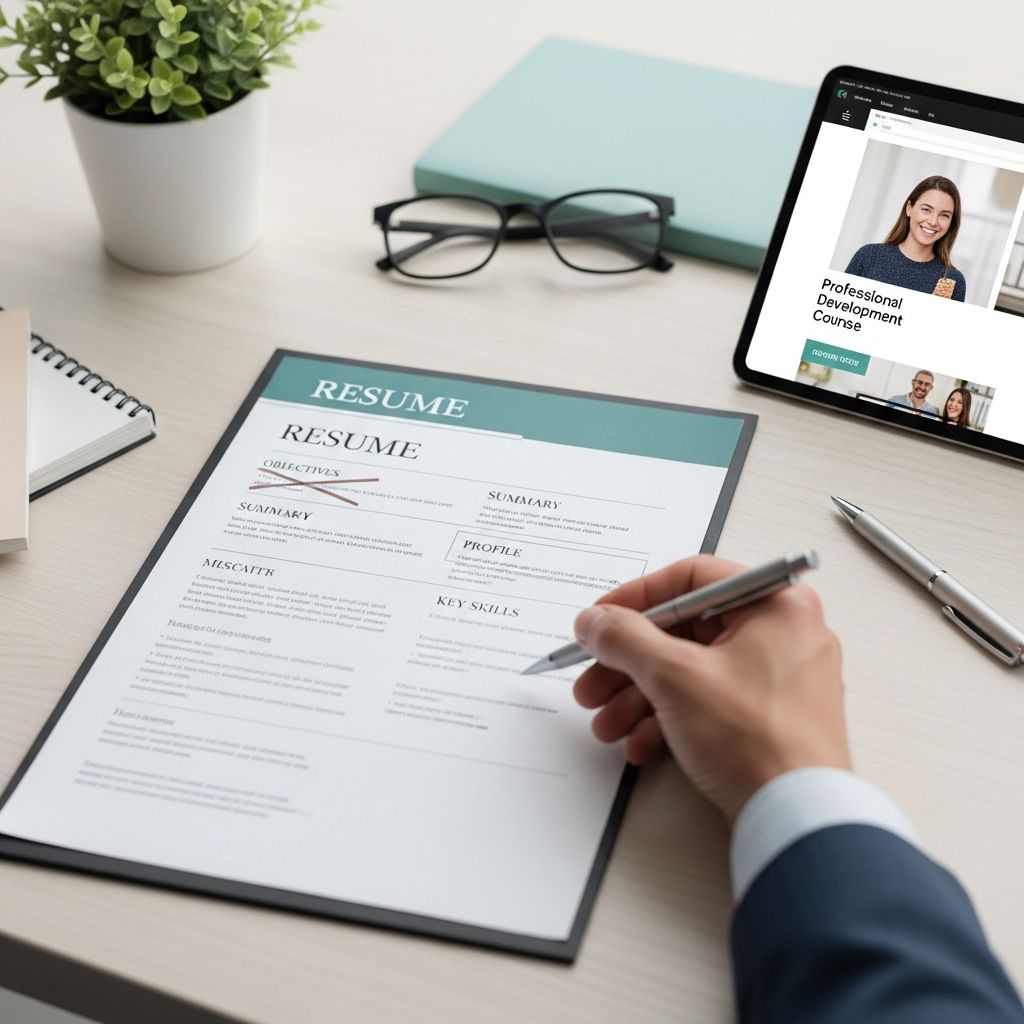
The first few lines of your resume are the most valuable real estate you have. Wasting them on a vague, outdated resume objective is one of the fastest ways to lose a recruiter’s attention. Modern hiring practices and applicant tracking systems (ATS) reward resumes that lead with clear value, measurable impact, and relevant keywords instead of generic career goals.
This guide explains why traditional objectives no longer help you, what to use instead, and how to build a compelling top section that makes hiring managers want to keep reading.
Why Traditional Resume Objectives Don’t Work Anymore
Objective statements used to be common because resumes were treated as short personal bios. Today, competition is higher, recruiters have less time, and hiring is heavily data-driven. Your resume must prove value in seconds.
Main problems with old-style objectives
- They focus on what you want instead of what the employer needs, which does not help a recruiter solve their hiring problem.
- They sound generic, using reusable phrases like “seeking a challenging position” that could appear on almost any resume.
- They waste prime space at the top of the page that could show skills, results, and credentials that matter.
- They lack keywords and context, making it harder for ATS tools to match your resume to the job description.
Research on resume effectiveness shows that recruiters often spend only a few seconds scanning each resume, which means weak or unfocused openings are likely to be skipped.
When a Short Objective Can Still Be Useful
While you should avoid traditional objective paragraphs, a short, targeted objective can make sense in certain specific cases.
- Entry-level candidates who have limited experience but clear skills and education.
- Career changers who need to explain why they are moving into a new field and how their background transfers.
- Returning workers re-entering the market after a long break who want to clarify their target role.
Even in these cases, the objective should still emphasize your contribution and the employer’s benefit, not just your aspirations.
Three Strong Alternatives to Resume Objectives
Most professionals are better served by modern, employer-focused profile sections that summarize their strengths and achievements.
1. Professional summary (value-focused profile)
A professional summary is a brief paragraph (2–4 sentences) that answers three questions:
- Who are you professionally?
- What specific strengths and experience do you bring?
- What types of results do you deliver?
Top resume experts describe the summary as a concise snapshot of your core qualifications and fit for the target role.
What to include in your summary
- Your professional identity (e.g., “Data analyst,” “Senior HR leader”).
- Years of relevant experience or level (e.g., entry-level, mid-career).
- Key skills and tools mentioned in the job description, such as software, methods, or domains.
- Concrete outcomes like revenue growth, cost savings, or process improvements.
Simple summary formula
Use this structure to write a strong summary:
- Line 1: Your role, level, and main focus.
- Line 2: 3–4 core strengths or areas of expertise.
- Line 3: 1–2 key achievements or types of results you routinely deliver.
2. Key achievements or highlights section
Instead of telling employers what you want, show them what you have already done. A short list of career highlights near the top of your resume quickly proves your ability.
How to structure a highlights section
- Use 3–5 bullet points.
- Start each with an action verb (“led,” “designed,” “improved”).
- Include numbers where possible: percentages, revenue, time saved, volume handled.
- Pick accomplishments that align with the job’s top responsibilities.
Recruiters and hiring managers consistently report that measurable achievements make resumes more persuasive than lists of duties.
3. Skills and expertise snapshot
A concise list of core skills helps both ATS software and human reviewers quickly see if you match the role.
Tips for a strong skills snapshot
- Group skills into 2–3 categories such as “Technical,” “Business,” and “Leadership.”
- Use the same wording employers use in the job description for key competencies.
- Mix hard skills (software, tools, languages) with select soft skills that are clearly relevant.
- Avoid long lists of generic traits like “hardworking” or “team player” without proof.
Comparing Old Objectives and Modern Alternatives
| Feature | Traditional Objective | Modern Alternative (Summary/Highlights) |
|---|---|---|
| Main focus | Your goals and preferences | Employer needs and your value |
| Impact on reader | Provides little evidence | Shows specific proof of ability |
| Fit with ATS | Often light on relevant keywords | Rich in role-specific language and context |
| Best use cases | Rare: early career or major career shift | Suitable for nearly all professionals |
| Length | Often 3–4 vague lines | 2–4 lines plus 3–5 concrete bullets |
How to Build a High-Impact Resume Top Section
Use this step-by-step approach to transform an old-fashioned objective into a modern, powerful opening.
Step 1: Clarify your target role
Before you write a single word, decide which role and level you’re aiming for. Studies of job search behavior show that targeted resumes perform better than generic ones because they more closely match employer requirements.
- Pick a clear job title (or two close variants).
- Gather 3–5 job descriptions for that role.
- Highlight repeated keywords, skills, and responsibilities.
Step 2: Write a focused professional summary
Using the formula above, draft a summary that speaks directly to the needs you saw in those job descriptions.
- Mention your title and years of experience.
- Align your strengths with the employer’s priorities.
- Include at least one result that involves numbers or clear outcomes.
Step 3: Add 3–5 achievement bullets
Under your summary, add a small section such as “Selected Achievements” or “Career Highlights.” Each bullet should answer:
- What problem did you solve?
- What did you do to solve it?
- What changed, and how can you measure it?
Research on evidence-based hiring indicates that past performance is one of the best predictors of future results, which is why concrete achievements are so compelling to employers.
Step 4: Build a concise skills block
Below your highlights, create a short skills section that mirrors the language employers use in their postings.
- Limit to the most relevant 8–15 skills.
- Use consistent formatting (e.g., comma-separated or bullets).
- Avoid listing tools or systems you have only seen once; prioritize what you can truly use on day one.
Adapting Your Approach for Different Career Situations
The best way to open your resume depends somewhat on where you are in your career. Here are some practical variations.
Students and recent graduates
- Use a profile statement focused on your degree, projects, internships, and technical or analytical skills.
- Feature academic projects or extracurricular roles as achievements (e.g., leading a team, building something measurable).
- Consider a short, employer-focused objective only if you lack work history; keep it to one or two sentences.
Career changers
- Lead with a summary that bridges your transferable skills to the new field, such as communication, analysis, or project management.
- Use achievements that demonstrate outcomes relevant to the new role (e.g., coordinating stakeholders, learning new tools quickly).
- If you add an objective, clearly state how your background helps employers in the new industry rather than explaining your personal reasons for changing fields.
Experienced professionals and leaders
- Emphasize strategic impact, such as revenue growth, turnaround efforts, or large-scale implementations.
- Highlight leadership, mentoring, and cross-functional results near the top of your resume.
- Use a mix of metrics: financial, operational, and people-focused (e.g., retention, engagement, or training outcomes).
ATS, Keywords, and Your Resume Opening
Most medium and large employers use applicant tracking systems to filter and organize applications. These tools initially scan resumes for:
- Relevant keywords and phrases from the job ad.
- Evidence of required experience or education.
- Clear alignment between your profile and the posted role.
Professional summaries and qualification highlights are naturally better suited than generic objectives for incorporating these keywords with meaningful context, which helps ATS and recruiters quickly understand your fit.
Common Mistakes to Avoid in Your New Opening Section
As you modernize your resume, watch out for these pitfalls:
- Being too broad: Trying to stay open to every possible role makes your summary vague and weak.
- Over-loading buzzwords: Keywords matter, but they must be supported by genuine experience and accomplishments.
- Writing in first person: Skip pronouns and start with strong nouns and verbs.
- Repeating your entire career history: The top section is a highlight reel, not a full biography.
Simple Checklist: Does Your Resume Still Use an Objective?
Use this quick checklist to decide if your top section needs an update:
- Does it start with “Objective,” “Seeking,” or “To obtain”?
- Does it talk mostly about what you hope to learn or gain?
- Could you paste it on almost any resume without changing much?
- Does it lack specific numbers, outcomes, or clear skills?
If you answered “yes” to any of these, you will almost certainly benefit from replacing your objective with a summary, highlights, and skills snapshot.
Frequently Asked Questions (FAQs)
Do I ever need a resume objective?
A short, targeted objective can be useful if you are a new graduate, returning to work after a gap, or making a major career change and need one or two sentences to clarify your target role. Even then, emphasize what you offer the employer rather than your personal goals.
Is a resume summary required?
No section is formally required, but a professional summary is one of the most effective ways to quickly position yourself and highlight your value, especially if you have several years of relevant experience.
How long should my summary be?
Aim for 2–4 concise sentences focused on your role, core strengths, and typical results. Avoid long, dense paragraphs; recruiters skim quickly and respond best to short, scannable content.
Where should skills go on my resume?
Placing a compact skills block near the top of your resume (below your summary or highlights) makes it easier for both ATS and human reviewers to confirm that you match the technical and domain requirements for the job.
Can I use the same summary for every application?
Use a reusable base version, but adjust wording, keywords, and emphasis for each application so it reflects the specific job description. Tailored resumes have a higher chance of being shortlisted than generic ones.
References
- What are the alternatives to a resume objective? — TopResume. 2023-06-15. https://topresume.com/career-advice/objective-statement-outdated
- Resume Objective vs Summary 2025: Which One Actually Gets You Hired? — The Interview Guys. 2025-02-10. https://blog.theinterviewguys.com/resume-objective-vs-summary/
- 51 Examples of General Resume Objective Statements — Indeed Career Guide. 2023-09-01. https://www.indeed.com/career-advice/resumes-cover-letters/general-resume-objectives-statements
- Your Career Narrative: A Powerful Alternative to the Resume Objective — Corporate Job Bank. 2022-05-20. https://corporatejobbank.com/your-career-narrative-a-powerful-alternative-to-the-resume-objective/
- 150 Resume Objective Examples to Get You Hired in 2025 — Huntr. 2025-01-05. https://huntr.co/blog/resume-objective-examples

Medha Deb is an editor with a master's degree in Applied Linguistics from the University of Hyderabad. She believes that her qualification has helped her develop a deep understanding of language and its application in various contexts. Medha specializes in the areas of beauty, health, sports, and wellness and is committed to ensuring that the content on the website is…