
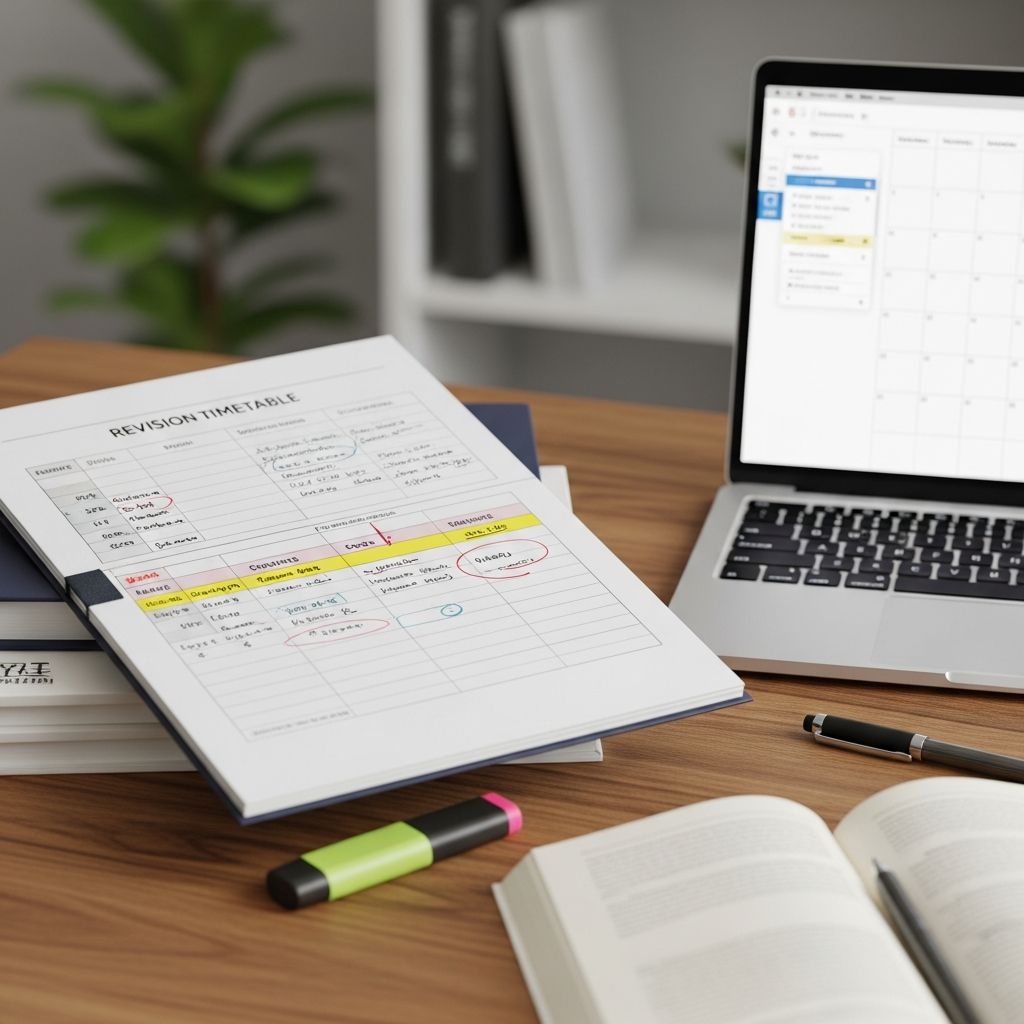
Traditional study plans often fail because they force rigid schedules that ignore your true knowledge gaps. A **retrospective revision timetable** flips this by recording what you’ve actually studied each day and dynamically prioritizing topics based on your performance, leading to more effective learning.
Why Forward-Looking Plans Fall Short
Prospective timetables assign topics to specific dates in advance, assuming equal difficulty across subjects. This overlooks personal strengths and weaknesses, leading to wasted time on mastered material while neglecting problem areas. Life interruptions further derail these fixed plans, causing guilt and inefficiency.
Students frequently report spending hours on familiar content due to the ‘fluency illusion’—feeling knowledgeable from passive review without true retention. In contrast, retrospective methods build on daily self-assessments to target high-yield revisions.
The Core Mechanics of Retrospective Planning
This system logs completed study sessions post hoc, rating each topic’s mastery level. It naturally embeds **spaced repetition** (reviewing at increasing intervals) and **interleaving** (mixing topics), proven to enhance long-term memory by 90% over cramming.
Begin with a baseline diagnostic: Attempt past papers or quizzes to score topics. Use colors or ratings—red for poor grasp, yellow for moderate, green for solid—to visualize needs.
Daily Workflow
- Study 2-4 topics using active recall: Test yourself without notes before checking answers.
- Rate performance: Red (<50% correct), Yellow (50-80%), Green (>80%).
- Log in a spreadsheet: Date, topic, rating, notes on errors.
- Next day, prioritize reds, then oldest yellows/greens for spacing.
This gamifies revision—you compete against your prior scores, boosting motivation as greens accumulate.
Integrating Evidence-Based Techniques
Retrospective timetables shine by combining top strategies backed by cognitive science.
Active Recall and Self-Testing
Instead of re-reading, retrieve information from memory. This strengthens neural pathways via the testing effect. In practice: Close books, write all you remember (‘blurting’), then correct. Tools like flashcards amplify this.
Spaced Repetition Schedules
Review reds immediately next session, yellows after 2-3 days, greens weekly. The 2357 method aligns: Revise day 2, 3, 5, 7 post-initial study. Studies show this solidifies memories far better than massed practice.
Interleaving for Deeper Connections
Mix subjects daily rather than blocking one per day. This builds contextual links, improving problem-solving in exams. Your log guides natural interleaving by surfacing varied weak spots.
| Technique | Benefit | Implementation in Retrospective Plan |
|---|---|---|
| Active Recall | Boosts retention 2x over passive reading | Rate sessions via quizzes |
| Spaced Repetition | 90% more effective than cramming | Prioritize by age and rating |
| Interleaving | Enhances discrimination between concepts | Mix topics from log daily |
Tools and Templates for Implementation
Google Sheets or Excel suffice: Columns for Date, Topic, Time Spent, Rating (dropdown: Red/Yellow/Green), Confidence Score (1-10), Notes.
Conditional formatting auto-colors rows. Sort by rating then date to plan tomorrow. Advanced users add Anki for digital flashcards synced to logs.
Sample starter template:
- Row 1: Headers
- Filter views for ‘Reds Only’
- Progress chart: % greens over time
Start small: 1-hour sessions with Pomodoro (25 min study + 5 min break) to maintain focus.
Real-World Success Stories and Data
Students using this method report 20-30% score improvements by focusing on weaknesses. One user cleared initial ‘reds’ in viruses by repeated targeted sessions, turning them green within a week.
Alexander Young’s SIT (Spacing, Interleaving, Testing) system mirrors this, yielding baseline-to-peak score jumps via gamified tracking. Med school applicants leverage it for high-stakes boards.
Overcoming Common Hurdles
Procrastination and Overwhelm
The log’s flexibility eliminates planning paralysis—no pre-committing to topics. Just study what calls loudest from your sheet.
ADHD or Dyslexia Adaptations
Short bursts with visual cues (colors, charts) suit neurodiverse learners. Pair with Feynman Technique: Explain topics simply to rubber ducks.
Group Study Integration
Share logs for accountability; teach reds to peers for dual recall benefits.
Advanced Tweaks for Peak Performance
Incorporate visualization: Map topics to a ‘memory palace’ post-rating. Track meta-metrics like sessions per topic for diminishing returns analysis.
Near exams, ramp testing: Full past papers weekly, feeding results back into the log.
Frequently Asked Questions
What if I miss a day?
No problem—the retrospective nature forgives gaps. Resume with top priorities; spacing adjusts automatically.
How many topics per day?
2-4, based on session length. Quality over quantity—deep recall trumps shallow coverage.
Digital vs. Paper?
Digital for sorting/filtering; paper for tactile satisfaction. Hybrid: Print weekly summaries.
Does it work for non-exam prep?
Yes, for certifications, languages—any spaced knowledge building.
Combine with other methods?
Perfectly: Layer Pomodoro, Feynman, or 2357 within sessions.
Launch Your Retrospective System Today
Set up a sheet now, baseline test 3 topics, and log your first session. Watch weaknesses fade as scores climb. This isn’t just planning—it’s precision learning tailored to you.
References
- Make An Effective Exam Revision Timetable — Alexander Young. 2023. https://blog.alexanderfyoung.com/how-to-make-an-effective-exam-revision-timetable-how-to-study-for-exams/
- The Science Of Effective Revision: 10 Proven Strategies — Flyp Academy. 2024. https://flyp.academy/blog/the-science-of-effective-revision-10-proven-strategies-to-maximise-your-study-time
- 7 Evidence-Based Study Strategies — Med School Insiders. 2023. https://medschoolinsiders.com/study-strategies/7-evidence-based-study-strategies-how-to-use-each/
- Five Best Revision Techniques — Birmingham City University. 2024. https://www.bcu.ac.uk/exams-and-revision/best-ways-to-revise/best-revision-techniques
- The Retrospective Study Timetable and Why it Works — Rebellious Blog. 2021-03-23. https://rebellious.blog/2021/03/23/the-retrospective-study-timetable-and-why-it-works/

- Integrated M.A. in Applied Linguistics, University of Hyderabad
- 5+ years in editorial, instructional, SEO, and research-based writing
Sneha is a relationships and lifestyle writer with a strong foundation in applied linguistics and certified training in relationship coaching. She brings over five years of writing experience to theskillvault, crafting thoughtful, research-driven content that empowers readers to build healthier relationships, boost emotional well-being, and embrace holistic living. Her writing and insights reflect the belief that beauty, happiness, and wellness…