
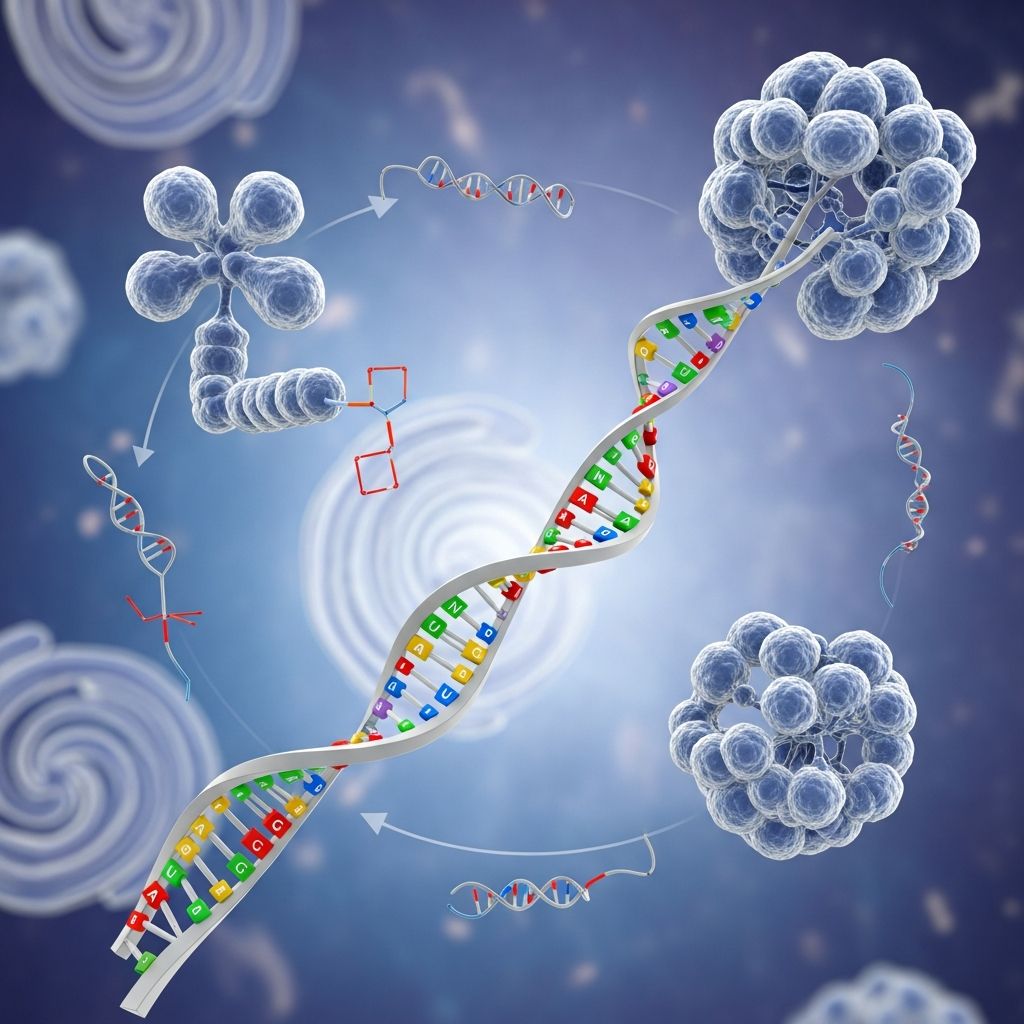
RNA, or ribonucleic acid, stands as a cornerstone of molecular biology, bridging the gap between genetic information storage in DNA and the functional proteins that drive cellular activities. Unlike the stable double helix of DNA, RNA’s single-stranded nature allows it to adopt complex folds, enabling diverse roles from information transfer to catalysis and regulation. This article delves into the primary categories of RNA, their structural features, and indispensable functions within the cell, drawing on established biochemical principles.
Foundational Structure of RNA
At its core, RNA comprises nucleotides linked by phosphodiester bonds, each consisting of a ribose sugar, a phosphate group, and one of four nitrogenous bases: adenine (A), guanine (G), cytosine (C), or uracil (U)—the key distinction from DNA’s thymine. This uracil substitution and the 2′-hydroxyl group on ribose render RNA more reactive and less stable, suited for transient roles. RNA molecules range from short regulatory snippets to long precursors, folding into shapes like hairpins, loops, and stems via base pairing, which dictate their interactions and activities.
- Single-stranded flexibility: Enables base-pairing with itself or DNA/RNA targets.
- Catalytic potential: Some RNAs act as ribozymes, speeding biochemical reactions.
- Location-specific: Found in nucleus, cytoplasm, and organelles like ribosomes.
Core Players in Protein Production
Protein synthesis, or translation, relies on three major RNA types: messenger RNA (mRNA), transfer RNA (tRNA), and ribosomal RNA (rRNA). These collaborate in ribosomes to decode genetic blueprints into amino acid chains.
Messenger RNA: The Genetic Dispatcher
mRNA serves as the intermediary, transcribing DNA sequences from genes into a portable format for ribosomes. Synthesized via transcription in the nucleus, pre-mRNA undergoes processing—capping, polyadenylation, and splicing—to yield mature mRNA, which exits to the cytoplasm. There, it dictates the sequence of amino acids by its codon triplets (e.g., AUG for methionine).
- Length: Hundreds to thousands of nucleotides.
- Stability: Regulated by 5′ cap and 3′ poly-A tail, lasting minutes to days.
- Key role: Carries blueprints for ~20,000 human proteins.
In viruses, mRNA can directly serve as genomic material, highlighting RNA’s versatility.
Transfer RNA: Precision Amino Acid Carriers
tRNA acts as an adaptor, matching mRNA codons to specific amino acids. Each tRNA features an anticodon loop complementary to an mRNA codon and a 3′ acceptor site covalently binding its amino acid, charged by aminoacyl-tRNA synthetases. With ~40-50 types per cell, tRNAs ensure accurate translation.
| tRNA Feature | Function |
|---|---|
| Cloverleaf structure | Anticodon arm pairs with mRNA; acceptor stem loads amino acid. |
| Modified bases | Enhance stability, reading accuracy (e.g., inosine wobble pairing). |
| Post-transcriptional edits | Expand codon recognition beyond 61 tRNAs for 20 amino acids. |
This ‘wobble’ hypothesis allows one tRNA to read multiple codons, optimizing efficiency.
Ribosomal RNA: The Protein Factory Scaffold
rRNA constitutes ~60% of ribosomal mass, forming the small (40S/30S) and large (60S/50S) subunits that assemble into the 80S/70S ribosome. Beyond structure, rRNA’s peptidyl transferase center catalyzes peptide bonds, marking it as a ribozyme.
- Prokaryotes: 3 rRNAs (16S, 23S, 5S).
- Eukaryotes: 4 rRNAs (18S, 28S, 5.8S, 5S).
- Synthesis: Transcribed in nucleolus, self-assembles with ~80 ribosomal proteins.
rRNA modifications by snoRNAs fine-tune ribosome function, impacting translation speed and fidelity.
Regulatory RNAs: Masters of Gene Control
Beyond translation, non-coding RNAs (ncRNAs) orchestrate gene expression, chromatin dynamics, and defense. Comprising >90% of cellular transcripts, they silence, activate, or modify targets.
MicroRNAs and siRNAs: Silencing Specialists
MicroRNAs (miRNAs, ~22 nt) and small interfering RNAs (siRNAs, 20-25 nt) trigger RNA interference (RNAi). Processed from hairpins (miRNA) or dsRNA (siRNA) by Dicer, they load into Argonaute proteins in RISC complexes, binding target mRNAs for degradation or translational repression.
- miRNA: Endogenous, imperfect base-pairing; regulates development, cancer.
- siRNA: Often exogenous (viruses); perfect matches cleave targets.
- Applications: CRISPR tools, mRNA vaccines leverage RNAi principles.
Small Nuclear RNAs: Splicing Architects
snRNAs (U1-U6, 100-300 nt) form snRNPs, core of the spliceosome. They recognize splice sites, excise introns, and ligate exons in pre-mRNA. U7 snRNA uniquely processes histone mRNAs.
Splicing generates protein diversity via alternative isoforms, crucial for multicellular complexity.
Emerging Regulators: snoRNAs, lncRNAs, and More
Small nucleolar RNAs (snoRNAs) guide rRNA modifications (methylation, pseudouridylation) in the nucleolus, stabilizing ribosomes. Long non-coding RNAs (lncRNAs, >200 nt) influence chromatin (e.g., Xist in X-inactivation), transcription, and splicing.
- piRNAs: Protect germ cells from transposons.
- circRNAs: Circular, sponge miRNAs.
- tsRNAs: tRNA-derived, stress responders.
RNA in Biotechnology and Medicine
RNA’s programmability fuels innovations. mRNA vaccines (e.g., COVID-19) instruct cells to produce antigens. RNAi therapeutics silence disease genes (e.g., patisiran for amyloidosis). CRISPR-Cas9 uses guide RNAs for precise editing. Antisense oligonucleotides target splicing defects in diseases like SMA.
Challenges include delivery, stability, and off-target effects, but lipid nanoparticles and chemical mods advance solutions.
| RNA Type | Biotech Application |
|---|---|
| mRNA | Vaccines, cancer immunotherapies. |
| siRNA/miRNA | Gene knockdown drugs. |
| guide RNA | Genome editing (CRISPR). |
Frequently Asked Questions (FAQs)
What is the main difference between RNA and DNA?
RNA is single-stranded with uracil instead of thymine and ribose sugar, making it less stable and multifunctional.
How many major types of RNA are involved in translation?
Three: mRNA (messenger), tRNA (transfer), rRNA (ribosomal).
What role do non-coding RNAs play?
They regulate gene expression, modify RNAs, and maintain genome stability via silencing, splicing, and chromatin control.
Can RNA act as an enzyme?
Yes, rRNA’s peptidyl transferase and self-splicing introns exemplify ribozymes.
Why is RNA World Hypothesis significant?
It posits RNA as life’s primordial molecule, storing info and catalyzing reactions before DNA/proteins evolved.
Comparative Overview of RNA Types
| RNA Type | Size (nt) | Primary Location | Key Function |
|---|---|---|---|
| mRNA | 100s-1000s | Cytoplasm | Genetic coding for proteins |
| tRNA | 70-90 | Cytoplasm | Amino acid delivery |
| rRNA | 100s-4000s | Ribosomes | Translation machinery |
| miRNA/siRNA | 20-25 | Cytoplasm | Gene silencing |
| snRNA | 100-300 | Nucleus | Pre-mRNA splicing |
| lncRNA | >200 | Nucleus/Cytoplasm | Gene/chromatin regulation |
This table encapsulates RNA diversity, underscoring their interconnected roles in cellular orchestration.
References
- RNA- Structure, Types and Functions — Biochemistry For Medics. 2013-02-01. https://www.slideshare.net/slideshow/rna/16891382
- Structure, Functions and Types of RNA — BYJU’S. 2023-01-15. https://byjus.com/biology/structure-of-rna/
- Biochemistry, RNA Structure — StatPearls – NCBI Bookshelf. 2023-07-17. https://www.ncbi.nlm.nih.gov/books/NBK558999/
- Types of RNA — Khan Academy. 2025-01-01. https://www.khanacademy.org/test-prep/mcat/biomolecules/x04f6bc56:transcription-and-translation/a/types-of-rna
- Ribonucleic Acid (RNA) Fact Sheet — National Human Genome Research Institute. 2023-05-10. https://www.genome.gov/about-genomics/educational-resources/fact-sheets/ribonucleic-acid-fact-sheet

- Integrated M.A. in Applied Linguistics, University of Hyderabad
- 5+ years in editorial, instructional, SEO, and research-based writing
Sneha is a relationships and lifestyle writer with a strong foundation in applied linguistics and certified training in relationship coaching. She brings over five years of writing experience to theskillvault, crafting thoughtful, research-driven content that empowers readers to build healthier relationships, boost emotional well-being, and embrace holistic living. Her writing and insights reflect the belief that beauty, happiness, and wellness…