
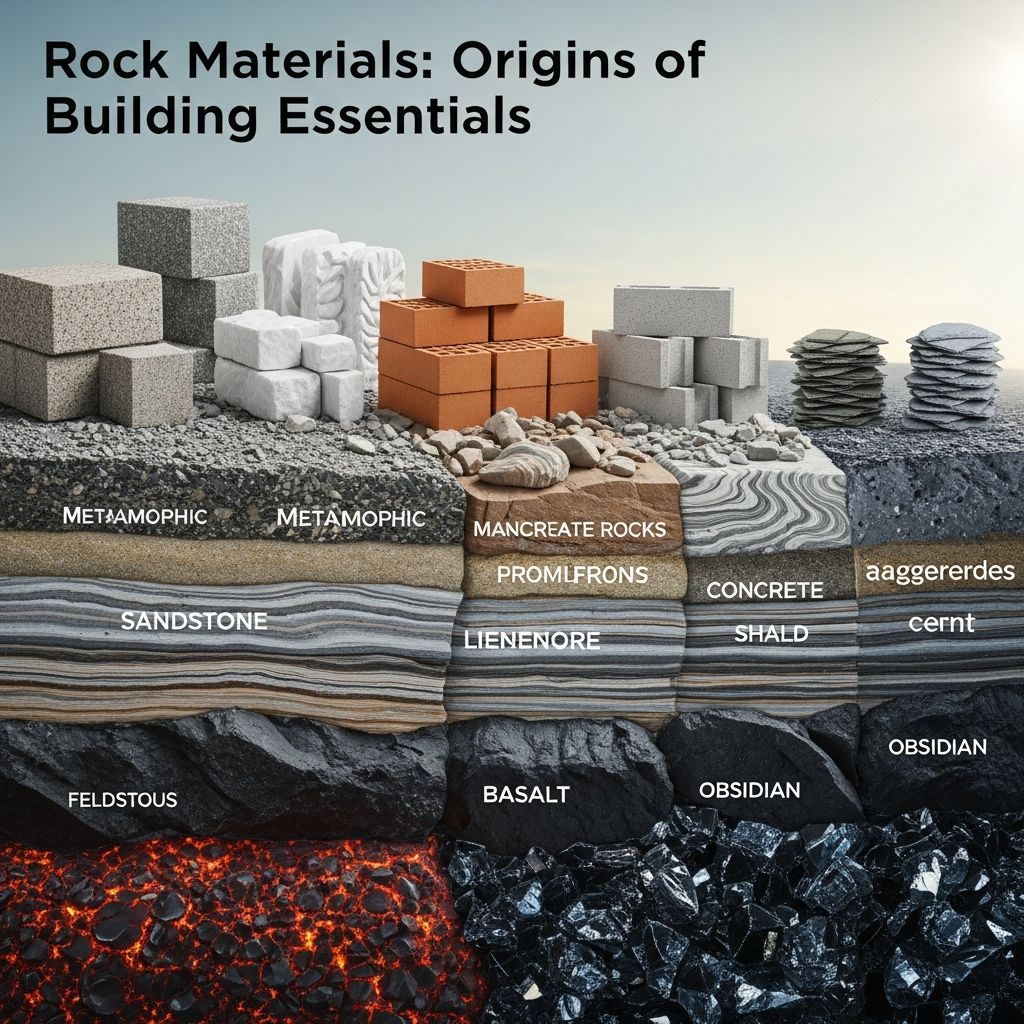
Rocks form the backbone of countless construction materials used in homes, roads, and monuments around the world. Understanding their geological origins—igneous, sedimentary, or metamorphic—reveals why certain stones excel in durability while others offer unique aesthetic appeal. This article delves into these rock types, their formation processes, mineral compositions, and practical applications in building.
The Fundamental Rock Cycle in Construction
The rock cycle drives the transformation of Earth’s materials, recycling igneous, sedimentary, and metamorphic rocks through heat, pressure, and erosion. This dynamic process ensures a steady supply of raw materials for human use. Deep within the Earth, magma cools to form igneous rocks; surface erosion creates sediments that compact into sedimentary layers; and intense conditions reshape existing rocks into metamorphic varieties. Plate tectonics accelerates these changes, influencing everything from mountain ranges to quarries that supply modern builders.
Most surface rocks are sedimentary, covering vast landscapes and providing accessible resources for construction. Igneous and metamorphic rocks, often deeper or in mountainous regions, offer superior strength for structural demands. Canada’s rich deposits, including potash and gypsum, highlight how these cycles support global industries.
Igneous Rocks: Forged in Earth’s Fiery Core
Igneous rocks emerge from molten magma or lava cooling and solidifying. Plutonic types like granite crystallize slowly underground, creating interlocking mineral grains for exceptional hardness. Volcanic varieties, such as basalt, cool rapidly on the surface, resulting in finer textures but similar durability.
**Granite’s Enduring Strength**
Granite dominates countertops, flooring, and facades due to its quartz, feldspar, and mica composition. Formed miles below ground, its dense structure resists scratches and weathering, making it ideal for high-traffic areas. The consistent flecked pattern adds visual uniformity, prized in architecture from ancient obelisks to modern skyscrapers.
- Key Properties: High compressive strength (up to 19,000 psi), low porosity, acid-resistant.
- Common Uses: Kitchen surfaces, curbing, monuments.
- Global Sources: Brazil, India, USA.
Other igneous stones like gabbro provide cost-effective alternatives with dark hues and robust performance in paving.
Sedimentary Rocks: Layers of Time and History
Sedimentary rocks arise from accumulated particles—sand, clay, shells—compacted over eons by water, wind, and tectonic forces. These rocks often preserve fossils, telling stories of ancient environments. They comprise about 75% of Earth’s surface, offering economical, workable materials for builders.
**Sandstone: Nature’s Textured Canvas**
Composed mainly of quartz grains cemented by silica or calcite, sandstone varies from porous buff varieties to dense quartzites. Its layered bedding creates natural patterns for cladding and paving. While softer than igneous rocks, treatments enhance its weather resistance.
| Sedimentary Rock | Composition | Strength (psi) | Best Uses |
|---|---|---|---|
| Limestone | Calcium carbonate (fossils/shells) | 4,000-12,000 | Foundations, facades |
| Sandstone | Quartz grains | 5,000-20,000 | Wall veneers, roofs |
| Shale | Clay minerals | Low (1,000-5,000) | Bricks, tiles |
**Limestone: Versatile and Abundant**
Limestone, from marine shells and coral, crushes easily into aggregate for concrete—a staple in roads and buildings. Indiana limestone adorns iconic structures like the Empire State Building for its uniform color and carvability.
Metamorphic Rocks: Transformed by Pressure and Heat
Metamorphic rocks evolve when existing stones endure extreme heat (below melting) and pressure, recrystallizing minerals into new forms. This process erases fossils, creating foliated textures like slate’s cleavage or marble’s swirls.
**Marble: Elegance from Limestone**
Metamorphosed limestone yields marble, with calcite crystals forming luminous veins. Prized for sculptures and luxury interiors, it polishes to a high sheen but requires sealing against acids. Carrara marble, from Italy, exemplifies purity and workability.
- Visual Traits: Banding, swirling patterns from tectonic folding.
- Durability: Moderate; etches under acidic exposure.
- Applications: Flooring, stairs, bathroom vanities.
**Slate: Precision Roofing and Flooring**
Slate, metamorphosed shale, splits into thin, waterproof sheets perfect for roofs enduring harsh climates. Its non-porous nature resists moss and algae, ensuring longevity in places like Welsh quarries supply.
Mineral Building Blocks: Silicates vs. Carbonates
Rock properties hinge on minerals: silicates (quartz-based) versus carbonates (calcite-based). Silicate stones—granite, quartzite, slate—are hardest (Mohs 6-7), acid-resistant, and durable for exteriors. Carbonate stones—limestone, marble, travertine—are softer (Mohs 3-4), easier to cut but vulnerable to pollution and acids.
This dichotomy guides selection: silicates for harsh environments, carbonates for indoor beauty. For instance, travertine’s porous, honeycombed look suits modern spas after honing.
Beyond Dimension Stone: Processed Rock Derivatives
Not all rock materials remain as slabs. Crushed limestone produces cement, binding concrete globally. Gypsum, a sulfate evaporite, calcines into plaster and drywall for smooth interiors. Shale fires into bricks, while quartz sands melt for glass windows.
**Concrete’s Rock Foundation**
Portland cement from limestone and clay reacts with water for hydraulic setting. Aggregates—crushed granite or gravel—occupy 60-80% volume, dictating strength. Reinforced variants build bridges spanning centuries.
**Gypsum in Modern Walls**
Mined from sedimentary beds, gypsum (CaSO4·2H2O) dehydrates to hemihydrate for quick-setting plaster. Fire-resistant drywall revolutionized safe, affordable housing post-WWII.
Global Quarrying and Sustainability Challenges
Quarrying yields dimension stone for premium uses, but extraction scars landscapes. Regulations now mandate reclamation, turning pits into lakes or parks. Recycling crushed concrete reduces virgin demand, conserving resources. As urban growth accelerates, sustainable sourcing—from ethical mines to low-water cutting—becomes paramount.
Frequently Asked Questions (FAQs)
What is the strongest rock type for building?
Granite, an igneous silicate rock, offers superior compressive strength and durability for load-bearing structures.
Why does marble etch from lemon juice?
As a calcium carbonate, marble reacts with acids like citric acid, dissolving surface calcite—seal it for protection.
How is concrete made from rocks?
Limestone calcines to lime, mixed with clay for clinker, ground into cement; rocks provide aggregates.
Are sedimentary rocks always fossil-rich?
Many contain fossils from organic origins, but compaction can obscure them; limestone often preserves them clearly.
What role does the rock cycle play in materials supply?
It recycles rocks via tectonics, ensuring renewable surface deposits for quarrying and processing.
References
- Stone Origin and Composition — Laticrete. Accessed 2026. https://me.laticrete.com/our-products/tile-stone-and-surface-care/resources/care-and-maintenance/stone-origin-and-composition
- Origins of Rock — Government of Manitoba (.gov). Accessed 2026. https://www.gov.mb.ca/iem/min-ed/kidsrock/origins/index.html
- Building Materials That Come from Rocks — Smithsonian Q?rius (.edu). Accessed 2026. https://qrius.si.edu/taxonomy/term/11942

Medha Deb is an editor with a master's degree in Applied Linguistics from the University of Hyderabad. She believes that her qualification has helped her develop a deep understanding of language and its application in various contexts. Medha specializes in the areas of beauty, health, sports, and wellness and is committed to ensuring that the content on the website is…