
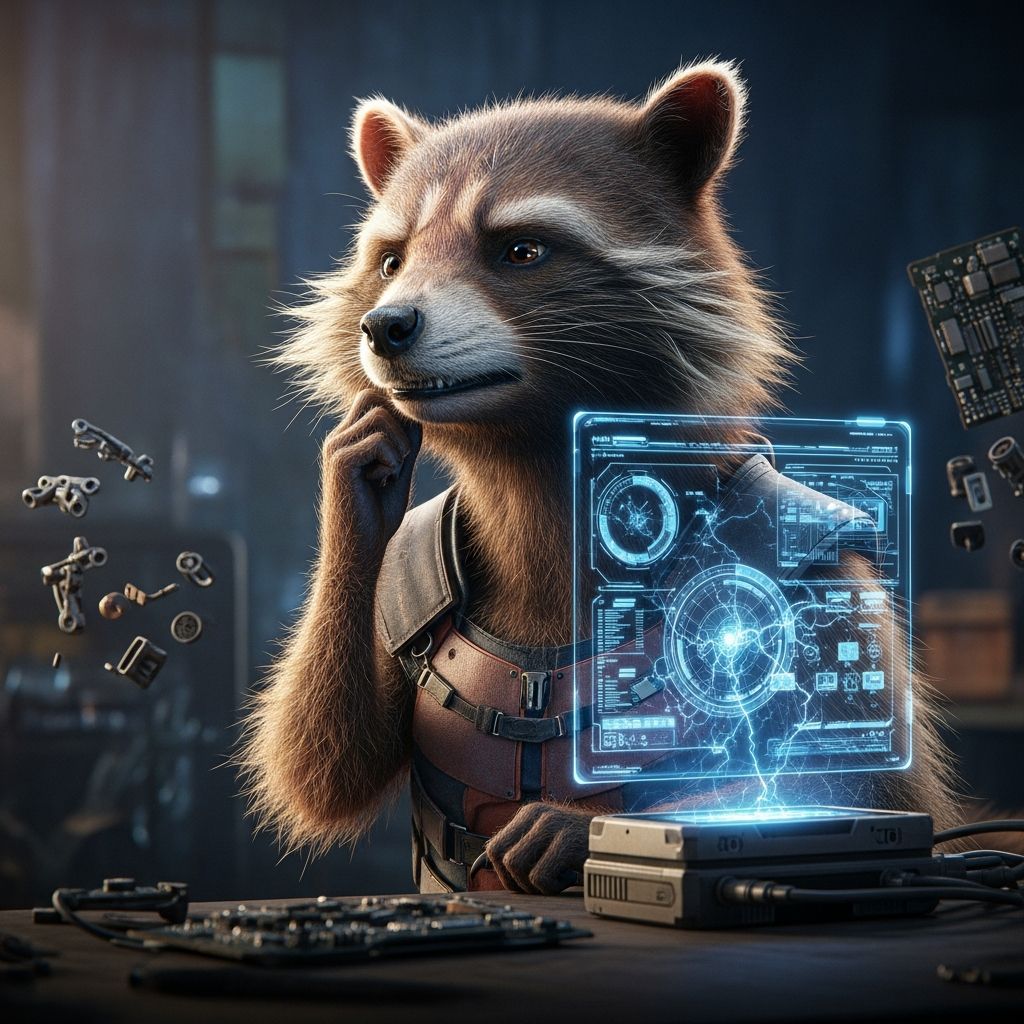
The Misunderstood Mind of Rocket Raccoon
At first glance, Rocket Raccoon is easy to misread. A genetically engineered raccoon with a penchant for heavy weaponry, a sharp tongue, and a love of chaos, he seems like little more than comic relief with a trigger finger. But peel back the layers of sarcasm, bravado, and tactical brilliance, and you uncover a deeply complex character shaped by trauma, isolation, and a fierce, if guarded, loyalty. Rocket is not just a raccoon with a machine gun; he’s a study in how pain, intelligence, and connection shape identity in the Marvel universe.
Survival as a Second Skin
Rocket’s origin is one of violation and experimentation. Created in a lab, subjected to procedures that stripped him of autonomy and normalcy, his very existence is a product of cruelty. This background doesn’t just explain his skills; it defines his worldview. From an early age, Rocket learned that the world is not safe, that trust is dangerous, and that the only reliable protection is competence and firepower.
His survival instincts are not just physical; they’re psychological. He anticipates betrayal, expects the worst, and prepares for it. This isn’t paranoia in the clinical sense, but a rational adaptation to a life where being vulnerable meant being hurt. His constant readiness for conflict, his tendency to escalate situations, and his distrust of authority figures all stem from this core belief: the world is hostile, and only the prepared survive.
Intelligence as Armor and Weapon
Rocket’s intellect is staggering. He’s a master engineer, strategist, and tactician, capable of building advanced weapons, hacking alien systems, and improvising solutions under extreme pressure. But his intelligence isn’t just a tool; it’s a shield. By being the smartest one in the room, he maintains control. He can outthink opponents, manipulate situations, and keep others at a distance through sheer mental superiority.
This intellectual dominance also serves as a weapon. His sarcasm, insults, and cutting observations are not random; they’re calculated to deflect emotional vulnerability. When someone tries to get close, Rocket often responds with mockery or aggression, pushing them away before they can see the hurt beneath. His brilliance keeps others in awe or frustration, but rarely in a position to truly challenge his emotional defenses.
Emotional Intelligence in Disguise
Despite his abrasive exterior, Rocket possesses a high degree of emotional intelligence—just not in the way one might expect. He reads people quickly, understands motivations, and exploits emotional weaknesses with precision. He knows when to provoke, when to retreat, and when to offer a rare moment of genuine support.
His relationship with Groot is the clearest example. Rocket doesn’t just tolerate Groot; he deeply understands him, translates his limited vocabulary, and protects him with ferocious loyalty. This isn’t just habit or convenience; it’s a bond built on mutual recognition of pain and difference. Rocket sees in Groot a being who, like him, is fundamentally misunderstood and othered, and that shared experience creates a connection that transcends words.
Similarly, his interactions with the rest of the Guardians reveal a nuanced understanding of group dynamics. He knows when to challenge Star-Lord’s leadership, when to back Gamora’s judgment, and when to let Drax’s literalness play out for comic effect. He may not express empathy in soft tones, but he acts on it—often at great personal risk.
Personality Type: The Pragmatic Strategist
While formal personality typing can be speculative, Rocket’s behavior aligns closely with a type that values autonomy, practicality, and strategic thinking. He is intensely independent, resistant to authority, and focused on tangible results rather than abstract ideals. His decision-making is driven by what works, not what is politically correct or emotionally satisfying.
He exhibits strong extraverted thinking (Te) in his ability to organize, plan, and execute complex operations under pressure. His internal framework (introverted thinking, Ti) is evident in his technical mastery and problem-solving style—he doesn’t just follow rules; he understands systems and exploits them.
His emotional world is guarded, suggesting a less developed or repressed extraverted feeling (Fe) function. He doesn’t naturally seek harmony or express warmth in conventional ways. Instead, his values are deeply personal (introverted feeling, Fi), rooted in loyalty to a very small circle and a fierce sense of justice for the marginalized and exploited—beings like himself.
Defiance as Identity
Rocket’s defiance isn’t just rebellion for its own sake; it’s a core part of his identity. He refuses to be defined by how others see him—as a freak, a weapon, or a pet. His insistence on being called “Rocket” rather than “raccoon” is symbolic: he demands recognition as a person, not a specimen.
This defiance extends to authority, rules, and social norms. He mocks titles, ignores protocols, and challenges anyone who tries to control him. This isn’t mere childishness; it’s a refusal to be subjugated again. Every act of rebellion is a reassertion of autonomy, a declaration that he will not be owned or used.
Yet this same defiance can be self-sabotaging. His need to be in control and his distrust of others can isolate him, even from those who care about him. He often pushes people away just as they begin to get close, repeating the cycle of loneliness that shaped him.
Loyalty to the Few, Distrust of the Many
Rocket’s loyalty is not broad or indiscriminate. He doesn’t believe in causes, nations, or abstract ideals in the way that, say, Captain America does. His loyalty is intensely personal, reserved for those who have proven themselves through shared struggle and mutual acceptance.
Groot is the obvious example, but his bond with the Guardians as a whole is equally significant. Over time, he comes to see them not just as allies, but as family. This doesn’t mean he becomes soft or sentimental; it means he is willing to die for them, to endure pain for them, and to suppress his own instincts for their sake.
His distrust of the many, however, remains. He is skeptical of institutions, governments, and large organizations. He assumes they are corrupt, self-serving, or indifferent to individuals like him. This skepticism is not unfounded; his entire life has been shaped by systems that treated him as a tool, not a person.
Humor as a Defense Mechanism
Rocket’s humor is sharp, often cruel, and always on display. But beneath the jokes lies a powerful defense mechanism. Humor allows him to:
- Deflect serious emotional conversations
- Maintain emotional distance from others
- Assert dominance in social situations
- Process trauma in a way that feels manageable
When faced with fear, grief, or vulnerability, Rocket often responds with sarcasm or a crude joke. This isn’t because he doesn’t feel deeply; it’s because he doesn’t know how to express those feelings in a way that doesn’t leave him exposed. Laughter is safer than tears, and mockery is safer than confession.
Leadership in the Shadows
Rocket is not a traditional leader. He doesn’t seek titles, give inspirational speeches, or try to unify people around a vision. But in practice, he often leads—through competence, decisiveness, and an unflinching willingness to do what others won’t.
When the Guardians are in crisis, it’s often Rocket who devises the plan, coordinates the attack, and keeps the team focused. He doesn’t wait for permission; he acts. His leadership is pragmatic, results-oriented, and often born out of necessity rather than ambition.
This shadow leadership style is effective because it’s grounded in reality. Rocket doesn’t promise glory or honor; he promises survival and, if possible, victory. His followers (whether he admits it or not) trust him because he delivers, even when the odds are impossible.
Key Traits of Rocket’s Personality
| Trait | Description |
|---|---|
| High Intelligence | Master engineer, strategist, and tactician; relies on logic and systems. |
| Emotional Guardedness | Protects himself through sarcasm, aggression, and emotional distance. |
| Autonomy-Driven | Values independence and control; resists authority and rules. |
| Pragmatic | Focused on what works, not ideals; willing to make hard choices. |
| Loyalty to a Few | Deeply committed to a small circle; distrustful of institutions. |
How Rocket Compares to Other Avengers
Unlike many Earth-based heroes, Rocket doesn’t operate from a place of idealism or duty. He’s not driven by a sense of justice in the abstract, but by personal loyalty and a desire to protect those he cares about. This makes him more similar to characters like Black Widow or Hawkeye—operatives who understand the gray areas of morality—than to idealists like Captain America.
His relationship with technology also sets him apart. While Tony Stark sees tech as a means to elevate humanity, Rocket sees it as a tool for survival and empowerment. His use of weapons and gadgets is less about innovation for its own sake and more about leveling the playing field for the underdog.
Frequently Asked Questions
Is Rocket Raccoon a hero or an antihero?
Rocket is best understood as an antihero. He lacks the traditional heroic demeanor, often acting out of self-interest or loyalty rather than pure altruism. However, his actions consistently protect the innocent and defeat greater threats, making him heroic in outcome if not always in motive.
Why is Rocket so angry all the time?
Rocket’s anger stems from a lifetime of trauma, experimentation, and being treated as less than human. His aggression is a defense mechanism, a way to maintain control in a world that has repeatedly taken it from him.
Can Rocket be trusted?
Rocket can be trusted—but only within limits. He is fiercely loyal to those he considers family, but he will lie, steal, and manipulate to achieve his goals. Trusting Rocket means accepting that he operates by his own code, not by conventional rules.
Does Rocket have a moral code?
Yes, but it’s personal rather than universal. Rocket values loyalty, autonomy, and fairness for the oppressed. He despises exploitation, cruelty, and those who abuse power. His code is not always clean, but it is consistent with his experiences.
How does Rocket’s intelligence affect his relationships?
His intelligence creates both connection and distance. It allows him to solve problems and protect his team, but it also makes him impatient with others and prone to condescension. Over time, he learns to temper his intellect with loyalty, but the tension between his mind and his heart remains central to his character.
References
- Guardians of the Galaxy: Original Motion Picture Soundtrack and Screenplay — Marvel Studios. 2014. https://www.marvel.com/movies/guardians-of-the-galaxy
- Marvel Cinematic Universe: Character Biographies and Development Notes — Marvel Studios. 2023. https://www.marvel.com/characters
- Personality Psychology: Domains of Knowledge About Human Nature — Randy J. Larsen & David M. Buss. McGraw-Hill Education. 2021.

- Integrated M.A. in Applied Linguistics, University of Hyderabad
- 5+ years in editorial, instructional, SEO, and research-based writing
Sneha is a relationships and lifestyle writer with a strong foundation in applied linguistics and certified training in relationship coaching. She brings over five years of writing experience to theskillvault, crafting thoughtful, research-driven content that empowers readers to build healthier relationships, boost emotional well-being, and embrace holistic living. Her writing and insights reflect the belief that beauty, happiness, and wellness…