
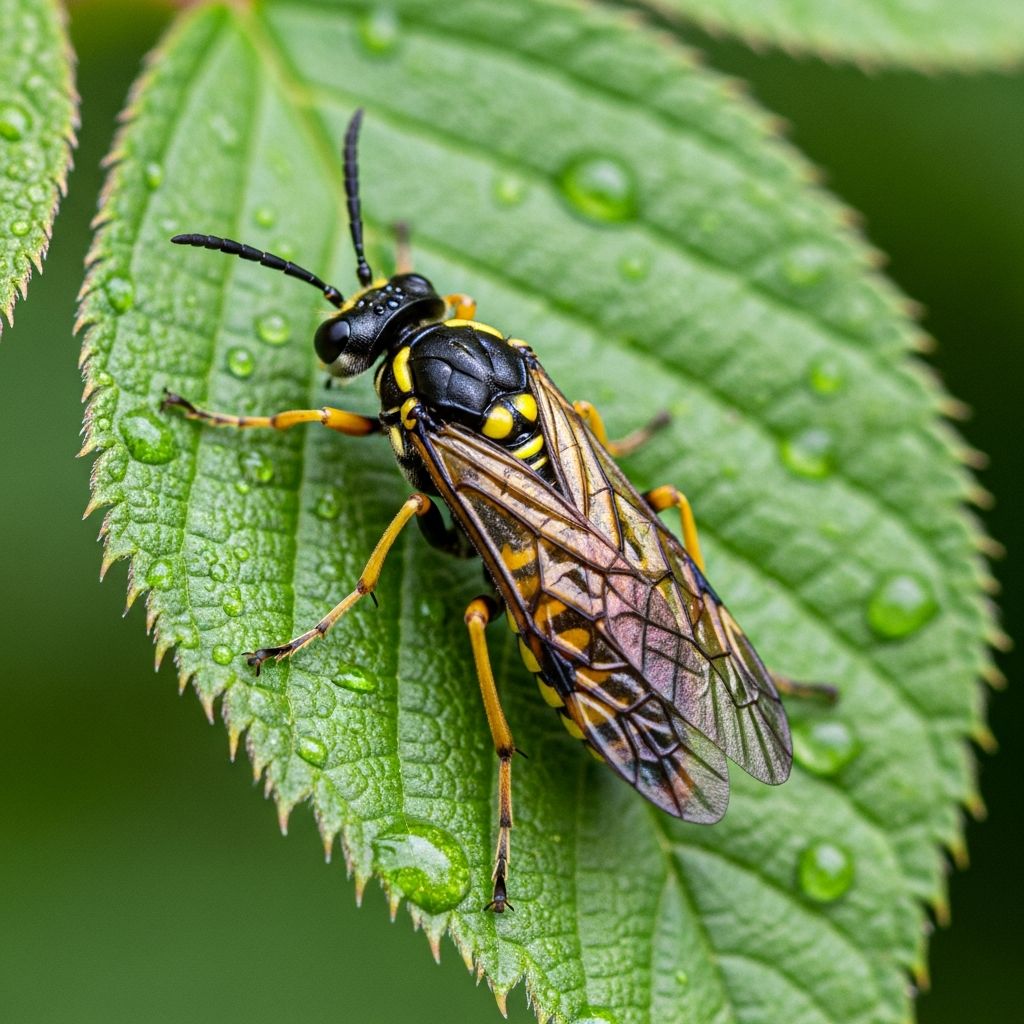
Sawflies belong to the suborder Symphyta in the order Hymenoptera, sharing lineage with bees, wasps, and ants but distinguished by their plant-eating habits and lack of stings in adults.
Biological Classification and Distinct Features
Sawflies form a diverse group within Hymenoptera, characterized by their broad waist unlike the pinched abdomen of stinging wasps. Adults typically measure under half an inch, with two pairs of translucent wings connected by hooks for flight stability. The thorax comprises three segments—prothorax, mesothorax, and metathorax—supporting legs with tibial spurs.
The defining trait is the female’s saw-like ovipositor, a serrated structure used to slice into plant tissues for egg deposition, inspiring their name.
- Wing venation: Parallel anal veins often fuse, a trait prominent in families like Argidae and Diprionidae.
- Body variation: Ranges from stout, hairy, bee-mimicking forms to slender, wasp-like bodies.
- Antennae: Elbowed or filiform, aiding in sensing host plants.
Complete Metamorphosis: Life Stages in Detail
Sawflies undergo holometabolous development with four stages: egg, larva, pupa, and adult.
Egg Stage
Females select sunlit, mature leaves to avoid slow larval development in shade. They cut slits in leaves, petioles, or stems, laying 30-90 eggs singly or in rafts. Some wood-feeding species drill into bark. Eggs hatch in 2-8 weeks, influenced by temperature.
Larval Stage
Larvae, often mistaken for caterpillars, possess three thoracic leg pairs and 6+ abdominal prolegs lacking crochets—key identifiers. They feed gregariously on foliage, stripping branches, preferring old needles in conifers but attacking new growth too.
Development spans 2-4 months across 6 instars, with full growth in 25-31 days for some species like red-headed pine sawflies. Larvae may overwinter as prepupae.
| Feature | Sawfly Larva | Caterpillar |
|---|---|---|
| Prolegs | 6 or more, no crochets | 2-5 pairs, with crochets |
| Behavior | Often gregarious | Solitary or gregarious |
| Head | Distinct, often spotted | Usually hairless |
Pupal Stage
Mature larvae drop to soil, litter, or spin leaf-attached cocoons. Wood-borers pupate in tunnels; some form parachute-like silken discs. Pupation lasts months to two years, with overwintering common.
Adult Stage
Short-lived (7-9 days), adults nectar- and pollen-feed, focusing on reproduction. Many species are parthenogenetic; unfertilized eggs yield males (arrhenotoky).
Feeding Habits and Host Preferences
Primarily herbivorous, sawfly larvae target trees, shrubs, and ornamentals. Most are folivores, but specialists include wood-borers (Siricidae), leaf-miners (Heterarthrinae), gall-formers, and stem-borers.
- Conifers: Pines suffer from gregarious feeders defoliating old needles.
- Deciduous: Roses, sycamores, bottlebrush host various species.
- Tropical: Congregate on trunks by day, feed nocturnally.
Severe infestations cause tree mortality via defoliation.
Behavioral Adaptations and Defenses
Larvae employ anti-predator strategies: gregarious feeding dilutes risk; some cluster heads-out or abdomen-tap. Spitfire sawflies regurgitate irritating fluids deterring ants. Adults mimic wasps with black-yellow patterns.
Plant defenses are circumvented by feeding on low-chemical areas or resistance.
Ecological Roles and Garden Impacts
As herbivores, sawflies influence plant communities, recycling nutrients but posing pest threats. In landscapes, they damage ornamentals; in forests, conifer sawflies threaten timber.
Generations vary: 1-5+ yearly, with peak feeding May-June.
Identification Tips for Common Species
Red-headed pine sawfly: Yellowish-white larvae with black spots, red head; cocoons reddish-brown.
Steel-blue sawfly: Pupates in leaf litter cocoons.
Long-tailed sawfly: Solitary or small groups, bores into bark for pupation.
Adults: Wasp-like, non-stinging.
Management and Control Strategies
Early detection aids control. Handpick small groups; encourage predators like birds, parasitic wasps.
- Cultural: Rake litter to expose pupae; prune infested branches.
- Biological: Bacillus thuringiensis var. kurstaki ineffective on sawflies; use spinosad or pyrethroids.
- Chemical: Insecticidal soaps, neem oil for larvae; apply evenings.
Monitor for gregarious feeding.
Frequently Asked Questions (FAQs)
Do sawfly adults sting?
No, adults lack stingers despite wasp-like appearance; only ovipositor present.
How do sawfly larvae differ from caterpillars?
Sawfly larvae have more prolegs without crochets; always check under magnification.
Can sawflies kill trees?
Yes, repeated defoliation by gregarious larvae can lead to tree death, especially conifers.
Are all sawfly species pests?
Most are, but some are minor; wood-borers cause most structural damage.
How many generations occur yearly?
1-5+, depending on species and climate; many overwinter as pupae.
Research Insights and Future Monitoring
Ongoing studies track sawfly dynamics amid climate shifts, noting extended seasons. Citizen science aids detection.
References
- Sawfly – Wikipedia — Wikipedia contributors. 2023-10-01. https://en.wikipedia.org/wiki/Sawfly
- Sawflies – The Australian Museum — Australian Museum. 2022-05-15. https://australian.museum/learn/animals/insects/sawflies/
- Conifer Sawflies Fact Sheet — University of New Hampshire Extension. 2024-03-20. https://extension.unh.edu/resource/conifer-sawflies-fact-sheet
- Landscape pests-Sawfly — PNW Handbooks. 2023-08-10. https://pnwhandbooks.org/insect/hort/landscape/common/landscape-sawfly
- Sawflies — University of Wisconsin Horticulture. 2024-01-12. https://hort.extension.wisc.edu/articles/sawflies/
- Biology and behavior | Sawfly GenUS — IDtools. 2023-11-05. https://idtools.org/tools/24/index.cfm?pageID=1844

- Integrated M.A. in Applied Linguistics, University of Hyderabad
- 5+ years in editorial, instructional, SEO, and research-based writing
Sneha is a relationships and lifestyle writer with a strong foundation in applied linguistics and certified training in relationship coaching. She brings over five years of writing experience to theskillvault, crafting thoughtful, research-driven content that empowers readers to build healthier relationships, boost emotional well-being, and embrace holistic living. Her writing and insights reflect the belief that beauty, happiness, and wellness…