
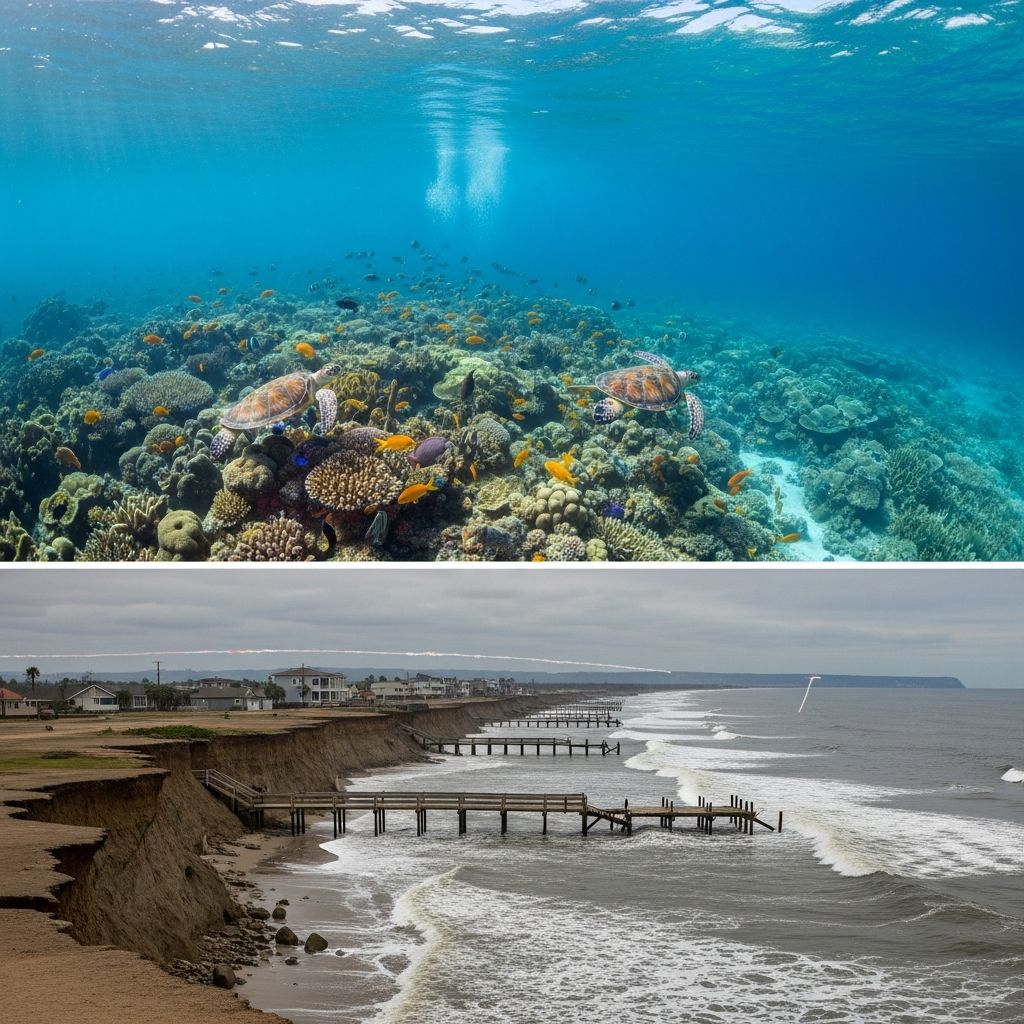
The Rising Ocean: Understanding a Critical Environmental Phenomenon
The planet’s oceans are experiencing measurable increases in their surface heights—a phenomenon that fundamentally alters coastal geography, threatens human settlements, and reshapes ecosystems worldwide. This transformation represents one of the most tangible consequences of contemporary climate change, with implications extending far beyond beach erosion. Unlike localized water level fluctuations caused by tides or storms, ocean level rise reflects deep systemic changes in Earth’s climate system, driven primarily by human activities that have accelerated over the past century. Understanding this process requires examining both the physical mechanisms driving the change and the cascading effects rippling through human societies and natural environments.
Defining Ocean Level Rise in Physical Terms
Ocean level rise describes the sustained increase in the average height of the ocean surface relative to the land in specific locations worldwide. This measurement captures a complex phenomenon resulting from multiple interconnected processes operating simultaneously across global water systems. The term encompasses both relative changes—where land subsides while water height remains constant—and absolute changes where water volume genuinely increases. Scientists measure these variations using satellites, tide gauges, and gravitational sensors to track patterns across decades, revealing a consistent upward trajectory that accelerates over time. The process operates differently across geographic regions, with some coastal areas experiencing more dramatic changes due to local geological factors and ocean circulation patterns.
Primary Mechanisms Driving Elevation Increases
Two dominant physical processes account for the majority of observed ocean level rise, each representing distinct aspects of climate system transformation:
Thermal Expansion and Warming Waters
As atmospheric temperatures climb due to greenhouse gas accumulation, the ocean absorbs approximately 90 percent of excess heat trapped in the atmosphere. This absorbed energy causes water molecules to move more vigorously, requiring greater space—a phenomenon known as thermal expansion. According to analysis of 20-year trends, thermal expansion accounts for approximately 42 percent of contemporary sea level rise. The mechanism operates straightforwardly: warmer water physically occupies more volume than cooler water at the same mass. Since oceans cover roughly 71 percent of Earth’s surface, even modest temperature increases translate into substantial volumetric changes. The ocean’s surface temperature has risen approximately 1.5 degrees Fahrenheit since 1880, with this thermal expansion serving as the primary contributor to level increases throughout the previous century.
Glacial and Ice Sheet Melting
The second major contributor involves the conversion of frozen freshwater into liquid form flowing into ocean basins. Mountain glaciers worldwide have diminished dramatically, while massive ice sheets covering Greenland and Antarctica experience accelerating disintegration. Contemporary data indicates that glacial melting contributes 21 percent of sea level rise, while Greenland and Antarctic ice sheet contributions account for an additional 23 percent. The Greenland ice sheet, Earth’s largest, presently melts at rates four times faster than observed in 2003, contributing 20 percent of current elevation increases. Multiple factors intensify this melting: rising air temperatures heat ice sheet surfaces directly, while warmer ocean water erodes ice shelves from beneath and along their edges, destabilizing massive ice structures. Scientists project that continued warming could produce between 3.1 and 10.6 inches of elevation increase from Greenland alone by 2100, with Antarctic contributions potentially adding another 1.2 to 11 inches.
Secondary Contributors
Beyond thermal expansion and ice melting, smaller factors influence ocean levels. Groundwater depletion represents a subtle yet measurable contributor, as humans extract water from aquifers faster than natural recharge processes replenish them, effectively transferring terrestrial water to ocean basins. Additionally, subsidence—the gradual sinking of coastal land—magnifies relative sea level rise in vulnerable regions, though this results from geological processes and human activities like aquifer extraction rather than actual ocean volume increases.
Quantifying the Acceleration and Projecting Future Trajectories
Historical measurements reveal an acceleration pattern rather than steady increase. Over the past two decades, elevation gains have intensified compared to earlier periods, reflecting both the nonlinear response of ice sheets to warming and the accumulation of thermal changes in ocean waters. Current projections suggest that if greenhouse gas emissions continue at present rates, ocean levels could rise substantially by century’s end, with potential consequences magnifying exponentially as the rate of increase accelerates.
The relationship between global temperature targets and ocean level outcomes remains direct and measurable. Temperature stabilization at the 1.5 to 2 degrees Celsius warming threshold specified in the Paris Agreement carries profound implications for coastal flood risk, as surpassing these targets triggers potentially irreversible processes. Each additional tenth of a degree of warming corresponds to measurable increases in ice melt rates and thermal expansion, creating urgency around climate mitigation efforts.
Cascading Effects on Human Communities and Infrastructure
Rising ocean levels generate multifaceted consequences affecting billions of people inhabiting coastal zones. The impacts extend beyond simple inundation, creating complex challenges requiring coordinated responses:
Increased Frequency of Flooding Events
Perhaps the most immediate consequence involves the escalation of coastal flooding frequency and severity. Flooding events previously classified as rare “100-year floods” occurring approximately once per century now occur annually or multiple times yearly in many locations, with projections suggesting this pattern will intensify substantially by 2050. This transformation means that infrastructure, ecosystems, and communities experience chronic water intrusion rather than episodic events they might withstand through adaptation strategies designed for historical patterns. Currently, approximately 14 million additional individuals inhabit coastal communities facing at least a 1-in-20 annual flood risk due to recent ocean level increases. Projections indicate this number could rise to 73 million by century’s end if current emissions trajectories persist.
Infrastructure Vulnerability and Economic Disruption
Coastal urban infrastructure—developed during stable ocean level conditions—faces mounting threats from elevated water surfaces. Roads, bridges, subway systems, water supply pipelines, electrical generation facilities, sewage treatment plants, petroleum extraction infrastructure, and waste management sites all occupy vulnerable coastal zones. The economic implications extend beyond repair costs, encompassing disruption to commerce, employment displacement, and regional economic instability. Industries dependent on coastal access—maritime shipping, fisheries, tourism, and energy production—face cascading operational challenges as infrastructure degrades and access becomes compromised.
Ecosystem Transformation and Biodiversity Loss
Natural ecosystems adapted to stable water levels experience destabilization as conditions shift. Salt marshes, mangrove forests, coastal wetlands, and other transitional environments that provide critical habitat for wildlife, protect against storms, support fisheries, and offer recreational opportunities face inundation and transformation. As saltwater advances inland, freshwater aquifers become contaminated through saltwater intrusion, threatening both municipal and agricultural water supplies that sustain human populations and natural ecosystems. Coral reefs and other sensitive marine habitats experience stress from both thermal changes and altered salinity patterns, reducing their capacity to support biodiversity and provide coastal protection services.
Agricultural and Water Security Implications
The contamination of freshwater resources through saltwater intrusion creates acute challenges for regions depending on groundwater for irrigation and domestic consumption. Coastal agricultural lands face salinization, reducing productivity and threatening food security. These impacts disproportionately affect developing nations with limited resources for adaptation, creating potential humanitarian crises alongside environmental degradation.
Mitigation Strategies: Addressing Root Causes
Effective responses to ocean level rise operate at multiple levels, addressing both underlying causes and anticipated consequences:
Emissions Reduction and Climate Stabilization
Fundamental mitigation requires reducing greenhouse gas emissions through systematic transformation of energy systems, transportation infrastructure, and land use practices. This involves transitioning from fossil fuel combustion to renewable energy sources, implementing sustainable agriculture approaches, reducing deforestation, and improving energy efficiency across economic sectors. Fulfillment of national climate pledges by major emitting nations and corporations remains essential for limiting warming trajectories and preventing the most catastrophic ocean level scenarios.
Renewable Energy and Green Infrastructure Development
Scaling clean energy technologies, establishing green financing mechanisms through green banks, and supporting sustainable transportation systems all contribute to emissions reductions necessary for climate stabilization. These transitions require substantial investment and policy support but offer co-benefits including improved air quality, energy independence, and economic opportunities in emerging industries.
Adaptation Approaches: Managing Inevitable Changes
While mitigation efforts aim to limit future warming, adaptation strategies acknowledge that certain ocean level rise remains inevitable due to existing atmospheric greenhouse gas concentrations and thermal inertia in ocean systems. Adaptation encompasses multiple complementary approaches:
- Structural Protection: Constructing seawalls, levees, and flood barriers to shield communities and infrastructure from elevated water levels and storm surge
- Infrastructure Resilience: Elevating critical facilities, upgrading drainage and stormwater systems, and redesigning sewage infrastructure to accommodate chronic flooding
- Accommodation Strategies: Modifying buildings through elevation, utilizing salt-tolerant agricultural varieties, and adjusting zoning regulations to reduce exposure in vulnerable zones
- Coastal Ecosystem Restoration: Protecting and restoring wetlands, mangrove forests, salt marshes, and coral reefs that provide natural flood protection while supporting biodiversity
- Planned Retreat: Strategically relocating populations, infrastructure, and economic activities from areas where protection becomes economically infeasible or ecologically damaging
- Integrated Planning: Developing comprehensive coastal management strategies that balance protection, accommodation, and retreat approaches based on local conditions and resources
Regional Variations and Differential Impacts
Ocean level rise manifests differently across geographic regions due to variations in local geology, ocean currents, land subsidence patterns, and existing climate stressors. Some areas experience dramatic increases while others show more modest changes. Small island nations and low-lying coastal plains face existential threats, while higher-elevation coastal regions experience less immediate impacts. This geographic variability creates complex international dimensions to ocean level rise, as vulnerable populations in developing nations often contribute least to greenhouse gas emissions causing the phenomenon, raising equity and justice considerations in climate policy discussions.
Scientific Understanding and Future Projections
Ongoing research improves estimates of future ocean level trajectories under different climate scenarios. Scientists develop sophisticated models incorporating ice sheet dynamics, thermal expansion calculations, and regional variations to project outcomes under various emissions pathways. These projections consistently indicate that limiting warming to 1.5 degrees Celsius produces substantially different outcomes compared to 2 degrees Celsius or higher warming scenarios, emphasizing the significance of mitigation efforts undertaken in the current decade.
Frequently Asked Questions
Q: What distinguishes sea level rise from normal tidal variations?
A: Tides result from gravitational interactions between Earth, Moon, and Sun, occurring predictably multiple times daily with consistent patterns. Sea level rise represents sustained increases in baseline ocean height measured over years and decades, reflecting climate system changes rather than cyclical astronomical influences. Rising sea levels mean that even tidal minimums reach heights previously only occurring at maximum tide, effectively amplifying flood risk.
Q: How do scientists measure ocean level changes accurately?
A: Modern measurement employs satellite altimetry, which bounces radar signals off ocean surfaces to measure height with millimeter precision across global oceans. Coastal tide gauges provide ground-based confirmation. Gravitational satellites detect mass redistribution from melting ice sheets. These integrated approaches create comprehensive datasets spanning decades, revealing both long-term trends and regional variations.
Q: Can individual nations address ocean level rise independently?
A: While individual nations implement local adaptation measures, ocean level rise represents a global phenomenon requiring coordinated international responses. Mitigation of climate change demands collective emissions reductions across all major emitting nations and economic sectors. Adaptation strategies, however, can reflect local priorities and resources, allowing nations to tailor responses to regional conditions and vulnerabilities.
Q: How quickly must emissions reductions occur to prevent catastrophic ocean level rise?
A: Scientists indicate that achieving net-zero greenhouse gas emissions by mid-century represents the threshold for limiting warming to 1.5 degrees Celsius and preventing the most severe ocean level rise scenarios. This requires rapid transitions in energy systems, transportation, and land use beginning immediately, as delays in emissions reductions compress the timeline for transformation and increase the risk of exceeding critical temperature thresholds.
Q: What role do ocean currents play in sea level variations?
A: Ocean currents redistribute heat and mass globally, creating regional variations in sea level rise. Coastal areas may experience different rates of increase depending on local current patterns, with some regions experiencing accelerated changes while others experience more modest increases. These variations require region-specific adaptation planning and sophisticated modeling to project local impacts accurately.
References
- How Do We Stop Sea Level Rise? — Earth.Org. 2023. https://earth.org/how-do-we-stop-sea-level-rise/
- Sea-Level Rise — Princeton University Center for Policy Research on Energy and the Environment (CPREE). Accessed 2025. https://cpree.princeton.edu/sea-level-rise
- Climate Change: Global Sea Level — National Oceanic and Atmospheric Administration (NOAA) Climate.gov. Accessed 2025. https://www.climate.gov/news-features/understanding-climate/climate-change-global-sea-level
- The Effects of Sea Level Rise Program (ESLR) — National Centers for Coastal Ocean Science (NCCOS), NOAA. Accessed 2025. https://coastalscience.noaa.gov/science-areas/climate-change/ecological-effects-sea-level-rise-program/
- Sea-Level Rise & Global Climate Change: A Review of Impacts to U.S. Coasts — Center for Climate and Energy Solutions (C2ES). Accessed 2025. https://www.c2es.org/document/sea-level-rise-global-climate-change-a-review-of-impacts-to-u-s-coasts/
- Sea Level Rise — Woods Hole Oceanographic Institution (WHOI). Accessed 2025. https://www.whoi.edu/ocean-learning-hub/ocean-topics/climate-weather/sea-level-rise/

Medha Deb is an editor with a master's degree in Applied Linguistics from the University of Hyderabad. She believes that her qualification has helped her develop a deep understanding of language and its application in various contexts. Medha specializes in the areas of beauty, health, sports, and wellness and is committed to ensuring that the content on the website is…