
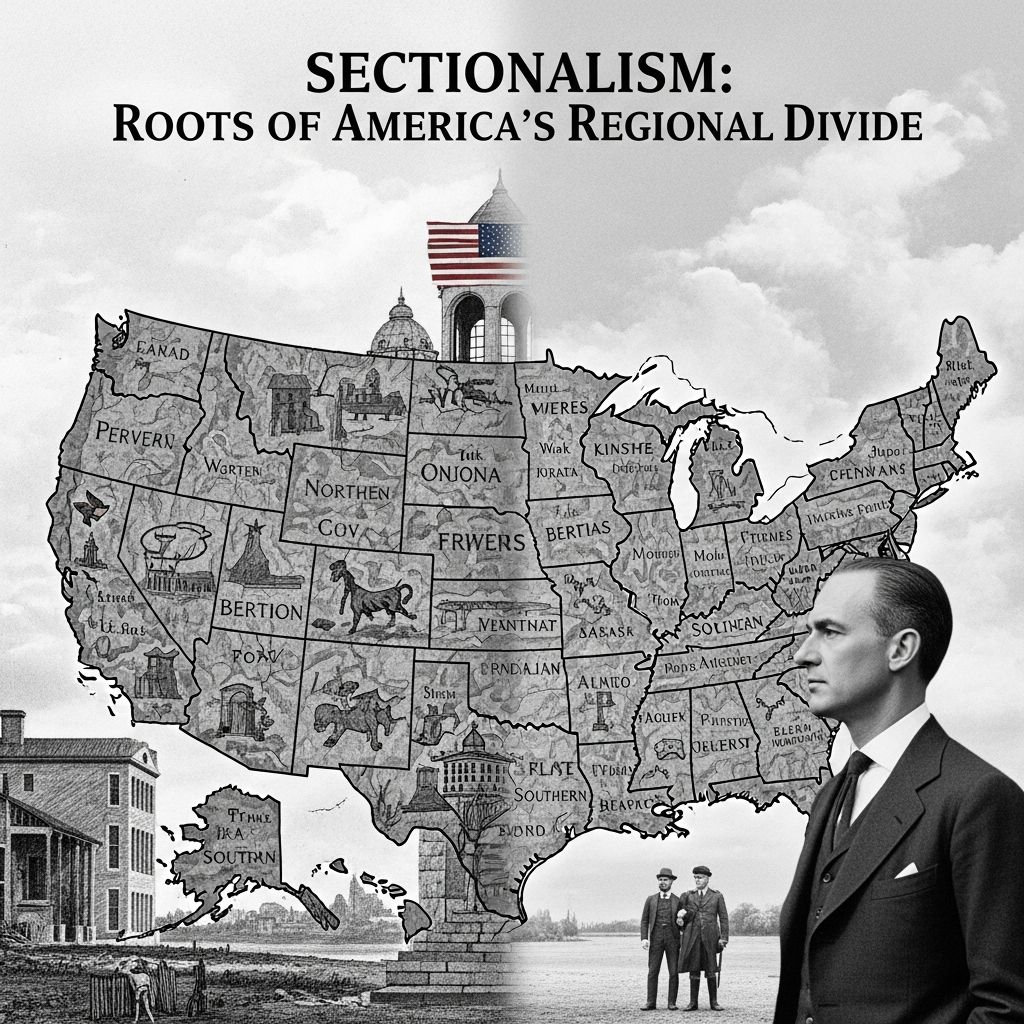
Sectionalism refers to the intense loyalty to one’s region over the nation as a whole, often leading to political and social tensions. In 19th-century America, this phenomenon manifested starkly between the industrial North, agrarian South, and expanding West, culminating in the Civil War.
Defining Regional Loyalties in Early America
From the nation’s founding, geographic, economic, and cultural differences fostered distinct regional identities. The North developed manufacturing hubs powered by immigration and wage labor, while the South relied on plantation agriculture sustained by enslaved labor. The West, meanwhile, represented frontier expansion with ambitions for land and opportunity.
These divergences created ‘sections’—cohesive communities bound by shared values and interests that sometimes superseded national unity. Historians note that sectionalism predated the Civil War and persisted afterward, influencing politics and policy.
Economic Foundations of Division
By the early 1800s, economic structures solidified regional divides. Northern states embraced tariffs to protect factories, viewing them as vital for growth. Southern economies, centered on cotton exports, opposed such measures as they raised import costs without benefiting agriculture.
- Northern Industry: Factories, railroads, and urban centers thrived on free labor and innovation.
- Southern Plantations: King Cotton dominated, with slavery underpinning vast estates exporting to Europe.
- Western Frontiers: Farmers sought cheap land and markets, often aligning variably with North or South.
These economies shaped political priorities, with the North favoring internal improvements like infrastructure, while the South prioritized free trade.
Slavery as the Central Fault Line
Slavery emerged as the most divisive issue, intertwining with economics and ideology. Southerners defended it as essential to their way of life and constitutional rights, while Northerners increasingly viewed it as immoral, pushing for restriction in new territories.
The debate intensified with westward expansion post-Louisiana Purchase and Mexican-American War, raising questions: Would new lands permit slavery? This ‘sectional crisis’ pitted slaveholding states against free ones, threatening balance in Congress.
Early Crises and Compromises
Tensions first boiled over in 1819 with Missouri’s bid for statehood as a slave state, risking Southern dominance in Senate. The Missouri Compromise admitted Missouri as slave and Maine as free, drawing a line at 36°30′ north latitude for future states.
| Compromise | Year | Key Provisions | Outcome |
|---|---|---|---|
| Missouri Compromise | 1820 | Missouri slave, Maine free; 36°30′ line | Temporary balance, but fragile |
| Compromise of 1850 | 1850 | California free; stronger fugitive slave law | Heightened North-South animosity |
| Kansas-Nebraska Act | 1854 | Popular sovereignty on slavery | Bleeding Kansas violence |
The Compromise of 1850 addressed lands from the Mexican War, admitting California as free but conceding a tougher Fugitive Slave Act, fueling Northern resentment. The Kansas-Nebraska Act repealed the Missouri line, allowing ‘popular sovereignty,’ sparking brutal conflicts in ‘Bleeding Kansas.’
Political Fragmentation and Party Splits
Parties fractured along sectional lines. Democrats split in 1860, with Northerners backing Stephen Douglas and Southerners John Breckinridge, reflecting slavery divides. Republicans, born anti-slavery, drew Northern support.
The Wilmot Proviso of 1846 exemplified early rifts: a failed amendment to ban slavery in Mexican War territories, highlighting Northern resistance.
Path to Secession and Civil War
Abraham Lincoln’s 1860 election, without Southern votes, prompted secession. South Carolina led seven states to form the Confederacy, viewing Republican victory as an existential threat to slavery.
Sectionalism transformed a policy debate into war, as regions prioritized local interests over union. Battles like Fort Sumter ignited the conflict that claimed over 600,000 lives.
Beyond the Civil War: Lingering Effects
Post-war Reconstruction aimed to integrate the South, but sectional resentments endured, shaping Jim Crow laws and economic disparities. Modern echoes appear in regional political divides.
Regional Profiles in Depth
The Industrial North
Urbanization and immigration fueled factories in New England and Midwest. Abolitionism grew via figures like William Lloyd Garrison, viewing slavery as a moral abomination.
The Agrarian South
Cotton ‘is king,’ per Senator John C. Calhoun, with slavery defended as a ‘positive good.’ States’ rights doctrines justified resistance to federal interference.
The Expanding West
Settlers sought land via Homestead Acts, often siding against Southern expansionism. Conflicts like those in Kansas pitted pro- and anti-slavery forces.
Key Figures and Events
- Henry Clay: ‘Great Compromiser’ behind Missouri and 1850 deals.
- John C. Calhoun: Southern spokesman for nullification and states’ rights.
- Daniel Webster: Northern advocate for union over sectionalism.
- Dred Scott Decision (1857): Supreme Court ruled Congress couldn’t ban slavery, inflaming tensions.
Sectionalism in Global Context
While unique to America, similar regionalisms occurred elsewhere, like Brazil’s North-South divides. Yet U.S. sectionalism’s link to slavery made it explosive.
Frequently Asked Questions
What exactly is sectionalism?
Sectionalism is prioritizing regional interests over national ones, often based on economic, cultural, or ideological differences.
How did sectionalism lead to the Civil War?
Clashes over slavery expansion, tariffs, and states’ rights escalated, culminating in Southern secession after Lincoln’s election.
Was slavery the only cause of sectionalism?
No, economic differences like tariffs and infrastructure mattered, but slavery was the core issue.
Did compromises resolve sectional tensions?
Temporarily, but they often exacerbated divisions, as seen in Kansas-Nebraska.
Does sectionalism still exist today?
Yes, in modern political polarization between coasts and heartland, though less tied to slavery.
Lessons for Today
Sectionalism warns of unity’s fragility when regions prioritize self-interest. Understanding it illuminates current divides and the value of compromise.
References
- Sectionalism | Definition, History, Examples, & Civil War — Britannica. 2023-10-15. https://www.britannica.com/topic/sectionalism
- Sectionalism in the U.S. | Definition, History & Causes — Study.com. 2024-01-20. https://study.com/academy/lesson/video/sectionalism-in-us-history-definition-conflict.html
- Sectionalism – Essential Civil War Curriculum — Essential Civil War Curriculum. 2022-05-10. https://www.essentialcivilwarcurriculum.com/sectionalism.html
- Sectionalism: Understanding the Divisions that Led to the U.S. Civil War — History is Now Magazine. 2026-02-11. http://www.historyisnowmagazine.com/blog/2026/2/11/sectionalism-understanding-the-divisions-that-led-to-the-us-civil-war

- Integrated M.A. in Applied Linguistics, University of Hyderabad
- 5+ years in editorial, instructional, SEO, and research-based writing
Sneha is a relationships and lifestyle writer with a strong foundation in applied linguistics and certified training in relationship coaching. She brings over five years of writing experience to theskillvault, crafting thoughtful, research-driven content that empowers readers to build healthier relationships, boost emotional well-being, and embrace holistic living. Her writing and insights reflect the belief that beauty, happiness, and wellness…