
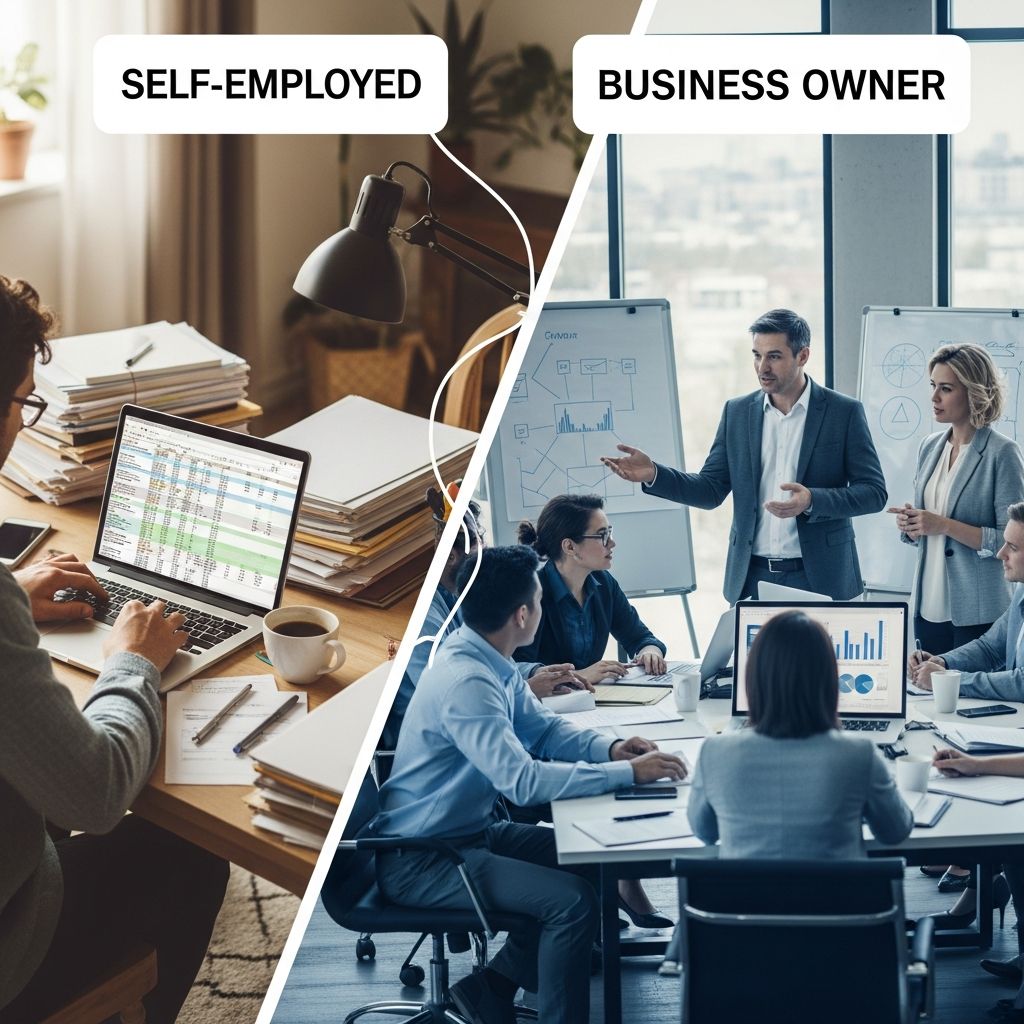
Plenty of people say they “work for themselves,” but that phrase can describe two very different realities: being self-employed or being a business owner. Understanding the distinction affects your day-to-day work, taxes, legal risk, and how your income can grow over time.
This guide breaks down the differences in clear language so you can identify where you are today and map a path to where you want to go next.
Core Definitions: What Each Term Really Means
There is no single universal legal definition that separates “self-employed” from “business owner” in every country, but in practice and under U.S. tax guidance, there are common patterns.
| Aspect | Self-Employed | Business Owner |
|---|---|---|
| Basic idea | You are the business | You run a business that can operate without you |
| Typical structures | Sole proprietor, independent contractor, single-member LLC | LLC, corporation, partnership, multi-member LLC |
| Team | Usually no employees; may use contractors | Commonly employs staff and/or contractors |
| Owner’s role | Performs most or all of the billable work personally | Focuses more on systems, management, and growth |
| Income source | Direct payment for personal work and time | Profit from the business; may receive salary + distributions |
What It Means to Be Self-Employed
Self-employed people earn income directly from their own labor and expertise. Freelancers, independent contractors, and many consultants fall into this category. In the U.S., the IRS treats you as self-employed if you carry on a trade or business as a sole proprietor or independent contractor, or if you are a member of certain partnerships.
- You typically operate under your own name or a simple business name.
- You are fully responsible for finding clients and delivering the work.
- There is little or no separation between you and your business for tax and liability unless you form an entity such as an LLC.
What It Means to Own a Business
Business owners oversee an organization that can generate revenue beyond their own direct labor. They may still work in the business, but their role is more about direction and decision-making than personally providing every service.
- You may hire employees or regularly engage contractors.
- Your business is often a distinct legal entity, such as an LLC or corporation, which can limit your personal liability.
- Your focus shifts toward building systems, brand, and long-term value.
Key Differences: How Self-Employed and Business Owners Operate
The labels matter less than how your work is organized. Here are the most important ways the two paths differ.
1. Who Does the Work?
- Self-employed: You perform the core work — design, consulting, coaching, programming, repairs, etc. If you stop working, income usually stops quickly.
- Business owner: You design how the work gets done. Employees, contractors, or systems handle much of the day-to-day delivery, so revenue can continue even when you step back.
2. Level of Formal Structure
Self-employed people can start and operate with relatively minimal formalities. Business owners usually have more structured operations.
- Self-employed: Often operate as sole proprietors using a Social Security number, minimal licensing, and straightforward bookkeeping.
- Business owners: Commonly register entities, maintain separate business bank accounts, payroll systems, and more complex records for tax and compliance.
3. Risk and Liability
The way your work is structured affects what you personally risk if something goes wrong.
- Self-employed: As a sole proprietor, business debts and legal claims can reach your personal assets, unless you have specific protections like professional liability insurance or an entity that is respected and properly maintained.
- Business owner: With structures like LLCs and corporations, owners typically have limited personal liability, meaning the entity, not the individual, is usually responsible for business debts and obligations, though there are exceptions.
4. Scalability and Growth Potential
One of the biggest practical differences is how income can grow.
- Self-employed: Earnings are closely tied to your hours and capacity. There is some room to raise rates or work more efficiently, but eventually time is the main constraint.
- Business owner: By hiring, automating, or introducing products, you can decouple revenue from your own hours. Growth can come from expanding locations, adding services, or increasing volume.
Tax Basics: How Each Path Is Taxed
Tax treatment varies by jurisdiction, but many countries, including the U.S., draw similar lines between individual self-employment and business entities. The points below reflect U.S. federal tax concepts and are for educational purposes only, not legal or tax advice.
Self-Employment Tax and Reporting
In the U.S., if you are self-employed, you generally pay both the employer and employee portions of Social Security and Medicare taxes through self-employment tax in addition to income tax.
- You typically report your business income and expenses on a schedule attached to your personal tax return (for example, Schedule C for sole proprietors).
- If your net earnings from self-employment exceed a low threshold, you must pay self-employment tax, which covers Social Security and Medicare contributions.
- Because no employer withholds your taxes, you often pay estimated taxes during the year to avoid penalties.
Business Entity Taxation
Business owners may have more options in how income is taxed, depending on the entity they choose.
- Pass-through entities: Partnerships and many LLCs pass income to owners, who report it on their personal returns, but the entity may file a separate informational return.
- Corporations: Some corporations are taxed separately from their owners, which can create opportunities and complexities in how profits are taken out (salary, dividends, or distributions).
- Payroll taxes: If you have employees, the business must withhold and remit payroll taxes and meet employment-tax filing obligations.
Because the rules are complex and change over time, most experts advise consulting qualified tax professionals when you move from simple self-employment to a more formal business.
Income, Benefits, and Everyday Lifestyle
Beyond taxes and legal structures, the difference shows up strongly in your daily experience.
Income and Stability
- Self-employed: Income is often variable, tied to client projects or billable hours. There is no set salary unless you create one for budgeting purposes. Cash flow can be highly seasonal.
- Business owner: You may pay yourself a regular salary from the business, plus periodic profit distributions when the company does well. This can add predictability, especially as the business matures.
Benefits and Time Off
- Self-employed: You must arrange your own health insurance, retirement savings, and paid time off if you want it. Time away from work may mean income stops during that period.
- Business owner: You might design benefits for yourself and your employees, such as health plans or retirement contributions, depending on the size and structure of the business. Time off may be easier if others can keep operations running.
Control and Flexibility
Both paths offer autonomy, but the nature of that control differs.
- Self-employed: You directly control your work, schedule, and client list, but you can feel pressure to say yes to every project because income is so closely tied to your effort.
- Business owner: You control the strategy and direction of the company, but you also take responsibility for employees, systems, and long-term planning. There is more leverage, but also more leadership responsibility.
How to Tell Which One You Are Right Now
If the lines feel blurry, ask yourself a few diagnostic questions.
- Do you have employees on payroll?
If yes, you are almost certainly operating as a business owner, at least in part, because you have employer obligations such as withholding payroll taxes and often providing certain benefits. - Can your business earn money while you are not personally doing the core work?
If revenue depends almost entirely on your personal time, you are functionally self-employed. If systems, products, or other people can keep revenue coming, you are closer to being a business owner. - Is there a separate legal entity?
If your work is organized under an LLC, corporation, or partnership with its own accounts, contracts, and formal records, you are likely operating as a business owner, even if you still do most of the work. - What is your long-term intent?
If you prefer a solo practice that supports your lifestyle, you may deliberately choose to stay self-employed. If your goal is to build something that could be sold or scaled, you are thinking like a business owner.
When (and Why) People Transition From Self-Employed to Business Owner
Many careers start with self-employment: a freelancer, contractor, or solo consultant builds a client base and then gradually adds systems and people. That evolution changes both risk and opportunity.
Common Reasons to Shift Toward Business Ownership
- You hit a ceiling on hours and want to grow income without working significantly more.
- Clients are asking for broader services you cannot personally deliver alone.
- You want to build an asset that has value beyond your personal reputation.
- You seek better liability protection and a clearer separation between personal and business finances.
Practical Steps Often Involved in That Transition
- Formalizing the business structure (for example, forming an LLC or corporation where appropriate).
- Opening dedicated business bank accounts and implementing more robust accounting.
- Hiring your first contractor or employee to take on parts of delivery or administration.
- Documenting processes so work can be delivered consistently by people other than you.
Pros and Cons: Self-Employed vs Business Owner
There is no “better” choice in absolute terms; each path suits different personalities and life goals.
| Advantages | Challenges | |
|---|---|---|
| Self-Employed |
|
|
| Business Owner |
|
|
How to Choose the Path That Fits You
Instead of asking which is better in general, consider which aligns with your current stage of life, risk tolerance, and ambitions.
Self-Employment Might Fit You If:
- You value flexibility and autonomy above building a large organization.
- You enjoy doing the work yourself and want a direct connection to clients.
- You prefer simpler systems and are comfortable managing your own taxes and benefits with professional help as needed.
Business Ownership Might Fit You If:
- You are motivated by growth, scale, and leading teams.
- You are willing to handle more complexity for the chance to build a larger or more enduring enterprise.
- You want the possibility of stepping back from daily delivery while the business continues to operate.
Frequently Asked Questions (FAQs)
Q: Are all self-employed people considered business owners?
A: Many tax authorities treat self-employed people as running a business for tax purposes, but in everyday language, people usually reserve the term “business owner” for those with more formal structures, employees, or operations that extend beyond one individual.
Q: Is a freelancer a business owner or self-employed?
A: Freelancers are typically self-employed — they provide services directly to clients, often on a contract basis. Some freelancers eventually formalize into business owners when they start hiring others or building an agency model.
Q: Do I need to form an LLC or corporation to be a business owner?
A: You can technically be a business owner as a sole proprietor, but forming an entity like an LLC or corporation can provide liability protection and may change how you are taxed. Whether to form one depends on your risk profile, income, and local laws, so professional advice is important.
Q: If I hire one assistant, does that automatically make me a business owner?
A: Hiring staff moves you in the direction of business ownership because you take on employer responsibilities such as withholding payroll taxes and complying with labor rules. However, in the early stages, you might still feel functionally self-employed if most work depends on you.
Q: Who pays more in taxes: self-employed people or business owners?
A: Self-employed individuals pay self-employment tax on their net earnings in addition to income tax, which can feel high because it includes both employer and employee portions of Social Security and Medicare. Business owners may have more flexibility in how they take income and in selecting structures that affect their tax burden, but the overall impact depends on the specific situation; there is no universal “cheaper” option.
References
- Independent contractor (self-employed) or employee? — Internal Revenue Service. 2024-03-12. https://www.irs.gov/businesses/small-businesses-self-employed/independent-contractor-self-employed-or-employee
- Small Business Owner vs. Self-Employed: What’s the Difference? — TaxAct. 2023-02-15. https://blog.taxact.com/small-business-owner-vs-self-employed-whats-the-difference/
- Self employed or small business owner: which one are you? — Hansa. 2022-10-05. https://www.withhansa.com/resources/self-employed-or-small-business-owner-which-one-are-you
- Self-Employed vs. Business Owner: Legal & Tax Differences — 1-800Accountant. 2023-06-01. https://1800accountant.com/blog/tax-strategies-self-employed-v-small-business-owners
- Should You Transition from Being Self-employed to a Small Business Owner? — NSKT Global. 2022-11-18. https://www.nsktglobal.com/usa/blog/should-you-transition-from-being-self-employed-to-a-small-business-owner

Medha Deb is an editor with a master's degree in Applied Linguistics from the University of Hyderabad. She believes that her qualification has helped her develop a deep understanding of language and its application in various contexts. Medha specializes in the areas of beauty, health, sports, and wellness and is committed to ensuring that the content on the website is…