
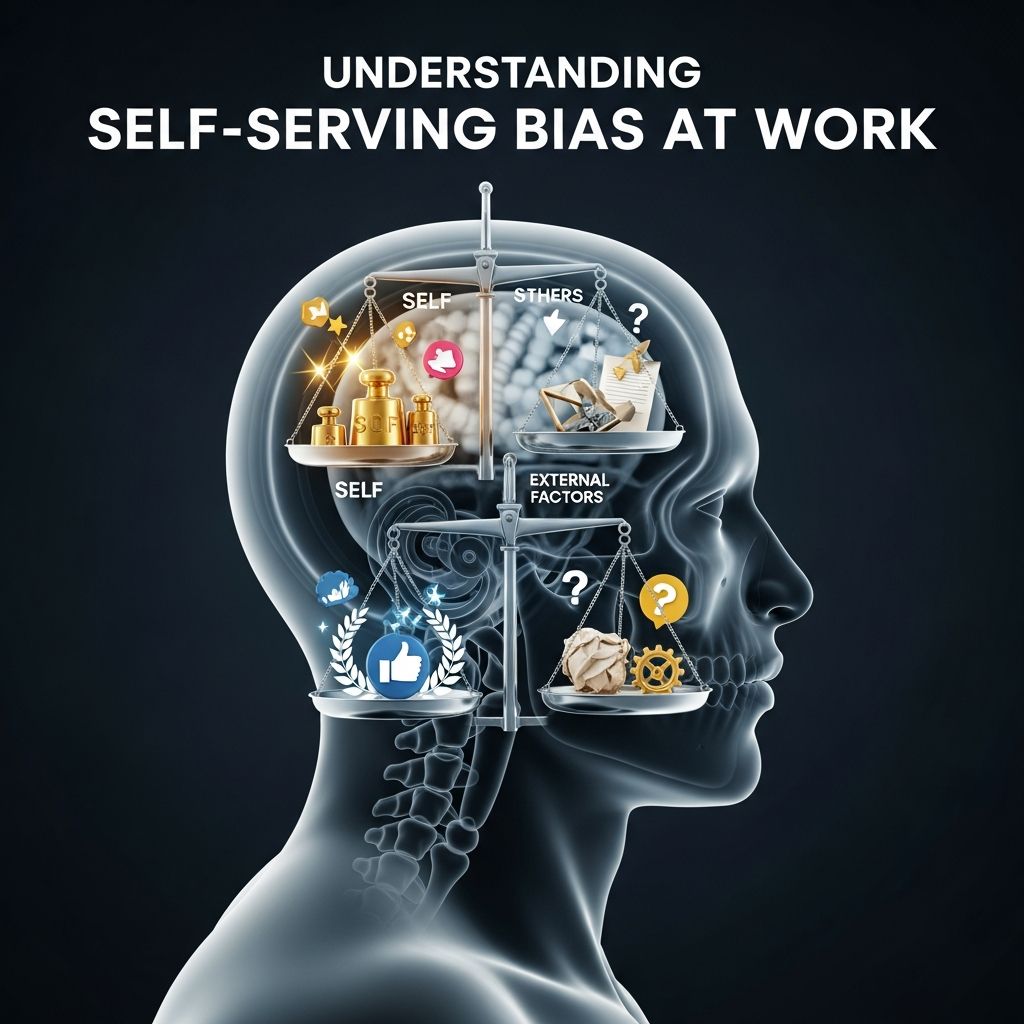
In every organization, people explain success and failure in different ways. Some say, “I worked hard,” when things go well and, “The timing was bad,” when they fall short. This common pattern has a name in psychology: self-serving bias.
Understanding this bias is essential for leaders, HR professionals, and coaches who want fairer performance evaluations, healthier feedback cultures, and stronger learning mindsets.
What Is Self-Serving Bias?
Psychologists define self-serving bias as the tendency to attribute our successes to internal, personal factors (such as ability, effort, or talent) and our failures to external, situational factors (such as luck, market conditions, or other people).
It is a type of attribution bias—a systematic error in how we explain causes of events and behaviors.
| Outcome | Self-serving explanation | Attribution type |
|---|---|---|
| Positive (e.g., promotion, successful project) | “I earned this through my skill and hard work.” | Internal / dispositional |
| Negative (e.g., missed target, failed launch) | “The market was against us; the brief was unclear.” | External / situational |
This bias appears across many contexts—from research studies in social psychology to day-to-day work conversations.
Why Our Brains Lean Toward Self-Serving Explanations
Researchers highlight several interacting reasons why people reliably show self-serving bias.
1. Protecting and Enhancing Self-Esteem
A major driver is the need to maintain a positive view of ourselves. When we take credit for good outcomes and deflect responsibility for bad ones, we preserve self-worth and limit feelings of shame, guilt, or incompetence.
Over time, this can support resilience and optimism, but it also distorts reality and blocks honest self-assessment.
2. Managing Our Public Image
Self-serving bias is not only about how we see ourselves; it also shapes how we want others to see us. Psychologists describe this as a self-presentation motive—protecting reputation, status, and credibility in front of colleagues, managers, or clients.
In team settings, this may appear as:
- Taking disproportionate credit when projects succeed
- Emphasizing external obstacles when results are weak
- Subtly shifting blame to other departments or individuals
3. Expectations and Surprise
Another line of research suggests people interpret outcomes based on their expectations. When events match what they anticipated, they are more likely to see internal causes; when events are surprising or inconsistent with expectations, they tend to highlight external factors.
For example:
- If a high-performing salesperson expects to close a deal and does, they attribute success to their ability.
- If that same salesperson unexpectedly loses a deal, they are more inclined to see the cause in bad timing or client politics.
4. Cognitive Shortcuts
Self-serving explanations also reflect mental shortcuts. It is cognitively easier to start from our existing beliefs (“I am competent”) and fit explanations around them, rather than fully re-evaluating our abilities every time something goes wrong.
How Self-Serving Bias Shows Up in the Workplace
In organizational life, self-serving bias can subtly influence many everyday processes.
Performance Reviews and Feedback
Self-serving bias can create a gap between how employees see their performance and how managers evaluate them. Studies show that people often attribute positive performance reviews to their capabilities and negative reviews to unfair evaluation or external barriers.
This may lead to:
- Resistance to constructive feedback
- Disputes about performance ratings or bonus decisions
- Limited learning from critical incidents or mistakes
Teamwork and Collaboration
Within teams, self-serving bias can become a group issue. People are inclined to see their own subgroup or department as responsible for success, while attributing failures to other units or outside pressures. This is closely related to group-serving bias, where members favorably explain outcomes for their in-group.
Consequences may include:
- Credit disputes between departments (e.g., sales vs. marketing)
- Breakdowns in trust after failures
- Finger-pointing instead of collective problem-solving
Leadership Decision-Making
Leaders are not immune. When strategies succeed, executives may over-attribute success to their vision and underplay macroeconomic or industry tailwinds. When strategies fail, they may focus on external shocks or resistance from staff.
Over time, this can reinforce overconfidence, reduce openness to dissenting views, and weaken risk management.
Learning, Innovation, and Psychological Safety
Self-serving bias can undermine a culture of learning by discouraging honest reflection on failures. Research on high-reliability organizations and learning cultures emphasizes the importance of candid analysis of errors and near-misses.
When people consistently blame context instead of examining their own decisions, the organization loses opportunities to improve processes, skills, and systems.
Related Biases That Interact With Self-Serving Bias
Self-serving bias often overlaps with other attribution biases that shape how we judge ourselves and others.
Actor–Observer Bias
Actor–observer bias describes the tendency to explain our own behavior in terms of external factors, while explaining others’ behavior in terms of internal traits.
- As “actors,” we highlight context: workload, constraints, lack of resources.
- As “observers,” we focus on others’ character: motivation, competence, reliability.
This can intensify misunderstandings between managers and employees, or between teams.
Fundamental Attribution Error
The fundamental attribution error is the tendency to overestimate personality factors and underestimate situational forces when evaluating others’ behavior.
Examples at work include:
- Assuming an underperforming employee is lazy, rather than exploring workload or unclear priorities.
- Judging a colleague as disorganized after one missed deadline, ignoring systemic bottlenecks.
Group-Serving Bias
Group-serving bias extends self-serving explanations to groups we belong to—teams, business units, or the organization as a whole.
- “Our team succeeded because we are more capable.”
- “We missed our goals because of corporate policies or market conditions.”
Recognizing these patterns is key to building cross-functional collaboration and avoiding silo thinking.
When Self-Serving Bias Helps—and When It Hurts
Self-serving bias is not purely negative. It can play an adaptive role, but it also carries clear risks.
Potential Benefits
- Emotional protection: Softens the impact of mistakes and setbacks, supporting resilience and persistence.
- Confidence and motivation: Taking credit for success may reinforce self-efficacy and the belief that effort pays off.
- Short-term coping: In high-pressure roles, externalizing some failure can prevent demoralization and burnout.
Costs and Risks
- Poor self-awareness: Over time, people may develop an unrealistically positive self-image that is not aligned with objective performance.
- Stalled development: If every failure is “someone else’s fault,” there is little incentive to build new skills or change behavior.
- Damaged trust: Colleagues notice when someone always claims credit yet rarely accepts responsibility, which erodes credibility.
- Flawed decisions: Leaders who misattribute causes of success or failure may repeat ineffective strategies or ignore early warning signals.
Practical Strategies to Reduce Self-Serving Bias
Completely eliminating self-serving bias is unrealistic. However, individuals and organizations can reduce its negative impact and encourage more balanced thinking.
1. Build Awareness and Shared Language
Understanding that self-serving bias is a common human tendency—not a personal flaw—makes it safer to discuss. Workshops, coaching, and leadership programs can introduce basic concepts of cognitive bias and attribution.
Useful actions include:
- Introducing examples of self-serving explanations in training
- Encouraging teams to notice patterns in how they explain outcomes
- Normalizing the idea that everyone, including leaders, is susceptible
2. Use Structured Reflection After Key Events
After projects, wins, or failures, structured debriefs help counter biased explanations. Instead of informal storytelling, use guided questions that prompt balanced attributions:
- “Which factors were under our control?”
- “What did we personally do well, and what could we improve next time?”
- “What external factors truly influenced the outcome?”
Rotating facilitators and inviting different perspectives reduces the chance that one narrative dominates.
3. Seek Disconfirming Evidence
To challenge self-serving stories, encourage practices such as:
- Asking, “What evidence would suggest my explanation is incomplete or wrong?”
- Requesting feedback from colleagues with different vantage points
- Comparing self-ratings with objective indicators (data, KPIs, customer feedback)
Research on evidence-based management shows that decisions grounded in diverse data sources and critical questioning are more robust than those based solely on personal impressions.
4. Foster Psychological Safety
People are more likely to accept responsibility when they feel safe to admit mistakes. Work on creating environments where:
- Leaders openly share their own misjudgments and what they learned
- Errors are treated as learning opportunities rather than only as grounds for punishment
- Questions and dissent are welcomed during planning and review
Research on team psychological safety links this climate to greater learning behaviors, innovation, and performance.
5. Integrate Coaching and Development Conversations
Coaching—formal or informal—helps individuals examine their own thinking patterns. Coaches can:
- Gently challenge one-sided explanations of events
- Ask how the coachee might have contributed to both positive and negative outcomes
- Support self-compassion so that people can acknowledge mistakes without harsh self-criticism
When people feel both supported and accountable, they are more willing to replace self-serving explanations with constructive self-reflection.
Self-Serving Bias and Diversity, Equity, and Inclusion
Self-serving bias can also intersect with fairness and equity. Because people often see themselves and their in-groups in a favorable light, they may underestimate the role of structural barriers or bias in others’ outcomes.
In practice, this might look like:
- A leader attributing their own advancement solely to merit, while downplaying network advantages or systemic preferences.
- Decision-makers overlooking how bias affected who received stretch assignments or visibility.
Addressing these blind spots requires pairing individual self-reflection with systemic analysis of policies, processes, and data.
Simple Questions to Catch Self-Serving Bias in the Moment
Professionals and leaders can use quick questions to check their thinking before reacting to outcomes:
- “If someone else were in my situation, how would I explain their result?”
- “What part of this outcome might reasonably be due to my decisions or actions?”
- “Am I giving external factors more weight when the result is negative than when it is positive?”
- “What would a neutral outsider highlight as the main causes here?”
Over time, these micro-habits can shift individuals and teams toward more balanced, evidence-based attributions.
Frequently Asked Questions About Self-Serving Bias
Q: Is self-serving bias always a bad thing?
No. It can offer short-term emotional protection and support confidence, especially after setbacks. However, when it becomes a default explanation style, it undermines learning, damages trust, and leads to distorted self-perception.
Q: How is self-serving bias different from healthy confidence?
Healthy confidence is grounded in realistic self-assessment and openness to feedback. Self-serving bias selectively credits the self for success and blames context for failure, making growth and accurate evaluation more difficult.
Q: Can teams show self-serving bias, not just individuals?
Yes. Teams and departments can collectively attribute success to their own competence and failures to other groups or external conditions. This group-level pattern is often called group-serving bias and can fuel silos and conflict between units.
Q: What role can managers play in reducing self-serving bias?
Managers can model balanced attributions, invite honest reflection after both wins and losses, provide specific evidence-based feedback, and create a psychologically safe environment where admitting mistakes is not punished but used for learning.
Q: Are some people or cultures less prone to self-serving bias?
Research suggests that cultural values, such as individualism versus collectivism, can shape how strongly self-serving patterns appear, and that individuals with depression may show a reduced or reversed self-serving bias. However, the tendency itself appears across many populations.
References
- What Is Self-Serving Bias? Definition & Examples — Scribbr. 2023-01-10. https://www.scribbr.com/research-bias/self-serving-bias/
- Self-Serving Bias in Psychology: Definition & Examples — Simply Psychology. 2023-06-15. https://www.simplypsychology.org/self-serving-bias.html
- Self-Serving Bias — Wikipedia. 2024-05-22. https://en.wikipedia.org/wiki/Self-serving_bias
- Self-Serving Bias: Examples, Definition, and Experiments — Healthline. 2020-07-21. https://www.healthline.com/health/self-serving-bias
- The Self-Serving Bias: Definition, Research, and Antidotes — Psychology Today. 2013-01-22. https://www.psychologytoday.com/us/blog/in-practice/201301/the-self-serving-bias-definition-research-and-antidotes

- Integrated M.A. in Applied Linguistics, University of Hyderabad
- 5+ years in editorial, instructional, SEO, and research-based writing
Sneha is a relationships and lifestyle writer with a strong foundation in applied linguistics and certified training in relationship coaching. She brings over five years of writing experience to theskillvault, crafting thoughtful, research-driven content that empowers readers to build healthier relationships, boost emotional well-being, and embrace holistic living. Her writing and insights reflect the belief that beauty, happiness, and wellness…