
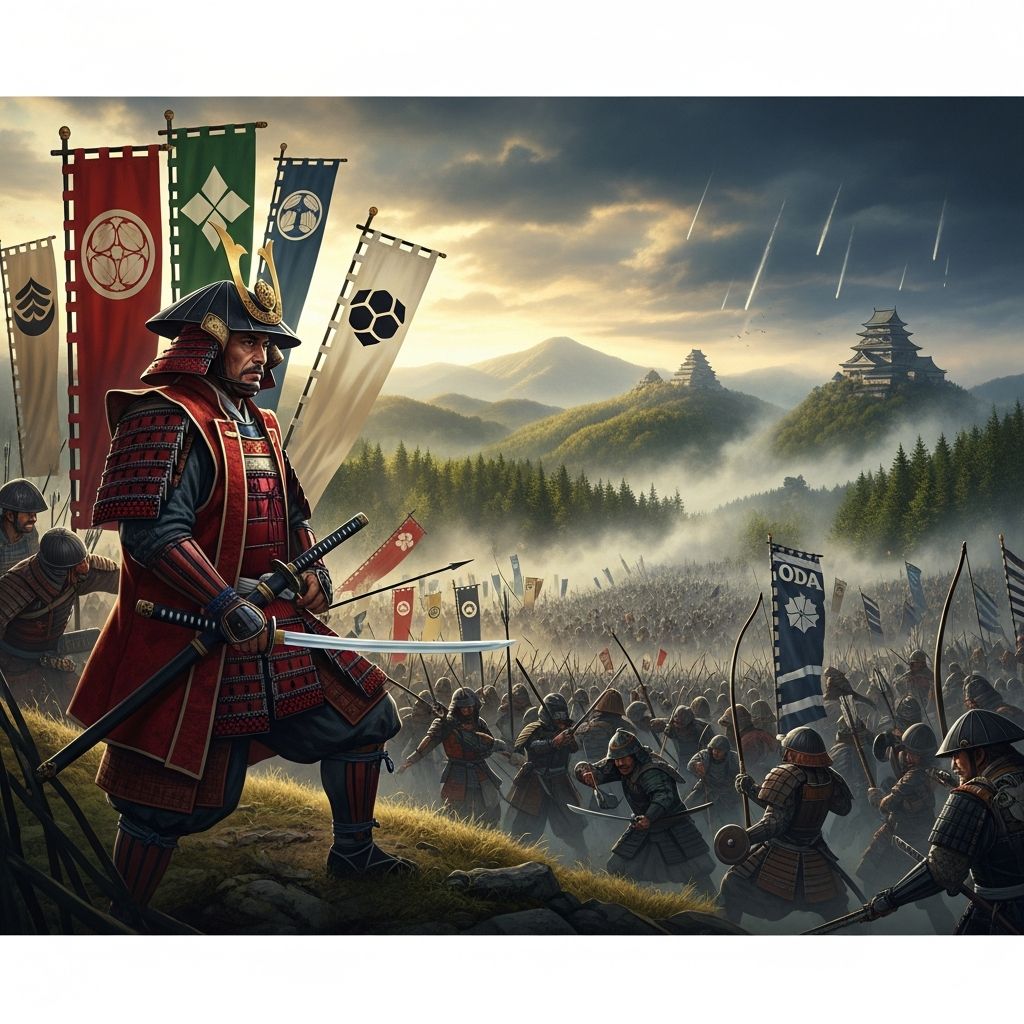
The Sengoku Period, often called the Warring States era, represents one of the most tumultuous chapters in Japanese history, spanning roughly from the mid-15th to late-16th century. This time of near-constant warfare saw the collapse of central authority, the rise of regional warlords known as daimyo, and profound social, military, and cultural transformations that ultimately led to Japan’s reunification.
Origins of Turmoil: From Muromachi Decline to Nationwide Conflict
The roots of the Sengoku Period trace back to the weakening of the Muromachi shogunate, which had ruled since 1336. By the 15th century, the Ashikaga shoguns in Kyoto struggled to maintain control amid rival factions and economic strains. The pivotal trigger was the Onin War (1467-1477), a brutal conflict between powerful families like the Yamana and Hosokawa clans over shogunal succession. This war devastated Kyoto, turning the capital into ruins and symbolizing the end of centralized power.
Post-Onin, Japan fragmented into dozens of independent domains. Local lords, or sengoku daimyo, seized control, absorbing weaker neighbors through conquest or alliance. Events like the Kyotoku incident in 1454 and the Meiō incident in 1493 further eroded imperial and shogunal influence, marking the period’s informal start. By the late 1400s, peasant revolts such as the Kaga ikki in 1488 challenged samurai dominance, highlighting widespread social upheaval.
The Power Vacuum: Daimyo Rise and Social Reordering
In the absence of a strong shogun, daimyo became the true rulers, governing han (domains) based on rice production measured in koku. These warlords built massive castles, levied taxes, and commanded private armies of samurai. The traditional social hierarchy blurred as merchants and peasants gained influence through wartime economies, though samurai remained the warrior elite.
- Daimyo strategies: Conquest, marriage alliances, and hostage exchanges to secure loyalty.
- Peasant uprisings: Ikki rebellions demanded land reforms and lower taxes amid famines.
- Economic shifts: Increased trade and castle towns fostered proto-urban centers.
This decentralization fueled innovation but also endless skirmishes, reducing the number of daimyo from hundreds to a few dozen by the mid-16th century.
Military Evolution: Firearms, Castles, and Tactical Genius
Warfare during the Sengoku era evolved dramatically. Traditional ashigaru infantry gave way to mass conscription, while the introduction of Portuguese matchlock arquebuses (tanegashima) in 1543 revolutionized battles. Daimyo like Oda Nobunaga exploited these firearms at clashes such as Nagashino (1575), where volleys decimated cavalry charges.
Stone-walled yamajiro and hirajiro castles proliferated, serving as fortified headquarters. Naval warfare also advanced with atakebune ships armed with cannons. Key innovations included:
| Innovation | Impact | Example |
|---|---|---|
| Arquebuses | Mass firepower over melee | Nagashino 1575 |
| Castles | Defensive strongholds | Azuchi Castle |
| Trench warfare | Positional tactics | Siege of Ishiyama Hongan-ji |
These changes favored adaptable leaders, shifting power toward those who embraced technology and large-scale mobilization.
Key Figures: The Architects of Chaos and Unity
Oda Nobunaga: The Demon King
Oda Nobunaga (1534-1582) emerged as the first great unifier. From Owari province, he crushed rivals with ruthless efficiency, entering Kyoto in 1568 to install Ashikaga Yoshiaki as puppet shogun. Nobunaga’s campaigns included the burning of Enryaku-ji monastery in 1571 and the Battle of Okehazama (1560), where he defeated a larger Imagawa force through bold ambush.
His economic policies, like free markets (rakuichi rakuza), bolstered his war machine. Betrayed by general Akechi Mitsuhide at Honno-ji in 1582, Nobunaga’s death sparked a power struggle.
Toyotomi Hideyoshi: The Peasant’s Champion
Toyotomi Hideyoshi (1537-1598), rising from sandal-bearer to regent, avenged Nobunaga and completed unification by 1590. He conducted a land survey (Taiko Kenchi) to tax based on productivity and froze the samurai class, banning upward mobility. Hideyoshi’s invasions of Korea (1592-1598) failed disastrously but occupied restless warriors.
Tokugawa Ieyasu: The Enduring Founder
Tokugawa Ieyasu (1543-1616) outlasted rivals, winning decisively at Sekigahara (1600). He redistributed domains, creating a sankin kotai system requiring daimyo attendance in Edo, ensuring loyalty. By 1603, Ieyasu established the Tokugawa shogunate, ushering in over two centuries of peace.
Cultural Flourishing Amid Destruction
Despite the violence, the Sengoku era sparked cultural renaissance. Zen Buddhism influenced tea ceremonies and Noh theater, while ink painting (suiboku-ga) captured the era’s transience. Castle architecture blended utility with grandeur, as seen in Azuchi Castle’s gold-laden interiors.
European contact began in 1543 with Portuguese traders, introducing Christianity (via Jesuits like Francis Xavier in 1549), guns, and goods like tobacco. This nanban trade boomed until Hideyoshi’s 1587 expulsion edict, though it left lasting impacts on cuisine and science.
Legacy: From Fragmentation to Edo Stability
The Sengoku Period ended variably—Nobunaga’s 1568 Kyoto entry, Yoshiaki’s 1573 exile, or Ieyasu’s 1603 shogunate. It transformed Japan from anarchy to a rigidly structured society under Tokugawa rule, setting the stage for isolationism (sakoku).
Socially, it rigidified the four-class system; militarily, it professionalized samurai; economically, it centralized rice-based feudalism. The era’s lessons in unity and governance influenced modern Japan.
Frequently Asked Questions (FAQs)
What caused the Sengoku Period?
The decline of the Muromachi shogunate and the Onin War (1467-1477) shattered central authority, empowering daimyo in a power vacuum.
Who unified Japan during Sengoku?
Oda Nobunaga started, Toyotomi Hideyoshi advanced, and Tokugawa Ieyasu completed unification with the 1603 shogunate.
How did guns change Sengoku warfare?
Introduced in 1543, arquebuses enabled mass volleys, favoring large armies over traditional archery and cavalry.
What was daily life like in Sengoku Japan?
Farmers endured taxes and conscription, samurai fought relentlessly, while trade and culture thrived in castle towns amid constant threat.
Did women play roles in Sengoku conflicts?
Yes, figures like Nohime (Nobunaga’s wife) and Tomoe Gozen-inspired onna-bugeisha defended castles and fought.
References
- Sengoku period — Wikipedia. Accessed 2026. https://en.wikipedia.org/wiki/Sengoku_period
- The Sengoku period (1477 – 1573) — Japan Experience. Accessed 2026. https://www.japan-experience.com/plan-your-trip/to-know/japanese-history/sengoku-period
- The Three Unifiers of Sengoku Era Japan — Japan Society. Accessed 2026. https://japansociety.org/news/the-three-unifiers-of-sengoku-era-japan/
- Sengoku Period — World History Encyclopedia. 2019-10-29. https://www.worldhistory.org/Sengoku_Period/
- Sengoku Jidai: Japan’s Warring States Period — U.S. National Park Service. Accessed 2026. https://www.nps.gov/gett/learn/historyculture/sengoku-jidai.htm

Medha Deb is an editor with a master's degree in Applied Linguistics from the University of Hyderabad. She believes that her qualification has helped her develop a deep understanding of language and its application in various contexts. Medha specializes in the areas of beauty, health, sports, and wellness and is committed to ensuring that the content on the website is…