
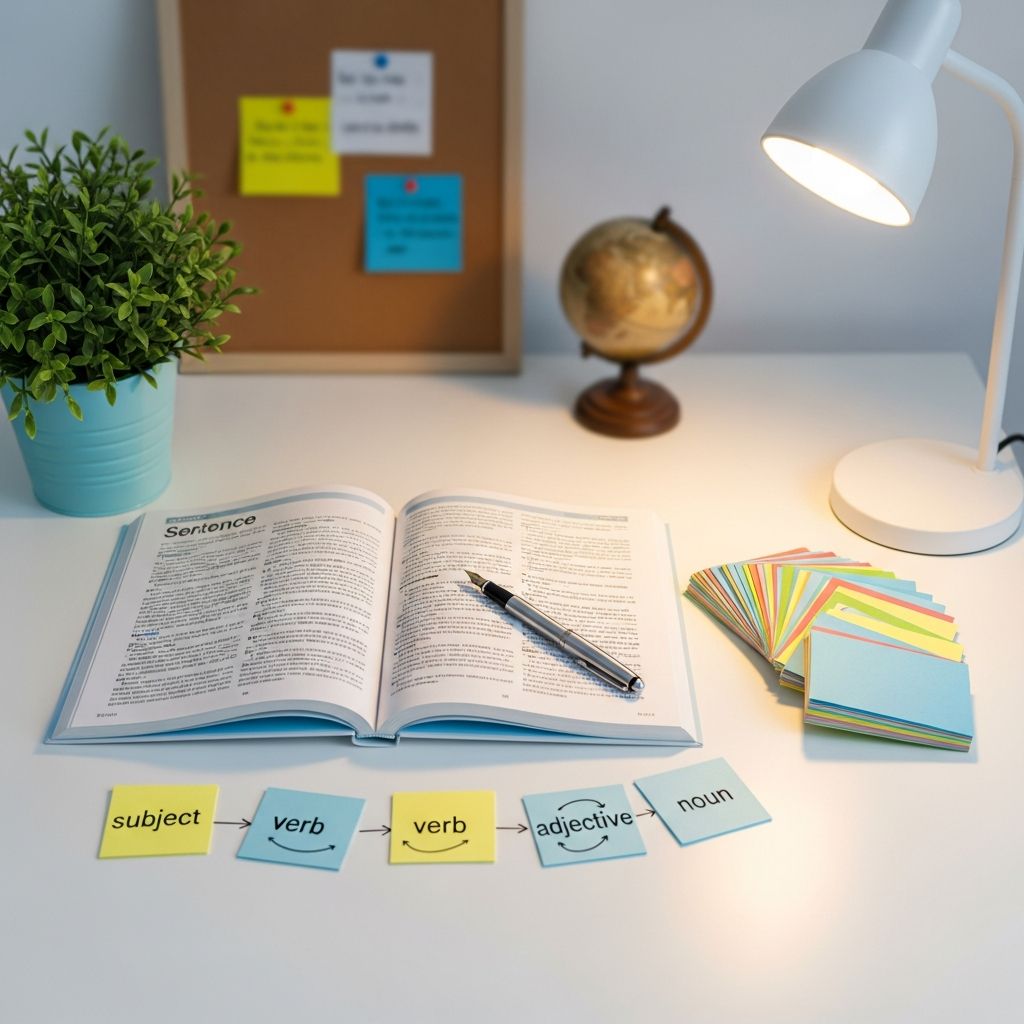
Sentence building techniques offer educators powerful tools to elevate student writing from basic to sophisticated. These methods focus on manipulating sentence elements to foster deeper understanding of grammar, syntax, and expression, leading to improved fluency and clarity in both reading and writing.
Understanding the Role of Sentences in Literacy Development
Sentences form the core of effective communication, serving as the basic units that convey complete ideas. In educational settings, mastering sentence construction directly impacts students’ ability to comprehend texts and produce coherent writing. Research shows that targeted practice with sentence structures enhances syntactic awareness, which is crucial for processing complex information and crafting nuanced prose.
Young learners often struggle with sentence boundaries, fragments, and basic grammar, while older students need to build variety through compounds and complexes. By integrating sentence-focused activities, teachers can bridge these gaps, making abstract rules tangible through hands-on practice.
Key Benefits of Sentence Building for Young Writers
- Enhances Comprehension: Breaking down and reconstructing sentences helps students internalize how words form meaning, improving their ability to parse challenging texts.
- Builds Writing Fluency: Regular practice with varied structures reduces choppy writing and promotes natural flow.
- Reinforces Grammar Naturally: Embedded in context, grammar lessons stick better than isolated drills.
- Boosts Confidence: Visible progress in sentence sophistication motivates students to tackle longer compositions.
These advantages extend across subjects, as strong sentences underpin scientific explanations, historical narratives, and literary analysis alike.
Core Sentence Building Strategies for Classrooms
Effective sentence building draws from proven practices like expansion, combining, deconstruction, and sorting. Each targets specific skills while keeping engagement high through interactive formats.
Sentence Expansion: Adding Depth and Detail
Sentence expansion starts with a kernel sentence, prompting students to layer in descriptors, clauses, and phrases. For instance, transform “The dog runs” into “The energetic brown dog runs swiftly through the sunny park, chasing a fluttering butterfly.” This builds vocabulary, syntax, and precision.
Implementation Steps:
- Present a simple sentence and targeted questions (e.g., “What kind? How? Where?”).
- Model expansions on the board, highlighting additions.
- Guide practice with frames like “The [adjective] [noun] [verb] [adverb] because [clause].”
- Independent trials, followed by peer sharing for feedback.
Across grades, adapt complexity: elementary focuses on adjectives/adverbs; middle school adds appositives; high school incorporates subordinates. Benefits include better pronoun use, conjunction mastery, and punctuation accuracy.
Sentence Combining: Crafting Complex Ideas
Combining merges simple sentences into multifaceted ones, teaching coordination and subordination. Example: “The storm arrived. Winds howled. Rain poured.” becomes “When the storm arrived, fierce winds howled as heavy rain poured down.” This mirrors real-world writing demands.
Studies confirm sentence combining boosts syntactic maturity from elementary through college levels. Use texts from class content for relevance, gradually increasing kernel count from two to four.
| Grade Level | Example Kernels | Targeted Combine |
|---|---|---|
| Elementary | “Birds fly. Sky is blue.” | “Birds fly in the blue sky.” |
| Middle | “She studied. Test was hard. She passed.” | “Although the test was hard, she studied and passed.” |
| High | “Climate changes. Ice melts. Sea levels rise rapidly.” | “As climate changes cause ice to melt, sea levels are rising more rapidly than ever.” |
Sentence Deconstruction: Analyzing for Insight
Deconstruction reverses combining by dissecting complex sentences into components, revealing underlying logic. Select a model: “Running late, the hurried student, who forgot his homework, dashed into class.” Students identify clauses, phrases, and roles.
This sharpens analytical skills, aiding comprehension of dense academic language. Pair with reconstruction for full cycle practice, using just minutes daily.
Sentence Sorting and Unscrambling: Hands-On Syntax Play
Sorting involves cards with words/phrases rearranged into logical orders, reinforcing cohesion. Unscrambling challenges build pattern recognition. Variations include type conversion (question to statement) or structure shifts (simple to compound).
Collaborative groups amplify discussion, with formative checks via sorted outputs.
Integrating Strategies Across Curriculum Areas
Embed these in all subjects: science for procedural sentences, history for chronological combines, literature for stylistic imitations. One-sentence summaries tie to text structures (cause/effect, descriptive), condensing passages while practicing expansion.
Weekly Routine Example:
- Monday: Expansion from science text.
- Wednesday: Combining historical events.
- Friday: Deconstruct literary excerpt, then imitate.
This reinforces content while honing sentences, with minimal prep.
Practical Tips for Teacher Implementation
Start simple, scaffold heavily, then release gradually. Use whiteboards for low-stakes practice, highlighters for visuals. Incorporate editing passes: one for variety, one for commas. Read aloud to catch rhythm issues.
Differentiate via frames for strugglers, open-ended for advanced. Track growth with pre/post writing samples.
Frequently Asked Questions (FAQs)
How often should sentence building activities occur?
Three to five times weekly, in 5-10 minute bursts, yields optimal gains without overwhelming schedules.
Do these work for English learners?
Yes, visual/scaffolded nature supports syntax acquisition, paired with vocab support.
Can they improve test scores?
Indirectly, via better essay clarity and reading stamina, as syntax aids processing.
What tools aid delivery?
Printable cards, digital apps for sorting, class texts for authenticity.
How to assess progress?
Review expanded/combined outputs for criteria like variety, accuracy; use rubrics.
Long-Term Impact on Student Achievement
Consistent practice yields writers who vary structures for readability, avoiding monotony. They produce paragraphs flowing seamlessly from strong sentences. Beyond mechanics, critical thinking sharpens as students synthesize ideas precisely.
Incorporate peer review: partners suggest expansions, fostering collaboration. Over time, transfer to independent compositions occurs naturally.
Challenges like resistance fade with gamification—sentence races or challenges. Persistence pays, transforming reluctant writers into expressive ones.
References
- How Sentence Construction Improves Student Literacy — Learning Focused. 2023. https://learningfocused.com/blogs/teaching-literacy/how-sentence-construction-improves-student-literacy
- Deconstructing and Combining Sentences to Support Comprehension and Writing — Keys to Literacy. 2023-10-01. https://keystoliteracy.com/blog/deconstructing-and-combining-sentences-to-support-comprehension-and-writing/
- Sentence Exploration & Student Composing Time — The Educator Summit. 2023. https://www.theeducatorsummit.com/blog/sentence-exploration-composing-time
- Improving and Combining Sentences: A Gradual Release — The Teacher Studio. 2023. https://theteacherstudio.com/improving-and-combining-sentences/
- Sentence Composing Practices — Sentence Composing. 2023. https://sentencecomposing.com/sentence-composing-practices/
- Helping Students Improve Sentence-level Skills — MIT Comparative Media Studies/Writing. 2023. https://cmsw.mit.edu/academics/writing-rhetoric-professional-communication/teaching-writing-communication/helping-students-improve-sentence-level-skills/

Medha Deb is an editor with a master's degree in Applied Linguistics from the University of Hyderabad. She believes that her qualification has helped her develop a deep understanding of language and its application in various contexts. Medha specializes in the areas of beauty, health, sports, and wellness and is committed to ensuring that the content on the website is…