
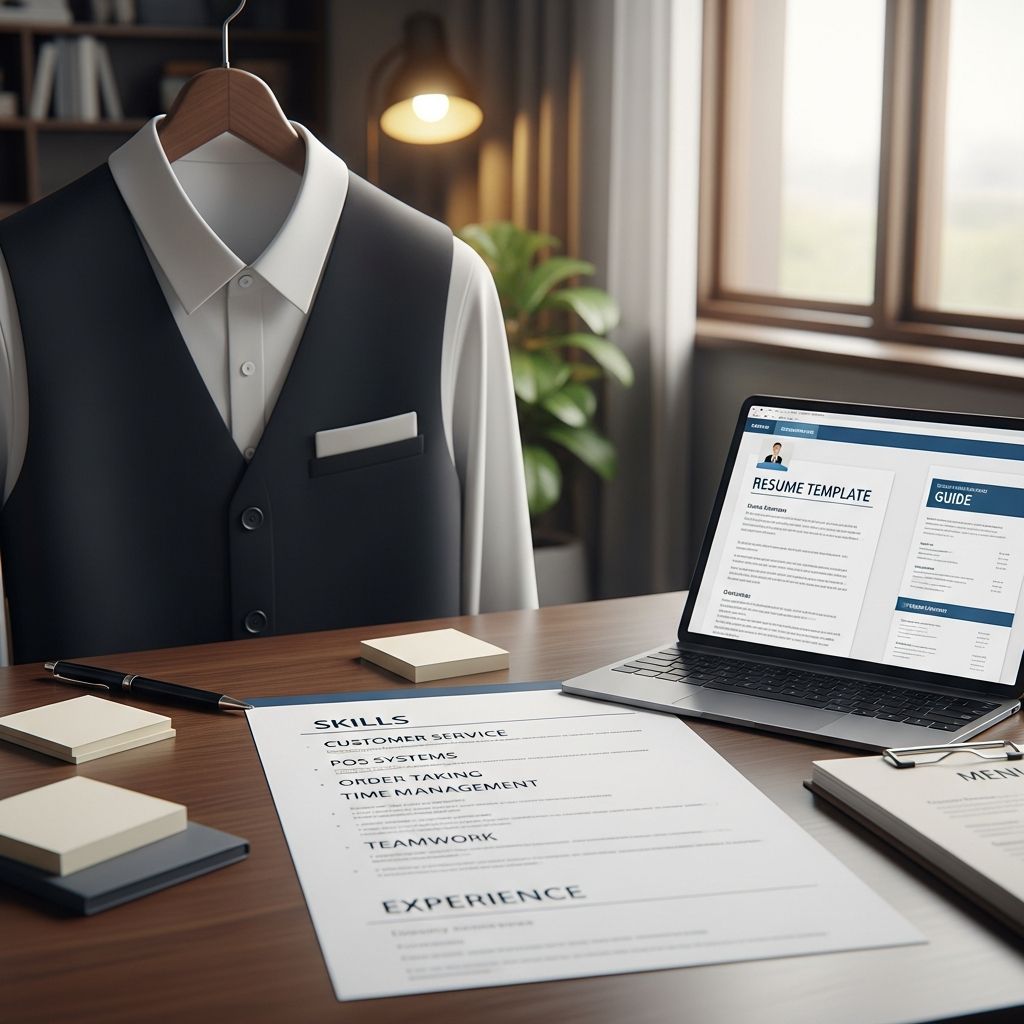
Working as a server means being the face of the restaurant, balancing customer satisfaction, speed, and accuracy in a fast-paced environment. A well-crafted server resume shows you can handle pressure, deliver great service, and support smooth restaurant operations.
This guide walks you through how to write a strong server resume from scratch: what to include, how to format it, which skills matter most, and how to tailor it for different types of restaurants.
Understanding the Server Role Before You Write
Knowing what employers expect from a server helps you choose the right achievements, skills, and keywords for your resume.
- Providing courteous, efficient table service and handling guest concerns professionally.
- Accurately taking orders, using POS systems, and coordinating with kitchen and bar staff.
- Maintaining food safety and hygiene standards as required by local regulations.
- Upselling menu items and driving higher check averages without pressuring guests.
- Contributing to a positive team atmosphere during busy shifts and peak hours.
Research on hospitality shows that customer service quality, quick problem resolution, and communication skills are key drivers of guest satisfaction and repeat visits, all of which you should highlight on your resume.
Choosing the Best Format for a Server Resume
Most candidates benefit from a reverse-chronological format, where your most recent restaurant experience appears first.
| Format | Best For | Pros | Considerations |
|---|---|---|---|
| Reverse-chronological | Most servers with 1+ years of experience | Clear career growth, ATS-friendly, easy to scan for hiring managers | Employment gaps are more visible |
| Functional | Career changers, limited experience | Emphasizes skills over dates | Some recruiters distrust purely functional formats |
| Hybrid | Experienced servers with varied roles | Balances skills and experience; good for senior or lead servers | Can become cluttered if not concise |
For ATS (applicant tracking systems) and human readers, keep the layout clean, use simple headings (e.g., “Experience,” “Education,” “Skills”), and avoid complex graphics.
Core Sections Every Server Resume Needs
Most strong server resumes follow a simple structure that recruiters can quickly scan:
- Contact information
- Professional summary or objective (optional but useful)
- Work experience
- Skills (technical and soft)
- Education and certifications
- Optional extras (languages, awards, volunteer work)
Contact Information: Clear and Professional
Your contact details should be brief, accurate, and professional.
- Full name
- City and province/state (full address is rarely needed)
- Phone number you actively check
- Professional email address (e.g., firstname.lastname@…)
- Optional: link to a professional profile (e.g., LinkedIn) if it’s up to date
Professional Summary: A Snapshot of Your Value
A 2–3 sentence summary quickly shows what type of server you are, where you have worked, and what you do well.
Use your summary to:
- Mention your years of experience and main environment (casual dining, fine dining, hotel, café).
- Highlight 2–3 strengths supported by results (e.g., upselling, guest satisfaction, speed).
- Include one or two relevant keywords from the job description for ATS compatibility.
For entry-level candidates, an objective can briefly state your goal and transferable skills (such as customer service, retail, or barista experience).
Work Experience: Show Results, Not Just Tasks
Recruiters see similar task lists on many server resumes. To stand out, emphasize measurable achievements and impact.
- List roles in reverse-chronological order with job title, restaurant name, location, and dates.
- Use 3–6 bullet points per recent job.
- Start each bullet with a strong action verb (e.g., “served,” “coordinated,” “upsold,” “resolved”).
- Include numbers when possible: table turnover, sales growth, covers per shift, guest ratings.
Examples of achievement-focused bullet styles:
- “Increased average check size by promoting daily specials and add-ons at dinner service.”
- “Handled high-volume sections of 10–12 tables while maintaining accurate orders and timely service.”
- “Trained new servers on POS usage, side-work standards, and guest service expectations.”
Education and Certifications
Most server roles do not require advanced degrees, but employers value relevant credentials, especially those related to food safety and alcohol service.
- Include your highest level of education (e.g., high school diploma, GED, college degree).
- Add food safety or alcohol service certifications such as ServSafe, Smart Serve, or equivalent regional permits, as these are often mandatory for serving roles.
- Mention in-house or brand training programs if they show customer service or leadership development.
Key Skills to Highlight on a Server Resume
The best server resumes combine soft skills (how you interact with customers and colleagues) with technical skills (what you can do with tools and procedures).
Soft Skills Employers Look For
- Customer service and hospitality
- Communication and active listening
- Patience and composure under pressure
- Teamwork and collaboration
- Time management and multitasking
- Conflict resolution and problem-solving
- Attention to detail and accuracy
Technical and Job-Specific Skills
- Proficiency with POS systems and handheld ordering devices
- Knowledge of menu items, ingredients, and common allergens
- Wine, beer, and cocktail basics for pairing and recommendations
- Cash handling and payment processing
- Food safety and hygiene practices (e.g., safe temperatures, cross-contamination prevention)
- Opening and closing procedures (side work, cash-out, inventory checks)
- Banquet or event service, if applicable
Studies on foodborne illnesses show that proper training and adherence to food safety procedures significantly reduce public health risks in restaurants, so highlighting any recognized food safety training strengthens your profile.
Tailoring Your Resume to Different Dining Environments
Not all server roles are the same. Adjust your resume focus according to the type of establishment.
Casual and Family Dining
- Emphasize speed, friendliness, and handling large sections.
- Highlight experience with high-volume service, kids’ menus, and large family groups.
- Mention suggestive selling of combo meals, desserts, and promotions.
Fine Dining and Upscale Restaurants
- Show knowledge of wine, multi-course service, and detailed menu explanations.
- Emphasize discretion, polished communication, and meticulous attention to detail.
- Include experience with reservations, tasting menus, wine pairings, and specialty service techniques (e.g., tableside preparations).
Cafés, Bars, and Hotels
- For cafés, highlight coffee knowledge, quick service, and takeout processes.
- For bars, emphasize drink knowledge, ID verification, and responsible alcohol service.
- For hotels, show coordination with front desk, room service, or banqueting teams.
Making Your Server Resume ATS-Friendly
Many hospitality employers use applicant tracking systems to filter resumes. To ensure your resume makes it to a human reader:
- Use simple headings such as “Experience,” “Skills,” and “Education.”
- Avoid images, text boxes, or unusual fonts that may not parse correctly.
- Incorporate relevant keywords from the job description, such as “POS,” “customer service,” “food safety,” and specific cuisine types.
- Save and submit in the requested file type (often PDF or DOCX).
Fine-Tuning: Style, Length, and Proofreading
The overall presentation of your resume influences how professional you appear.
- Length: Aim for one page for most server roles unless you have extensive hospitality experience across multiple positions.
- Font: Choose simple, readable fonts and keep font sizes consistent.
- Language: Use concise, direct phrasing and avoid slang.
- Proofreading: Carefully check spelling of restaurant names, job titles, and dates. Errors undermine the “attention to detail” many servers list as a strength.
Sample Skills Matrix for Server Resumes
The table below gives a simple way to think about how your skills might line up with different server roles.
| Skill Area | Casual Dining | Fine Dining | Banquet / Events |
|---|---|---|---|
| Customer Service | High-volume, family-oriented | Personalized, discreet | Efficient service for large groups |
| Menu Knowledge | Basic familiarity | Detailed ingredients and pairings | Set menus and timing |
| Upselling | Promos, desserts, add-ons | Wine, premium dishes | Event upgrades (bar packages) |
| Technical Skills | POS, takeout, basic bar | Wine service, reservations | Buffet setups, banquet POS |
Common Mistakes on Server Resumes (and How to Avoid Them)
- Vague job descriptions: Avoid bullet points that only list duties like “served guests” without showing impact.
- Ignoring numbers: Even approximate metrics (tables per shift, upsell rates, return guests) help quantify your performance.
- Overloading with unrelated experience: Focus on roles that show customer service, teamwork, or food service skills.
- Fancy designs that break ATS: Recruiters and ATS tools prefer clean, simple layouts.
- Not tailoring to the job: Use the job description to prioritize the most relevant skills and experiences.
Frequently Asked Questions About Server Resumes
Q: Do I need restaurant experience to get my first server job?
No. If you are new to serving, highlight transferable skills from retail, call centers, volunteer work, or any role involving customer interaction, cash handling, or teamwork. Emphasize your ability to learn quickly, stay calm under pressure, and communicate with diverse guests.
Q: Should I include every job I have had?
Not necessarily. Focus on the last 10 years and prioritize jobs that demonstrate customer service, hospitality, or reliability. You can safely omit short, unrelated roles unless they help fill a major employment gap.
Q: How can I show career growth as a server?
Show promotions (e.g., from host to server, or server to trainer), increased responsibilities (such as handling larger sections), mentoring new staff, or being trusted with VIP tables and complex reservations.
Q: Is a one-page resume always required?
For most server positions, a concise one-page resume is preferred because hiring managers skim quickly. However, if you have extensive, relevant experience in hotels, events, or management, a second page can be acceptable as long as every line adds value.
Q: How often should I update my server resume?
Update your resume whenever you change jobs, complete a new certification, gain a promotion, or achieve significant results (such as awards or improved guest satisfaction scores). Regular updates make it easier to apply quickly when a strong opportunity opens.
References
- Essential Components Every Server Resume Needs — The Interview Guys. 2024-01-10. https://blog.theinterviewguys.com/restaurant-server-resume-template/
- How to Write a Server Resume (With an Example) — Indeed Career Guide. 2023-07-18. https://ca.indeed.com/career-advice/resumes-cover-letters/server-resume
- 21 Server Resume Examples for 2026 — BeamJobs. 2024-05-02. https://www.beamjobs.com/resumes/server-resume-examples
- A Job-Winning Server Resume Template — Big Interview Resources. 2023-11-06. https://resources.biginterview.com/resume-templates/server-resume-template/
- Mastering the Art of Serving: Essential Server Skills — Jobscan. 2024-03-15. https://www.jobscan.co/skills/server
- Food Safety for Retail Food Establishments — U.S. Food and Drug Administration (FDA). 2022-12-01. https://www.fda.gov/food/buy-store-serve-safe-food/food-safety-retail-food-establishments

- Integrated M.A. in Applied Linguistics, University of Hyderabad
- 5+ years in editorial, instructional, SEO, and research-based writing
Sneha is a relationships and lifestyle writer with a strong foundation in applied linguistics and certified training in relationship coaching. She brings over five years of writing experience to theskillvault, crafting thoughtful, research-driven content that empowers readers to build healthier relationships, boost emotional well-being, and embrace holistic living. Her writing and insights reflect the belief that beauty, happiness, and wellness…