
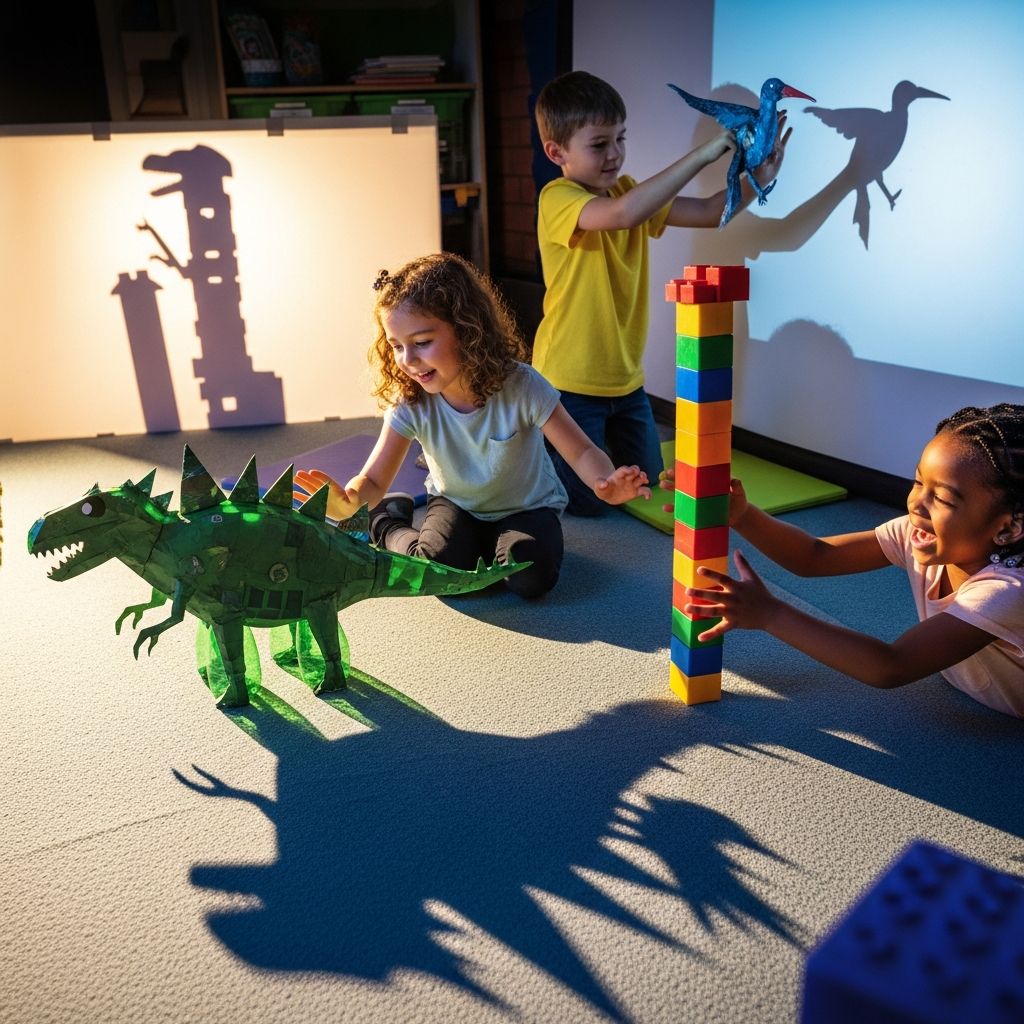
Shadows have captivated human imagination for centuries, and they offer remarkable opportunities for children to explore fundamental concepts in physics and light. When children engage with shadows through play and experimentation, they develop observational skills, scientific thinking, and creative expression simultaneously. The interplay between light sources and objects creates an accessible laboratory for discovering how the physical world operates.
Understanding the Foundations of Shadow Formation
Before diving into specific activities, it helps to understand what makes shadows such valuable learning tools. A shadow forms when an object blocks light from traveling in a straight line, creating a darker area on a surface behind it. This simple concept opens doors to exploring properties of light, angles, distance, and geometry. Children learn through direct observation that shadows are not arbitrary marks but predictable phenomena governed by the position of light sources and objects.
The beauty of shadow learning lies in its accessibility. Whether using natural sunlight, indoor lamps, or flashlights, children can experiment with light and shadow in almost any environment. These activities require minimal materials while offering maximum educational value, making them ideal for classrooms, homes, and outdoor learning spaces.
Light-Based Movement and Shape Recognition
One of the most engaging starting points involves interactive movement games that use shadows as feedback tools. Children can stand in sunlight or in front of a light source and be invited to create specific shapes with their bodies and arms. An adult or peer might call out instructions—”Make a star shape,” “Create the letter A,” or “Show me how tall you can be”—and children translate these verbal requests into physical positions that cast corresponding shadows.
This activity serves multiple developmental purposes. Children practice following directions, develop body awareness, and learn about spatial relationships. Beyond physical benefits, they begin understanding that the shadow they create is directly connected to their body position, fostering cause-and-effect reasoning.
Variations include having children replicate specific movements like standing on one foot, reaching upward, or moving on all fours. Rotating leadership roles—allowing children to suggest movements for others to shadow—adds an element of creativity and gives every child the opportunity to lead and follow.
Artistic Expression Through Shadow Outline Tracing
Shadow tracing transforms outdoor spaces into enormous canvases for artistic exploration. On a sunny day, children can stand on a driveway or sidewalk while someone traces the outline of their shadow using chalk. The resulting silhouette becomes a template for creative enhancement.
Children can draw details within their traced shadows—adding facial features, clothing patterns, or internal organs to create anatomically detailed figures. Alternatively, they might paint or color inside the outlined shadow, experimenting with different artistic techniques and color combinations.
This activity connects art and science, as children observe how their shadow’s size and shape change depending on the sun’s position throughout the day. Conducting the same tracing activity at different times—morning, midday, and afternoon—reveals how shadows lengthen, shorten, and shift direction as the sun moves across the sky.
Imaginative Play and Personification Activities
For younger children, particularly preschoolers and kindergarteners, engaging shadows in imaginative play builds emotional connections to learning. A “tea party with your shadow” transforms a simple concept into a memorable social experience. Children set up a small table or blanket with teacups and treats, then position themselves so their shadow appears across from them at the table.
This activity encourages solitary imaginative play—a valuable opportunity for self-regulation and creative thinking—or becomes a group experience when multiple children participate together. Children might “introduce” their shadows to friends, pour tea for both themselves and their shadows, and engage in pretend conversation. This playful approach demystifies shadows and creates positive associations with scientific observation.
Variations include hosting shadow “conversations,” asking children to imagine what their shadow might be thinking or feeling, and exploring how shadows change when children move or alter their position.
Shadow Puppet Theater and Narrative Creation
Shadow puppet theater combines light manipulation, storytelling, and performance art into a compelling activity. Creating a simple shadow puppet theater requires minimal resources: a white sheet or screen, a light source (lamp, flashlight, or projector), and cut-out puppet figures or hand shapes.
Children can use pre-made paper cutouts attached to popsicle sticks or create their own puppet designs. By holding these puppets between the light source and the screen, they cast shadows that become characters in stories. This activity naturally integrates literacy skills, as children develop narratives, establish character motivations, and practice dialogue.
Groups of children can collaborate to create scenes and stories, fostering teamwork and communication. Inviting an audience—family members, classmates, or other groups—adds an element of performance and responsibility that elevates the experience.
Observational Science Through Time-Lapse Shadow Studies
A more structured scientific approach involves tracking how shadows change throughout the day. Children can place an object—a block, toy, or stick—in the same location on white paper and trace its shadow at regular intervals: morning, late morning, midday, afternoon, and late afternoon.
By collecting these tracings, children create a visual record of how shadows transform. They observe that shadows grow longer in early morning, shrink toward midday when the sun is highest, then lengthen again in the afternoon. This activity teaches fundamental concepts about Earth’s rotation, the sun’s apparent movement, and how celestial mechanics influence everyday observations.
Documenting this progression with photographs creates a time-lapse sequence that children can review and analyze. Discussion questions might include: “Why do shadows change size?” “When is the shadow shortest?” and “Can you predict what the shadow will look like tomorrow at this time?”
Three-Dimensional Objects and Shadow Exploration
Many children first encounter shadows through two-dimensional thinking, but three-dimensional objects offer richer learning opportunities. Building structures using blocks, then tracing the resulting shadow, introduces children to the relationship between an object’s form and its shadow’s appearance.
When children rotate a three-dimensional object—perhaps a cylinder or cube—they observe how the shadow changes shape even though the object itself remains constant. This surprising discovery builds understanding that shadows represent only certain aspects of an object’s form, not its complete nature.
Children might construct elaborate block structures and trace their complex shadows, or draw pictures of the original structures alongside their shadow versions, analyzing the similarities and differences.
Interactive Light Source Manipulation
Indoor shadow activities using controllable light sources offer different learning experiences than outdoor sunlight experiments. Using lamps or flashlights, children can discover how moving the light source changes shadow size, shape, and position.
Systematic exploration reveals patterns: moving the light source closer to an object makes the shadow larger; moving it farther away makes the shadow smaller. Changing the angle of the light source alters the shadow’s direction and shape. These discoveries help children understand properties of light and develop predictive thinking.
Children can experiment with various objects—toys, geometric shapes, plant life, or their own hands—observing how different forms cast different shadows. This activity works equally well individually or in small groups, with children collaborating to test hypotheses and share observations.
Sidewalk Chalk Art Integration
Combining shadow activities with sidewalk chalk art creates opportunities for mixed-media creative expression. Children can first create chalk artwork on a driveway or sidewalk, then position themselves to cast shadows across or within the artwork. Photographing the resulting composition combines visual art, shadow play, and light manipulation into a single creative project.
This activity appeals to children who enjoy visual art, photography, and creative problem-solving. They must think about composition, considering how shadows will interact with existing artwork to create an aesthetically pleasing final image.
Developing Scientific Thinking Through Shadow Study
All shadow activities share a common thread: they encourage children to observe carefully, ask questions, form hypotheses, and test predictions. A child might wonder, “What happens if I move the light source to a different angle?” or “Why does my shadow look different at different times of day?”
These questions naturally lead to experimentation. Children become young scientists, conducting informal investigations and drawing conclusions based on their observations. This hands-on approach to learning builds confidence in scientific thinking and demonstrates that discovery doesn’t require laboratory equipment—just curiosity and careful observation.
Adaptability Across Age Groups and Settings
Shadow activities scale beautifully across developmental stages. Toddlers benefit from simple shadow chasing and light exploration. Preschoolers engage with imaginative play like shadow tea parties. Elementary-aged children tackle more complex investigations involving time-lapse documentation and three-dimensional object analysis. Older children can explore mathematical concepts like angles, proportions, and geometric relationships through shadow study.
These activities thrive in diverse settings: classrooms integrate shadow learning into science and art curricula; families explore shadows in backyards and living rooms; outdoor educators use natural light for environmental learning. The flexibility of shadow-based activities makes them invaluable educational tools.
Frequently Asked Questions
Q: What is the best time of day to conduct shadow activities outdoors?
A: Early morning and late afternoon provide long, dramatic shadows ideal for tracing and observation. Midday shadows are shorter but clearly defined, making them useful for different types of investigations. Conducting activities at multiple times reveals how shadows change throughout the day.
Q: Can shadow activities be done indoors on cloudy days?
A: Yes, indoor shadow activities using lamps, flashlights, or projectors work regardless of weather or time of day. These controlled light sources offer advantages for exploring how shadow size and position change with light source manipulation.
Q: What materials are necessary for shadow activities?
A: Most shadow activities require minimal materials: sunlight or a light source, chalk or paper for tracing, and objects to create shadows. Some activities benefit from puppets, sheets, or other props, but creativity and natural materials substitute effectively.
Q: How do shadow activities connect to standard curricula?
A: Shadow activities align with science standards addressing light and energy, geometry in mathematics, and artistic expression in arts education. They also develop critical thinking, observation skills, and scientific reasoning valued across disciplines.
Q: Can individual children complete shadow activities, or do they require groups?
A: Shadow activities accommodate both individual and group participation. Solo work encourages independent discovery and self-regulation, while group activities build collaboration and communication skills. Most activities easily adapt to either format.
References
- Educational Shadow Activities for Kids — Rhythms of Play. 2024. https://rhythmsofplay.com/educational-shadow-activities-for-kids/
- Shadow Activities For Preschoolers — Little Bins for Little Hands. 2024. https://littlebinsforlittlehands.com/shadow-activities-for-preschoolers/
- Shadow Experiments and Activities for Kids — Science Sparks. 2024. https://www.science-sparks.com/shadow-activity-ideas/
- Light and Shadow Activities for Preschoolers & Young Kids — The Inspired Treehouse. 2024. https://theinspiredtreehouse.com/light-and-shadow-play-for-kids/
- Next Generation Science Standards (NGSS) Framework — National Academy of Sciences. 2013. https://www.nextgenscience.org/
- 10 Activities About Light and Shadows — Macaroni Kid Merrimack Valley. 2024. https://merrimackvalleyma.macaronikid.com/articles/5eca7a84ed591b2a478b41dd/10-activities-about-light-and-shadows
- Indoor Shadows: Stand-Alone Activities — Peep and the Big Wide World Educators. 2024. http://www.peepandthebigwideworld.com/en/educators/curriculum/center-based-educators/23/shadows/node/824/

Medha Deb is an editor with a master's degree in Applied Linguistics from the University of Hyderabad. She believes that her qualification has helped her develop a deep understanding of language and its application in various contexts. Medha specializes in the areas of beauty, health, sports, and wellness and is committed to ensuring that the content on the website is…