
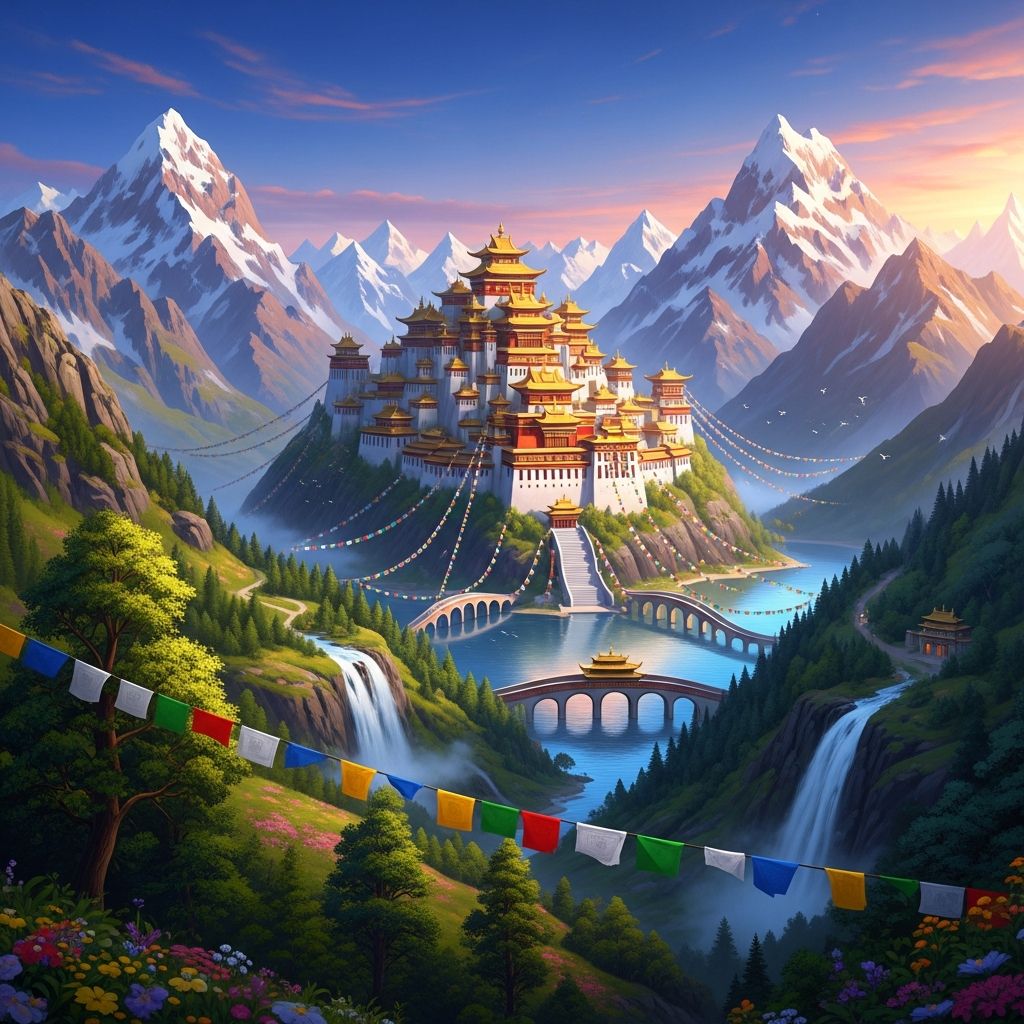
Understanding the Mystical Realm of Shambhala
Deep within the snow-covered peaks and remote valleys of Central Asia lies a place that has fascinated seekers, scholars, and adventurers for centuries. Shambhala represents one of humanity’s most enduring legends—a legendary kingdom said to exist beyond the perception of ordinary people, hidden from the material world yet thriving in a realm of spiritual enlightenment and ancient wisdom. Unlike fictional fantasies or modern inventions, Shambhala emerges from genuine religious texts and oral traditions spanning thousands of years, making it a unique intersection of mythology, spirituality, and historical inquiry.
The enchantment with Shambhala transcends simple curiosity about a lost place. For believers and practitioners of Buddhism, this kingdom represents a living spiritual ideal—a sanctuary where enlightened beings preserve sacred knowledge and prepare for humanity’s spiritual transformation. For explorers and historians, it presents an intriguing puzzle: Could such a place actually exist? What geographical features might conceal it? What draws so many intelligent and resourceful people to dedicate their lives to its discovery?
Religious Foundations and Sacred Teachings
The conceptual framework for Shambhala rests primarily on the Kalachakra teachings, one of Buddhism’s most complex and esoteric systems of spiritual practice. According to Buddhist tradition, the Buddha himself transmitted these teachings to King Suchandra of Shambhala approximately 2,500 years ago. This transmission marked the beginning of Shambhala’s role as a custodian of Buddhist wisdom, specifically the Kalachakra doctrine.
The Kalachakra teachings encompass far more than simple religious instruction. They integrate cosmology, psychology, history, and predictions about humanity’s spiritual future into a comprehensive system. The kingdom of Shambhala, in this framework, serves as the ultimate repository of these teachings, maintained across generations by an unbroken lineage of enlightened rulers known as the Shambhala Kings.
Beyond Buddhist texts, Shambhala appears in Hindu scriptures as well. The Vishnu Purana, an ancient Hindu text, suggests that Shambhala will serve as the birthplace of Kalki, a prophesied savior figure whose arrival signals a new age of cosmic renewal. This multi-religious recognition suggests that Shambhala may represent a concept that transcends individual traditions, embodying universal hopes for spiritual salvation and transformation.
Geographical Theories and Proposed Locations
Despite centuries of searching, no definitive location for Shambhala has been confirmed. However, researchers and scholars have proposed several plausible geographical sites based on ancient texts and geographical descriptions. These theories often overlap with regions of profound spiritual significance in Asian geography.
The Himalayan Theory
Modern Buddhist scholars frequently suggest that Shambhala exists somewhere within the higher reaches of the Himalayan mountain system, particularly in regions around the Dhauladhar Mountains near Mcleodganj in present-day India. This theory gains credibility from the detailed geographical references in Buddhist texts. The Kalachakra Tantra provides descriptions so specific that modern satellite imaging has apparently confirmed matching valley formations in the region. The isolation provided by the Himalayan terrain would adequately explain why such a kingdom could remain undiscovered despite extensive modern exploration and surveillance technology.
The Central Asian Hypothesis
Some researchers, following the explorations of twentieth-century adventurers like Nicholas Roerich, propose that Shambhala lies far to the north in the Altai Mountains of Central Asia. Roerich spent years investigating this region and believed that Belukha Mountain might serve as an entrance to the kingdom—a belief that persists among certain communities in that area. This location would place Shambhala in regions spanning parts of Russia, Mongolia, and Central Asian republics.
The Afghan Origins Theory
French explorer Alexandra David-Néel, renowned for her travels throughout Tibet in the early twentieth century, developed an alternative historical explanation. She hypothesized that Shambhala may once have functioned as a genuine Buddhist center located around ancient Balkh in Afghanistan, a civilization that was destroyed through conquest. According to this theory, the physical kingdom dissolved into history, but its teachings were preserved and transmitted through hidden valleys and monastic communities, gradually transforming historical fact into spiritual legend.
The Pakistani Valley Connection
Ancient texts from the tradition of Zhangzhung, which predates Tibetan Buddhism, place Shambhala in what is now recognized as the Sutlej Valley in Pakistan. This geographical identification provides another plausible location anchored in historical documentation and cultural memory of the region.
The Northwestern China and Kyrgyzstan Regions
Additional scholarly perspectives suggest that Shambhala might have existed in present-day Xinjiang Province in northwestern China or in eastern Kyrgyzstan, under a different historical name that has since been lost or transformed through cultural transmission.
The Prophecy of Future Emergence
Beyond its status as a hidden sanctuary, Shambhala holds profound significance in Buddhist eschatology through the prophecy of its eventual reemergence. This prophecy, woven throughout Buddhist teachings, describes a future moment when the world descends into spiritual darkness and material chaos.
According to the prophecy, the twenty-fifth King of Shambhala, known as Rudra Chakrin, will emerge from the hidden kingdom leading an army of light to confront and overcome the forces of darkness and ignorance. This prophesied battle symbolizes the ultimate triumph of wisdom over ignorance, though Buddhist teachers emphasize that it should not be interpreted literally but rather as a metaphor for the spiritual transformation each practitioner must undergo internally.
This eschatological vision provides meaning and hope within Buddhist cosmology. Rather than depicting an external salvation imposed by divine will, the prophecy describes spiritual awakening and the inevitable victory of enlightened consciousness over delusion. Practitioners see themselves as potential participants in this ultimate transformation, making the prophecy personally relevant rather than merely historical or futuristic.
Historical Origins and Founding Narratives
Buddhist texts preserve several origin stories explaining how Shambhala came into being. One prevalent account traces the kingdom’s foundation to King Manjuśrīkīrti in 159 BC. According to this narrative, this ancient ruler attempted to convert his subjects from sun worship to Buddhist practice. Those who resisted his spiritual reforms were expelled from the kingdom. Some of these expelled individuals, rather than dispersing, chose instead to establish their own hidden realm where they could preserve their traditional wisdom and way of life.
This origin story carries intriguing implications. It suggests that Shambhala’s founders possessed knowledge worth protecting—whether spiritual, scientific, or both. The narrative implies intentional concealment rather than accidental isolation, suggesting that those who established Shambhala possessed both the knowledge and capability to render their kingdom invisible to the outside world.
Another tradition describes how approximately 20,000 people deliberately vanished into mountain valleys, founding Shambhala as a sanctuary for the preservation of ancient wisdom. According to this account, these individuals synthesized solar wisdom with Dharma teachings, creating a civilization based on both scientific knowledge and spiritual practice, deliberately protected by geographical barriers—the ring of mountains described in sacred texts—and by spiritual practice accessible only to those possessing proper spiritual development.
Protection and Accessibility
Buddhist texts describe Shambhala as protected by eight mountain ranges, creating a natural fortress of extraordinary isolation. This geographical protection, however, represents only one layer of Shambhala’s concealment. According to spiritual teachings, the kingdom remains hidden not merely through physical barriers but through spiritual mechanisms beyond ordinary perception.
The texts propose that access to Shambhala requires more than physical capability or determination. Only those pure of heart and soul, fully enlightened or substantially advanced in their spiritual development, can truly perceive and enter the kingdom. This spiritual prerequisite explains why material expeditions, no matter how well-funded or resourced, inevitably fail. From the Buddhist perspective, seeking Shambhala with purely material intentions and ordinary consciousness proves futile because the seeker lacks the prerequisite spiritual development.
Some contemporary interpreters suggest that Shambhala may exist at the very edge of physical reality, serving as a bridge connecting the material world to dimensions beyond it. This perspective reconciles the impossibility of discovering Shambhala through conventional means with the conviction that it genuinely exists. The kingdom would be simultaneously real and undetectable through ordinary exploration.
Twentieth Century Expeditions and Government Interest
The mysterious allure of Shambhala captured not only spiritual seekers but also governmental institutions and powerful organizations. Between 1920 and 1940, four separate government-funded expeditions systematically searched the Himalayas for the legendary kingdom. These expeditions represented an extraordinary commitment of resources from diverse nations and political systems: the Nazi SS, Soviet secret police, American-backed mystics, and French explorers all followed ancient maps to Tibet, seeking a city that legend claimed was founded by 20,000 people who vanished into the mountains.
None of these expeditions succeeded in locating Shambhala. Yet their very occurrence demonstrates that serious researchers believed the kingdom’s existence constituted a genuine possibility worthy of official governmental investigation. The Nazi interest, in particular, became connected with occult mythology, though historians emphasize that claims about Nazi expeditions specifically searching for Aryan forefathers in Shambhala and the subterranean city of Agharti are considered dubious by contemporary scholarship.
The failure of these expeditions, despite their technological advantages and resources, paradoxically strengthened rather than weakened belief in Shambhala’s reality. From one perspective, the kingdom’s elusiveness proved not its non-existence but rather the sophistication of its concealment mechanisms.
Modern Interpretations and Spiritual Significance
Contemporary understanding of Shambhala encompasses a spectrum of interpretations. Some practitioners and scholars regard it as a purely spiritual concept—a state of consciousness or enlightened awareness that can be accessed internally rather than discovered geographically. From this perspective, the search for Shambhala represents a metaphorical journey toward spiritual awakening rather than a literal geographical quest.
Others maintain that Shambhala possessed or possesses genuine geographical reality but operates according to principles transcending ordinary material existence. The kingdom might exist in a location accessible only through specific combinations of spiritual development, proper timing, and circumstances beyond individual control.
For many Buddhists, Shambhala functions as a living symbol of hope and possibility. Whether physically real or spiritually significant, the kingdom represents the conviction that enlightenment and wisdom can survive and flourish even amid global ignorance and spiritual decline. It embodies the belief that a better world founded on spiritual truth and compassionate wisdom remains achievable.
Anecdotal Reports and Contemporary Accounts
Despite the absence of definitive archaeological evidence, anecdotal reports continue to emerge from those traveling through remote Himalayan regions. Local shepherds and trekkers report unusual phenomena in isolated valleys—strange lights in the sky, shadows without apparent sources, and chanting heard from valleys with no visible human settlements. While such reports defy scientific verification, they maintain the narrative of Shambhala’s existence alive within regional folk traditions and the experience of contemporary travelers.
Frequently Asked Questions
Q: Is Shambhala proven to be a real place?
A: No definitive proof of Shambhala’s physical existence has been established. It remains a legendary kingdom described in Buddhist and Hindu texts. However, some scholars suggest it may have been a historical Buddhist center that became mythologized, while others view it primarily as a spiritual concept rather than a geographical location.
Q: Where do most scholars believe Shambhala is located?
A: Modern Buddhist scholars most frequently propose that Shambhala exists somewhere in the higher Himalayan reaches, particularly around the Dhauladhar Mountains near Mcleodganj. However, alternative theories place it in Central Asia’s Altai Mountains, the Sutlej Valley in Pakistan, or other remote regions of Tibet and western China.
Q: What are the Kalachakra teachings?
A: The Kalachakra represents one of Buddhism’s most complex esoteric systems, traditionally said to have been taught by the Buddha to King Suchandra of Shambhala. These teachings integrate cosmology, psychology, and spiritual practice into a comprehensive system for achieving enlightenment.
Q: Why haven’t explorers found Shambhala despite extensive searching?
A: Buddhist teachings suggest that Shambhala remains hidden through both geographical barriers and spiritual protection accessible only to those with adequate spiritual development. From this perspective, material expeditions fail because they lack the prerequisite spiritual qualifications.
Q: What is the significance of the prophecy about Rudra Chakrin?
A: According to Buddhist prophecy, the twenty-fifth King of Shambhala will eventually emerge to defeat darkness and ignorance. This prophecy symbolizes the ultimate triumph of enlightened wisdom and serves as a source of spiritual hope and meaning for practitioners.
Q: Could Shambhala be purely spiritual rather than physical?
A: Many contemporary practitioners and scholars interpret Shambhala as representing a state of enlightened consciousness or spiritual awakening rather than a literal geographical location. This interpretation suggests that discovering Shambhala involves inner spiritual development rather than external exploration.
References
- The Hidden Kingdom of Shambhala: Myth, Mystery, and Awakening — Everest Art Studios. Accessed 2026. https://everestartstudios.com/blogs/news/the-hidden-kingdom-of-shambhala-myth-mystery-and-awakening
- What is Shambhala? Understanding the Mysterious Kingdom — Ancient Origins. Accessed 2026. https://www.ancient-origins.net/ancient-places-asia/mysteries-kingdom-shambhala-001529
- The SECRET Buddhist Kingdom Hidden in the Himalayas — YouTube Documentary Research. Accessed 2026. https://www.youtube.com/watch?v=dFhUrnv8a6I
- Exploration Mysteries: Shambhala — Explorersweb. Accessed 2026. https://explorersweb.com/exploration-mysteries-shambhala/
- Shambhala: Tibetan Buddhism’s Mythical Hidden Kingdom — NextShark. Accessed 2026. https://nextshark.com/south-asia-shambhala-tibetan-buddhism-mythical-hidden-kingdom
- Shambhala — Wikipedia. Accessed 2026. https://en.wikipedia.org/wiki/Shambhala

Medha Deb is an editor with a master's degree in Applied Linguistics from the University of Hyderabad. She believes that her qualification has helped her develop a deep understanding of language and its application in various contexts. Medha specializes in the areas of beauty, health, sports, and wellness and is committed to ensuring that the content on the website is…