
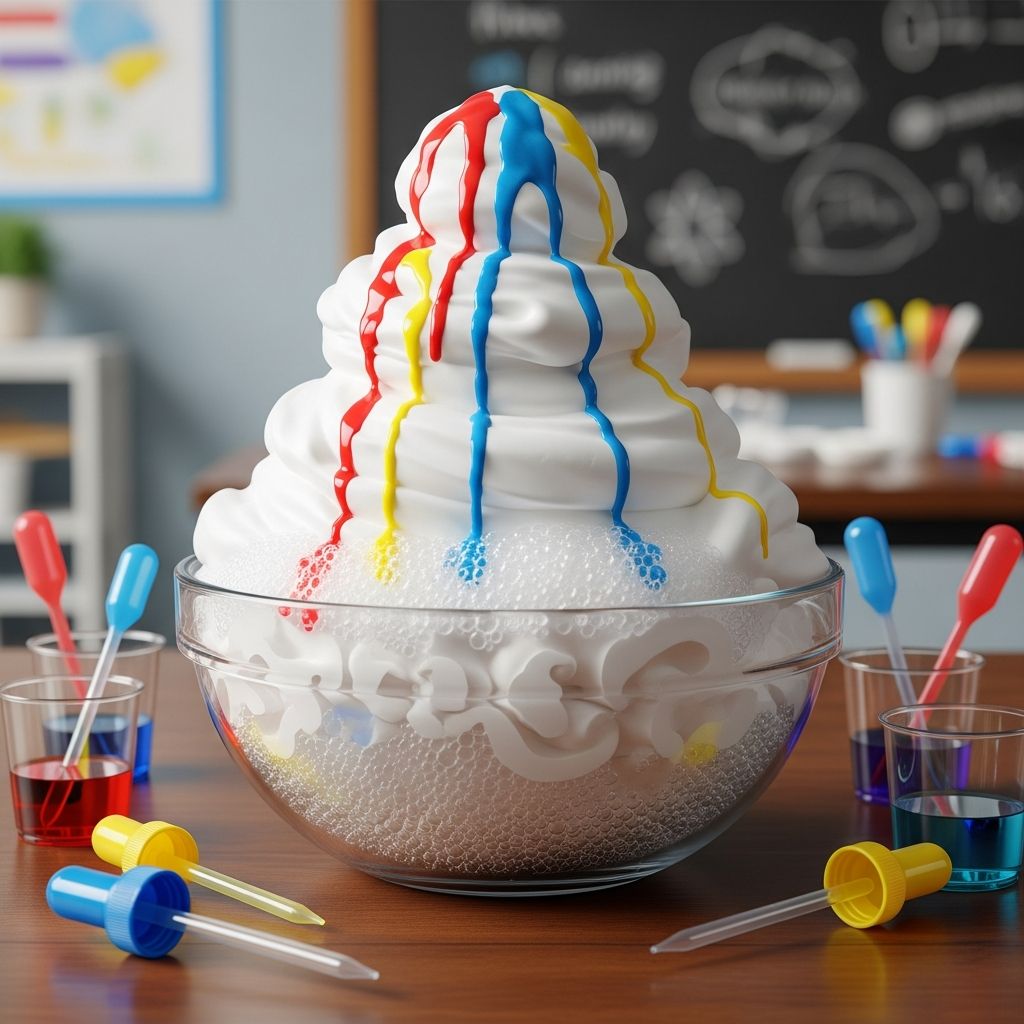
Shaving cream serves as an accessible gateway to scientific exploration, offering a versatile material that combines sensory engagement with core principles of physics and chemistry. Its foamy texture, derived from soap, air, and oils, creates unique opportunities for children to observe phenomena like density differences, chemical reactions, and surface tension in a hands-on way. These activities require minimal setup, using household items to transform ordinary spaces into interactive labs, fostering curiosity and critical thinking from an early age.
Why Shaving Cream Excels in STEM Activities
The appeal of shaving cream lies in its multifaceted properties: it floats on water due to lower density, traps air bubbles for moldable textures, and resists mixing with water-based substances, enabling vivid demonstrations. Educators and parents value it for developing fine motor skills, encouraging hypothesis testing, and providing safe sensory experiences. Unlike rigid lab tools, this everyday product invites experimentation without intimidation, making abstract concepts tangible.
Key benefits include enhanced hand-eye coordination through scooping and shaping, vocabulary building via descriptive language for textures and colors, and an introduction to safety protocols like avoiding ingestion. These experiments align with early childhood development goals, promoting persistence as children troubleshoot mixtures or wait for reactions.
Cloud Formation and Rainfall Simulation
Create a miniature water cycle model to illustrate how clouds hold and release precipitation. Fill a clear glass three-quarters with water, then layer a thick mound of shaving cream on top to represent a cloud. Add drops of food coloring onto the foam, watching as colors seep through and eventually “rain” into the water below.
This setup reveals density: shaving cream, being less dense than water, floats like atmospheric clouds composed of water droplets and ice crystals. As food coloring accumulates, saturation occurs, causing breakthrough due to gravity and excess weight. Children can predict outcomes by varying color volume or using multiple hues for rainbow effects.
- Materials: Clear glass, shaving cream, food coloring, dropper.
- Variations: Use warm vs. cold water to observe temperature impacts on absorption rates.
- Learning Outcomes: Grasps density, saturation, and the water cycle.
Moldable Fake Snow Creation
Mix shaving cream with cornstarch to produce a fluffy, sculptable substance mimicking snow. Start with a generous squirt of foam in a bin, gradually incorporating cornstarch until achieving a powdery yet cohesive consistency. Mold into figures like snowmen or angels.
The magic stems from cornstarch particles suspending within the foam’s air bubble network. Surface tension from soap bubbles supports these particles, yielding a non-sticky, moldable material. Adjustments ensure ideal texture: more cornstarch for dryness, extra foam for adhesion.
| Ratio Guide | Texture Result | Best For |
|---|---|---|
| 2:1 (Foam:Cornstarch) | Soft, sticky | Sensory play |
| 1:1 | Moldable, fluffy | Sculpting |
| 1:2 | Powdery, dry | Fine details |
Monstrous Volcano Eruptions
Build a volcanic landscape by mounding shaving cream into a cone shape on a tray, inserting a small cup at the peak. Fill with baking soda, then pour in vinegar mixed with food coloring for a fizzy explosion.
The reaction between baking soda (base) and vinegar (acid) generates carbon dioxide gas, trapped by the foam to amplify the eruption visually. This demonstrates acid-base chemistry, gas production, and foam’s bubble-trapping ability, scaling dramatically with foam volume.
- Safety Note: Conduct outdoors or over protected surfaces; supervise to prevent ingestion.
- Extensions: Layer colors for multi-stage flows, timing eruptions for measurement.
Abstract Art Printing Technique
Spread shaving cream evenly in a shallow tray, drizzle food coloring drops, and swirl gently with a stick. Press paper atop, lift to reveal transferred patterns, then dry flat.
Immiscibility is key: water-based coloring floats on oil-soap foam without blending fully, preserving distinct hues. Paper’s absorbency wicks colors away upon contact, creating unique marbled designs. Swirling introduces diffusion and pattern formation.
Encourage questions like: “Why don’t colors mix immediately?” to discuss emulsions and surface tension.
Melting Ice Color Explosions
Fill ice trays with water tinted by food coloring (add toys or glitter), freeze, then place cubes atop a bed of shaving cream in a bin. Observe as melting releases hues into the foam.
This merges states of matter (solid to liquid), temperature sensation, and color mixing. Foam absorbs meltwater slowly, heightening contrast between cold ice and ambient warmth, offering tactile differentiation.
Bubble-Powered Density Towers
Layer liquids of varying densities in a tall glass (honey, dish soap, water, oil), top with shaving foam, and drip colored water to watch it navigate layers.
Foam stabilizes the tower, demonstrating buoyancy and stratification. Colored drops sink or float based on density, threading through layers dramatically.
Sensory Texture Exploration Station
Set up stations with shaving cream mixed variously: plain, colored, scented, or embedded with beads. Children explore with tools and hands, describing sensations.
Builds descriptive language and sensory discrimination, linking to non-Newtonian fluid behaviors when thickened.
Hidden Message Revelations
Write messages on dark paper with white crayon, cover with shaving cream and coloring; wipe to reveal.
Leverages wax’s repellence to foam, creating contrast for secret reveals, teaching adhesion differences.
Expanding Foam Reactions
Combine dish soap, hydrogen peroxide, yeast, and shaving cream in a bottle for rapid expansion.
Yeast catalyzes peroxide decomposition into oxygen, inflating foam elephant-toothpaste style, showcasing catalysis and gas expansion.
Preparation Essentials and Pro Tips
Opt for foam-style, inexpensive shaving cream; avoid gels. Prepare trays, smocks, and cleanup tools. Test ratios beforehand. Age-adapt: toddlers for sensory, school-age for predictions.
Frequently Asked Questions (FAQs)
What type of shaving cream works best?
Foam varieties with “lather” labels provide optimal airiness; unscented for sensitivities, scented for engagement.
Is shaving cream safe if ingested?
Not for consumption; supervise closely and instruct against tasting to avoid stomach upset.
How to clean up messes?
Wipe with wet cloths; residue rinses easily. Use trays for containment.
Can these be done allergen-free?
Yes, substitute cornstarch with arrowroot; check foam ingredients.
What ages are ideal?
2+ for sensory, 5+ for full science discussions.
References
- Sensory Science: Shaving Cream Experiments for Kids — ImTheChefToo. 2023. https://www.imthecheftoo.com/blogs/stem-for-kids/sensory-science-shaving-cream-experiments-for-kids
- Snow Fluff – Science Fun For Everyone — ScienceFun.org. Accessed 2026. https://www.sciencefun.org/kidszone/experiments/snow-fluff/
- 9 Cool Science Experiments Using Everyday Household Ingredients — BostonMamas. 2014-02-11. https://www.bostonmamas.com/blog/2014/2/11/9-cool-science-experiments-using-everyday-household-ingredie.html
- How to Make Art with Shaving Cream — CuriOdyssey. Accessed 2026. https://curiodyssey.org/learn-explore/science-experiments-for-kids/how-to-make-art-with-shaving-cream/
- Make A Swirling Shaving Cream Sun Model — Science Friday. Accessed 2026. https://www.sciencefriday.com/educational-resources/shaving-cream-sun-model/

- Integrated M.A. in Applied Linguistics, University of Hyderabad
- 5+ years in editorial, instructional, SEO, and research-based writing
Sneha is a relationships and lifestyle writer with a strong foundation in applied linguistics and certified training in relationship coaching. She brings over five years of writing experience to theskillvault, crafting thoughtful, research-driven content that empowers readers to build healthier relationships, boost emotional well-being, and embrace holistic living. Her writing and insights reflect the belief that beauty, happiness, and wellness…