
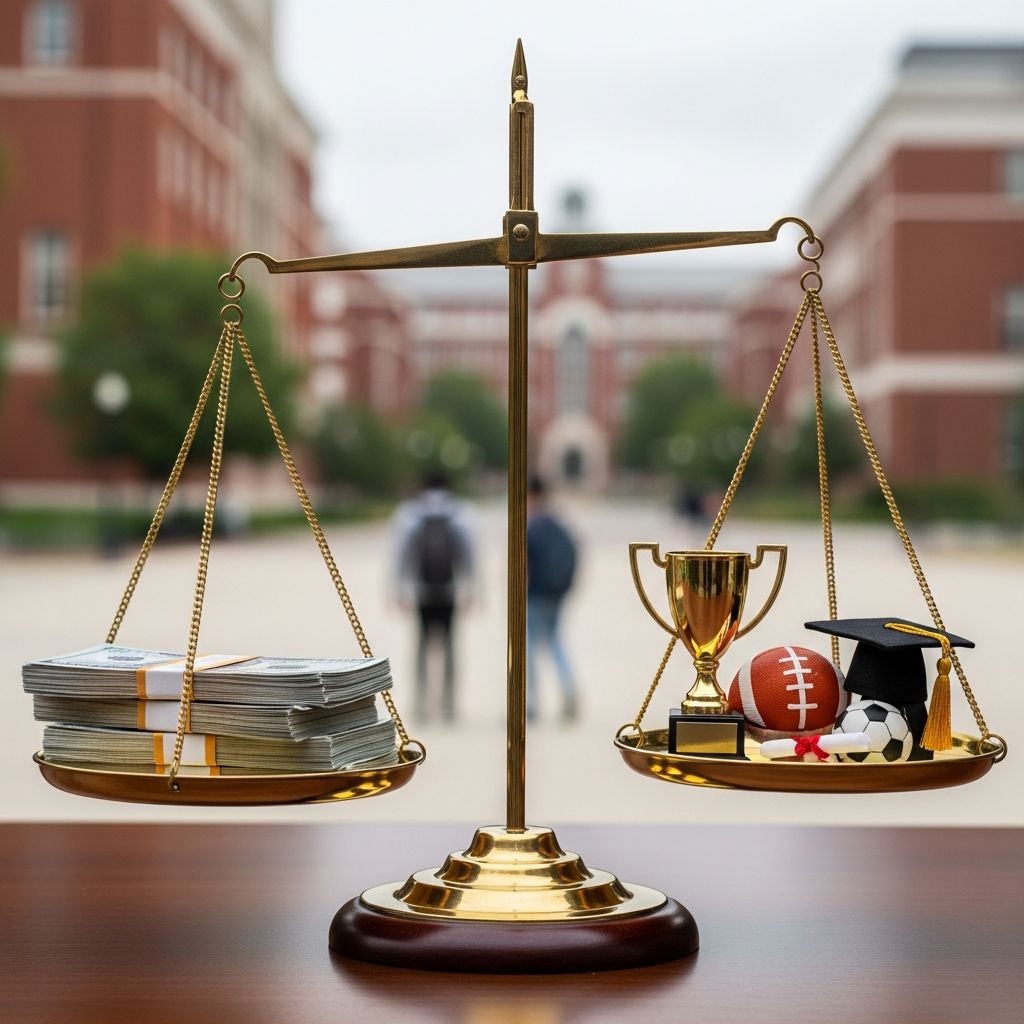
The question of whether universities should directly compensate their athletes has ignited fierce discussions in recent years, fueled by massive broadcast revenues and legal challenges to traditional amateurism rules. A landmark development came with the proposed House vs. NCAA settlement, which allows schools in major conferences to share up to $20.5 million annually with athletes from revenue-generating sports like football and basketball. This shift marks the end of the long-standing amateur model, where athletes received only scholarships despite generating billions for their institutions.
The Economic Realities Driving Change
College sports, particularly in Division I football and basketball, operate as a multibillion-dollar industry. Broadcast deals alone have escalated from millions to billions, with performers— the athletes—previously excluded from direct shares. The House settlement addresses this by permitting revenue sharing from these pots, including back pay from 2016 onward, potentially totaling $2.8 billion in damages. This recognizes that restricting payments constituted an antitrust violation, as noted by legal experts.
Yet, implementation introduces complexities. Schools face a salary cap around $20.5-$23.1 million per year initially, applying only to Power Five conference teams in revenue sports. Non-revenue athletes, like swimmers or track competitors, remain largely outside this framework, though some access Name, Image, and Likeness (NIL) deals.
Key Arguments in Favor of Athlete Compensation
- Fair Market Value: Athletes generate immense value through ticket sales, merchandise, and media rights. Direct pay aligns compensation with contributions, treating them as professionals in all but name.
- Exploitation Prevention: Under the old system, universities profited hugely while athletes bore injury risks without financial security. Payments provide stability for living expenses and post-career transitions.
- Recruitment Equity: With NIL already influencing choices, formalized pay levels the field, reducing undue influence from boosters or collectives.
- Legal Momentum: Court rulings like Alston v. NCAA paved the way, deeming compensation caps anticompetitive.
Arguments Against Direct Payments
- Amateurism Erosion: Paying athletes blurs lines between college and pro sports, potentially diminishing the educational focus.
- Financial Strain on Schools: Smaller programs may struggle with mandated shares, widening gaps between elite and mid-tier institutions.
- Inequity Among Athletes: Only football and basketball players in top conferences benefit substantially, sidelining others and creating roster disparities.
- Boosted NIL Complications: High-earners via NIL might see caps, but popular stars could supplement, perpetuating uneven wealth.
Legal and Regulatory Shifts Reshaping the Landscape
The House vs. NCAA case, led by former Arizona State swimmer Grant House, challenged NCAA restrictions as antitrust violations. Approved by Judge Claudia Wilken, it authorizes direct payments while settling damages, but leaves questions on booster involvement unresolved. Parallel suits continue, scrutinizing remaining pay limits.
Absent federal guidelines, universities navigate patchwork state laws and NCAA rules. Over eight NIL bills have stalled in Congress since 2021, including the College Athletes Protection and Compensation Act. The U.S. Department of Education’s 2025 rescission of Biden-era NIL-Title IX guidance exacerbates uncertainty.
Title IX Challenges in the New Era
Title IX mandates gender equity in sports participation and scholarships. Revenue sharing favors male-dominated football, posing compliance risks. Schools must decide if payments count as “educational benefits” requiring proportionality.
| Aspect | Male Athletes Impact | Female Athletes Impact | Potential Solutions |
|---|---|---|---|
| Revenue Sports | High (Football rosters) | Moderate (Women’s Basketball) | Supplemental NIL for women |
| Funding Allocation | ~70-80% share | Limited direct access | Title IX audits, equity pools |
| Litigation Risk | Low | High from advocates | Federal clarity needed |
Experts predict lawsuits from female athletes if disparities persist, urging market-value exemptions or balanced distributions.
Employee Status and Unionization Prospects
Direct payments bolster claims that athletes are employees under the National Labor Relations Act (NLRA). The NLRB’s 2023 Dartmouth ruling classified scholarship basketball players as workers entitled to bargaining. This could lead to campus unions, fragmented by public vs. private school status.
Unionization promises collective bargaining for wages and conditions but complicates recruiting and eligibility. Private schools face fewer state-law hurdles, while public ones contend with fragmented efforts. The settlement may accelerate these drives, viewing pay as the “first step”.
Impact on Recruitment and Program Dynamics
NIL has already tilted recruiting toward lucrative deals, muting dramatic shifts from revenue sharing. Top talents prioritize pay packages, with collectives filling gaps for non-covered sports. Schools experiment with models, balancing caps and incentives.
High-profile athletes like quarterbacks may blend salary and NIL, maintaining earnings above caps. Overall participation might decline in non-revenue sports if resources shift, prompting roster limits.
Future Outlook: Toward Federal Intervention?
As 2026 approaches, universities test payment structures amid litigation risks. Without congressional action, inequities in enforcement, gender balance, and competition loom. Stakeholders call for standards ensuring fairness while preserving college sports’ appeal.
The settlement transforms athletics into a hybrid model: part education, part enterprise. Success hinges on adaptive governance balancing athlete rights, institutional viability, and competitive integrity.
Frequently Asked Questions (FAQs)
Will all college athletes get paid under the new rules?
No, primarily football and basketball players in Power Five conferences qualify for direct revenue shares; others rely on NIL.
How much can schools pay annually?
Up to $20.5 million per school initially, with caps adjusting over time.
Does this affect Title IX compliance?
Potentially yes, due to male-skewed revenue sports; clear guidance is lacking.
Can athletes unionize now?
Direct pay strengthens employee arguments, likely spurring efforts, especially post-NLRB Dartmouth ruling.
What about non-revenue sports?
They remain ineligible for shares but can pursue NIL; some fear program cuts.
References
- The Plan to Pay College Athletes — Kellogg Insight, Northwestern University. 2024. https://insight.kellogg.northwestern.edu/article/plan-to-pay-college-athletes
- The Student-Athlete Compensation Shift — Where are the Federal Guidelines? — Cornell Law School Journal of Law and Public Policy. 2025-10-31. https://publications.lawschool.cornell.edu/jlpp/2025/10/31/the-student-athlete-compensation-shift-where-are-the-federal-guidelines/
- The Legal Showdown: House vs. NCAA and the Future of College Sports — Oreata AI Blog. Recent. https://www.oreateai.com/blog/the-legal-showdown-house-vs-ncaa-and-the-future-of-college-sports/1e10fd2c206d1089ff36b8ce46b928f1
- Sports & Entertainment Alert – The Year That Changed Sports Forever — Kaufcan Newsroom. Recent. https://www.kaufcan.com/newsroom/news/sports-entertainment-alert-the-year-that-changed-sports-forever
- College Athlete Compensation: Impacts of the House Settlement — Congressional Research Service. Recent. https://www.congress.gov/crs-product/LSB11349

Medha Deb is an editor with a master's degree in Applied Linguistics from the University of Hyderabad. She believes that her qualification has helped her develop a deep understanding of language and its application in various contexts. Medha specializes in the areas of beauty, health, sports, and wellness and is committed to ensuring that the content on the website is…