
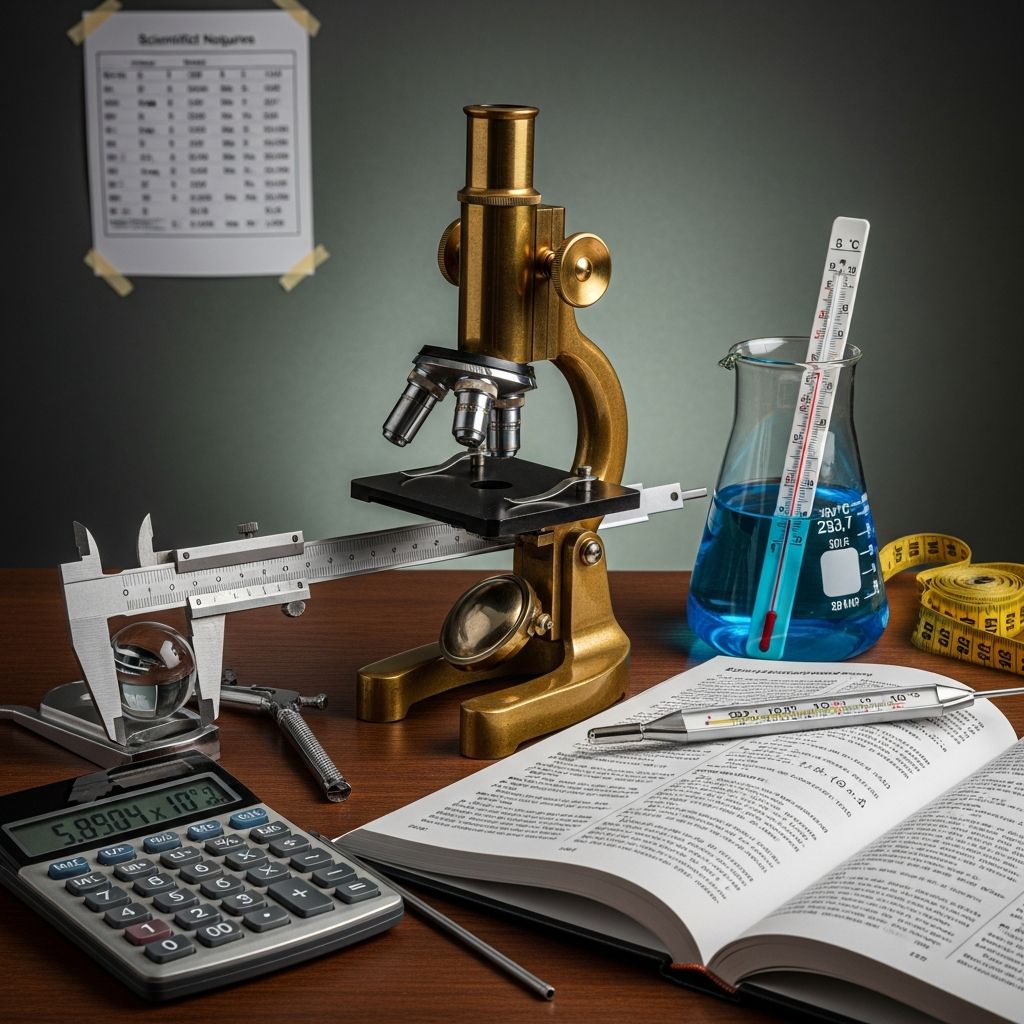
Significant figures represent the digits in a number that reflect the precision of a measurement. They ensure that calculations convey the appropriate level of reliability, preventing overstatement of accuracy in scientific work. Understanding these concepts is crucial for students, researchers, and professionals in fields like chemistry, physics, and engineering.
Why Precision Matters in Measurements
Every measurement carries inherent uncertainty due to the limitations of instruments and human observation. Significant figures quantify this uncertainty by indicating which digits are reliable. For instance, a ruler marked in millimeters can confidently measure to the nearest millimeter, making digits up to that resolution significant.
In laboratory settings, tools like graduated cylinders or burets provide varying precision levels. A beaker might offer rough volume estimates with fewer significant figures, while a buret delivers higher precision with more. This distinction guides how data should be reported and processed.
Core Principles of Significant Figures
The foundation of significant figures lies in distinguishing meaningful digits from placeholders. Non-zero digits always contribute to precision, while zeros require careful evaluation based on their position.
- All non-zero digits are inherently significant, as they directly represent measured values.
- Zeros positioned between non-zero digits (captive zeros) add to the count, indicating intermediate precision.
- Leading zeros before the first non-zero digit do not count, as they merely locate the decimal.
- Trailing zeros after the decimal point signify measured precision and are included.
- Trailing zeros in whole numbers without a decimal are ambiguous and typically not significant unless specified.
Exact numbers, such as counting objects or defined constants like the Planck constant, possess infinite significant figures and do not limit calculation precision.
Practical Rules for Counting Significant Figures
To systematically identify significant figures, follow these guidelines derived from standard scientific practices[10].
| Rule | Example | Significant Figures |
|---|---|---|
| Non-zero digits | 123.45 | 5 |
| Leading zeros | 0.00256 | 3 |
| Captive zeros | 1002 | 4 |
| Trailing zeros with decimal | 5.200 | 4 |
| Trailing zeros without decimal | 5200 | 2 |
| Exact numbers | 2 apples | Infinite |
These rules ensure consistency. For ambiguous cases like 5200, scientific notation (5.2 × 10³) clarifies two significant figures.
Applying Significant Figures in Basic Arithmetic
Addition and Subtraction
In addition or subtraction, the result’s precision is limited by the least precise measurement, determined by decimal places. Round the answer to match the furthest right decimal position among inputs.
Example: 12.52 + 349.0 + 8.24 = 369.76, but since 349.0 has one decimal place, round to 369.8.
- Align decimals vertically for clarity.
- Identify the term with the fewest decimal places.
- Round accordingly, even if it means truncating reliable digits.
Multiplication and Division
Here, the result matches the number with the fewest significant figures. Count sig figs in each operand and limit the answer similarly.
Example: (0.025 × 10²) × 370 = First, 370 has 2 sig figs, 0.025 × 100 = 2.5 (2 sig figs), then 2.5 × 370 ≈ 930 (2 sig figs).
Chain calculations carefully: perform operations step-by-step, applying rules at each multiplication/division, but delay rounding until the end for addition/subtraction chains.
Advanced Scenarios and Common Pitfalls
Measurements often involve scientific notation, where the coefficient determines sig figs. 3.52 × 10⁴ has three significant figures.
Avoid pitfalls like assuming all zeros are insignificant or ignoring instrument resolution. In volumes, a reading of 25.0 mL from a 10-mL graduated cylinder implies three sig figs if the scale allows.
Logarithms and trigonometry follow specialized rules: mantissa sig figs match input precision. For ranges, express as ± uncertainty alongside sig figs.
Real-World Applications in Laboratories
Consider density calculation: mass 25.43 g (4 sig figs), volume 10.0 mL (3 sig figs). Density = 25.43 / 10.0 = 2.543, rounded to 2.54 g/mL (3 sig figs).
In spectroscopy or titration, sig figs prevent misleading certainty. Reporting 99.999% purity from imprecise scales violates principles.
Standards bodies emphasize these for reproducible science. NIST guidelines align with these rules for metrology.
Tools and Techniques for Verification
Online calculators aid practice but understanding rules is key. Practice with mixed operations: (123.52 – 70.2) × 0.034 = First, 53.32 (3 decimal places from 70.2? Wait, align: 123.52 – 70.20 = 53.32, 4 sig figs? No, least decimal: 70.2 has 1, so 53.3, then ×0.034 (2 sig figs) = 1.8.
Frequently Asked Questions (FAQs)
What are significant figures?
Significant figures are the reliable digits in a measurement expressing its precision.
Do leading zeros count?
No, leading zeros like in 0.0045 indicate position, not precision; 0.0045 has 2 sig figs.
How do trailing zeros work without decimals?
They are not significant; 1200 has 2 sig figs unless written as 1.200 × 10³.
In addition, what limits the result?
The number with the fewest decimal places dictates rounding.
Are exact counts significant?
Yes, infinitely; 12 inches in a foot doesn’t limit calculations.
What’s the sig figs in 4500.?
Four, as the decimal makes trailing zero significant.
Practice Problems for Mastery
- Determine sig figs: 0.00789, 5600, 3.000 × 10².
- Add: 2.345 + 10.0 + 0.23.
- Multiply: 15.0 × 3.2.
Solutions: 1. 3, 2 (ambiguous), 4. 2. 12.575 → 12.6. 3. 48 → 48 (2 sig figs).
Regular practice builds intuition. Expand to conversions: 1.234 g to kg is 0.001234 kg (4 sig figs)[10].
In engineering, tolerances align with sig figs for part dimensions. Aerospace demands strict adherence.
Educational resources like Khan Academy reinforce via visuals.
References
- How to Determine Significant Figures — Study.com. Accessed 2026. https://study.com/skill/learn/how-to-determine-significant-figures-explanation.html
- Significant Figures — Wikipedia. 2026-04-04. https://en.wikipedia.org/wiki/Significant_figures
- A Short Guide to Significant Figures — Yale University, Department of Astronomy. Accessed 2026. http://www.astro.yale.edu/astro120/SigFig.pdf
- Math Skills Review: Significant Figures — Texas A&M University, Chemistry. Accessed 2026. https://www.chem.tamu.edu/class/fyp/mathrev/mr-sigfg.html
- Significant Figures — Columbia University, CCNMTL. Accessed 2026. https://ccnmtl.columbia.edu/projects/mmt/frontiers/web/chapter_5/6665.html
- Significant Figures Counter — Calculator Soup. Accessed 2026. https://www.calculatorsoup.com/calculators/math/significant-figures-counter.php

Medha Deb is an editor with a master's degree in Applied Linguistics from the University of Hyderabad. She believes that her qualification has helped her develop a deep understanding of language and its application in various contexts. Medha specializes in the areas of beauty, health, sports, and wellness and is committed to ensuring that the content on the website is…